The horses most closely associated with Moroccan Tbourida, often called Fantasia outside Morocco, are the Barb and Arab-Barb. They are not decorative extras to a gunpowder spectacle. A successful passage depends on horses that can stay responsive in a straight formation, change pace with the group and remain connected to their riders amid movement, dust, crowds and a sudden blank-powder report.
This guide focuses on the horse: the two breeds named in Morocco’s current competition procedures, what a spectator can learn by watching them, and why careful preparation matters more than raw speed. For the full history, terminology and event calendar, begin with our main Tbourida and Fantasia guide.
| Quick question | Answer |
|---|---|
| Main Tbourida breeds | Barb and Arab-Barb |
| Are all Fantasia horses Arabians? | No; the Arab-Barb is a distinct cross between Arab and Barb lines |
| What matters in the arena? | Control, alignment, shared acceleration and a composed finish |
| Is the horse judged only for speed? | No; official competition criteria also include the start, formation and tack presentation |
| Can a visitor ride a Tbourida horse? | Do not assume so; a performance horse is not automatically available for tourist riding |
The header image is an original editorial visualization. It does not document a named horse, rider, sorba or competition.
Barb and Arab-Barb: the two names to know
Morocco’s national horse-sector organization, SOREC, presents the Barb and Arab-Barb as central breeds in the country’s equestrian heritage. Its current guide to Moroccan horse breeds describes the Barb as an old North African saddle horse and the Arab-Barb as the result of crossing Arab and Barb ancestry.
The names are easy to confuse, especially in English-language travel writing. “Arab-Barb” does not simply mean any horse with an Arabian appearance, and “Fantasia horse” is not a separate breed. It is a convenient description of a horse used for the performance.
The Barb horse
The Barb is rooted in North Africa and closely connected to the region’s history of riding. SOREC emphasizes qualities such as balance, courage, agility and endurance. Those broad traits help explain the breed’s place in traditional equestrian use, but they do not mean every Barb is automatically suited to Tbourida.
Breed is only one part of the equation. The individual horse’s health, temperament, preparation, rider partnership and the demands of a particular sorba all matter. It is better to think of the Barb as an important foundation of the tradition than as a guaranteed performance type.
The Arab-Barb horse
The Arab-Barb combines Barb and Arab ancestry. SOREC describes it as a versatile saddle horse noted for robustness and adaptability, and specifically identifies it as suitable for Tbourida. Its current breed page gives a typical height range rather than one compulsory size, another reminder that these horses are not visually identical.
Visitors sometimes label every refined head or decorated horse “Arabian.” That shortcut erases the Barb contribution and the breeding history represented by the Arab-Barb. If the precise breed of an individual horse has not been confirmed by its owner or records, use the broader phrase Tbourida horse instead of guessing from a photograph.
What official Moroccan competition rules require
The clearest distinction between general cultural association and formal eligibility comes from SOREC’s National Studs procedures. Its current administrative page for Tbourida competitions says that horses entered in official competitions must be Barb and/or Arab-Barb and must carry the required identification document.
That rule applies to the organized competition system, not to every informal equestrian appearance a traveller might encounter. Rules can also be revised. Owners and riders should use the latest French or Arabic competition regulation from SOREC rather than treating a travel article as an entry manual.
SOREC describes a national pathway that begins with regional competitions, moves through interregional qualification and leads to major championships. Its official Tbourida competition overview says judges evaluate more than the final sound. Criteria include the quality of the start, alignment, rider dress, horse tack, weapons handling and the precision and simultaneity of the blank discharge.
For a spectator, that framework changes what is worth watching. The horse is part of a coordinated team performance from the first controlled movement to the regrouping after the charge.
What makes a Tbourida horse’s job demanding
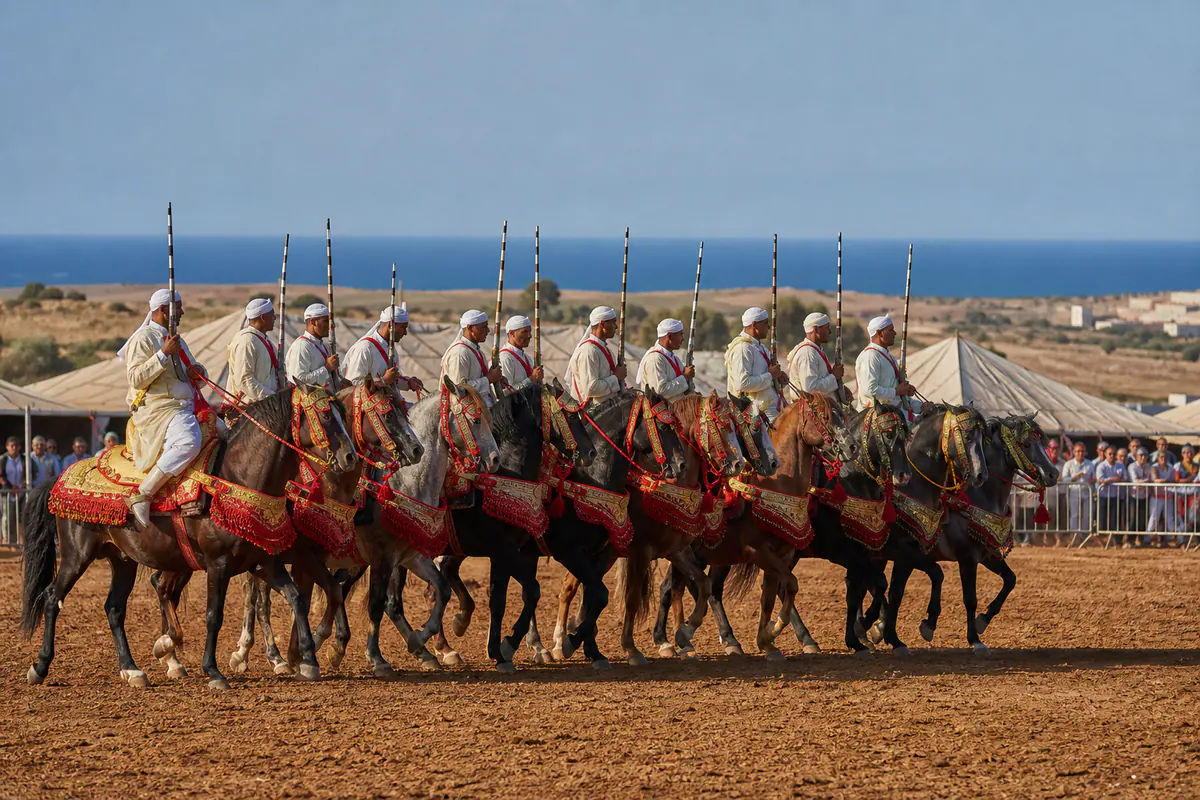
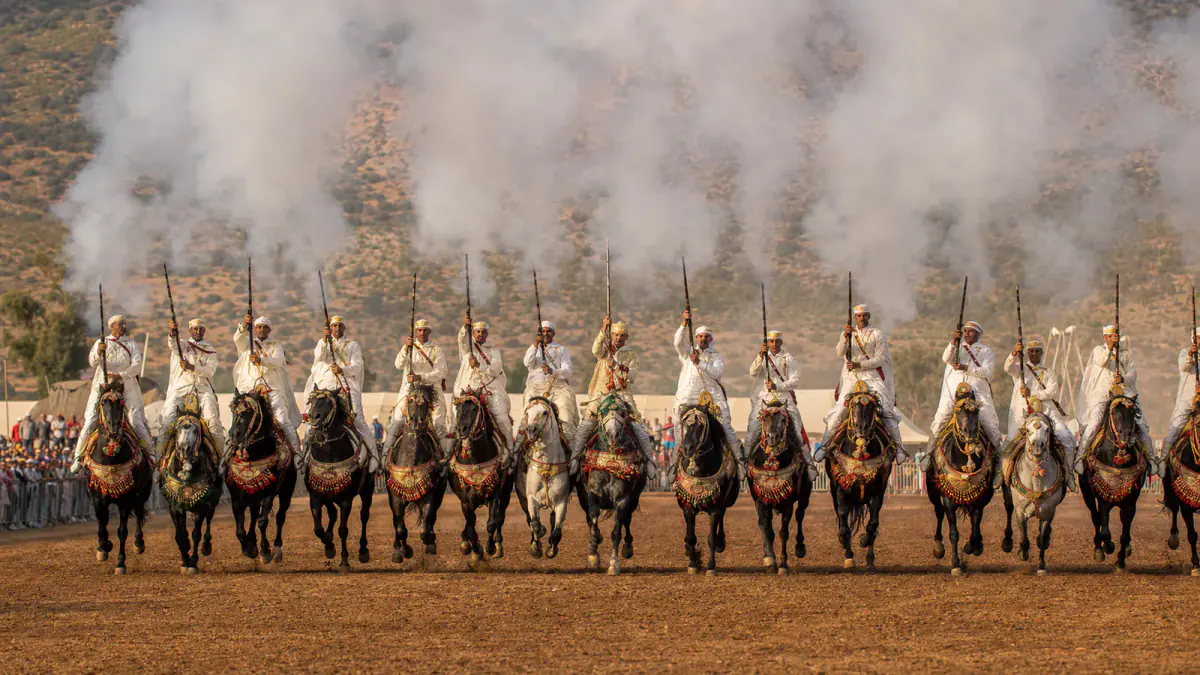
A sorba is not a conventional race. The aim is not for one horse to cross a finish line first. The horses must help form a readable horizontal line and travel as a group while their riders carry out a shared sequence.
Watch for four connected tasks:
- Controlled entry. During the hadda, horses enter at a measured pace while the group presents itself.
- Shared departure. A clean start requires multiple horses to respond without the line breaking immediately.
- Acceleration in formation. The group increases speed while preserving spacing and direction.
- Composure through the finish. The blank discharge is loud. The passage still has to conclude under control.
UNESCO’s Tbourida heritage listing describes a sorba as an odd number of riders and horses, generally between 15 and 25, directed by a leader positioned in the centre. That scale makes the collective task easier to appreciate: every horse-rider pair affects the line seen and heard by the audience.
Speed without alignment weakens the passage. Decoration without responsiveness cannot hold the group together. The performance is compelling precisely because visual elegance and practical control must coexist.
Preparation is more than teaching a horse to tolerate noise
It would be misleading to reduce preparation to “getting a horse used to gunfire.” Tbourida asks for balance across many elements: the rider’s cues, the horse’s physical readiness, group spacing, pace changes, arena conditions and a safely managed event environment.
The public sees only the passage, not the long relationship behind it. UNESCO notes that Tbourida knowledge is transmitted within families through oral teaching and observation. That transmission includes how riders learn the sequence and how horses are incorporated into the practice.
Responsible preparation should be understood through welfare as well as tradition. SOREC’s recent impact reporting says its competition framework has been developing judging references that value both regional tariqa and animal welfare. A horse showing obvious distress, injury or exhaustion should not be romanticized as evidence of authenticity.
This article cannot assess an individual horse from a distance, and spectators should not interfere with handlers. If you see a concern at an organized event, raise it calmly with an official rather than entering the preparation area.
Why the rider-horse partnership matters
The rider is not simply a passenger in ceremonial clothes. Maintaining a shared line requires continuous small decisions about pace and position. The horse must respond to those requests while also reading the movement of neighbouring horses.
The central leader, or mokaddem, gives the sorba its reference. Yet the formation cannot be held by one person alone. Each pair has to contribute to the same collective timing. A strong passage therefore reveals trust and repetition rather than a last-second trick.
This is also why a visitor should never assume that a performance horse can be borrowed for a casual ride. Riding centres and tourism operators have their own horses, insurance, equipment and ability requirements. A horse prepared for a sorba has a specialized role and may not be available or suitable for an unfamiliar rider.
If riding in Morocco is part of your trip, choose an operator that matches horses to experience, supplies appropriate safety equipment and explains the route and welfare practices. Do not ask to recreate a Tbourida charge or handle a ceremonial firearm.
Tack: practical equipment and cultural presentation
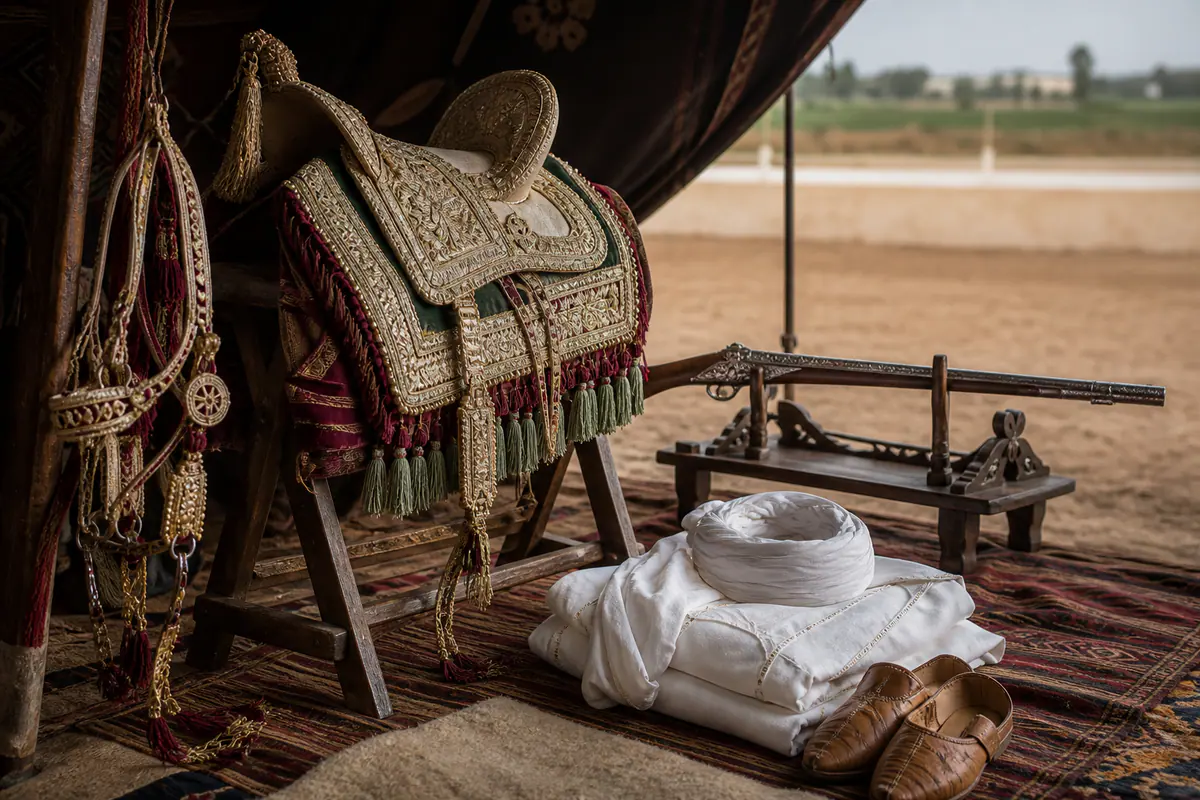
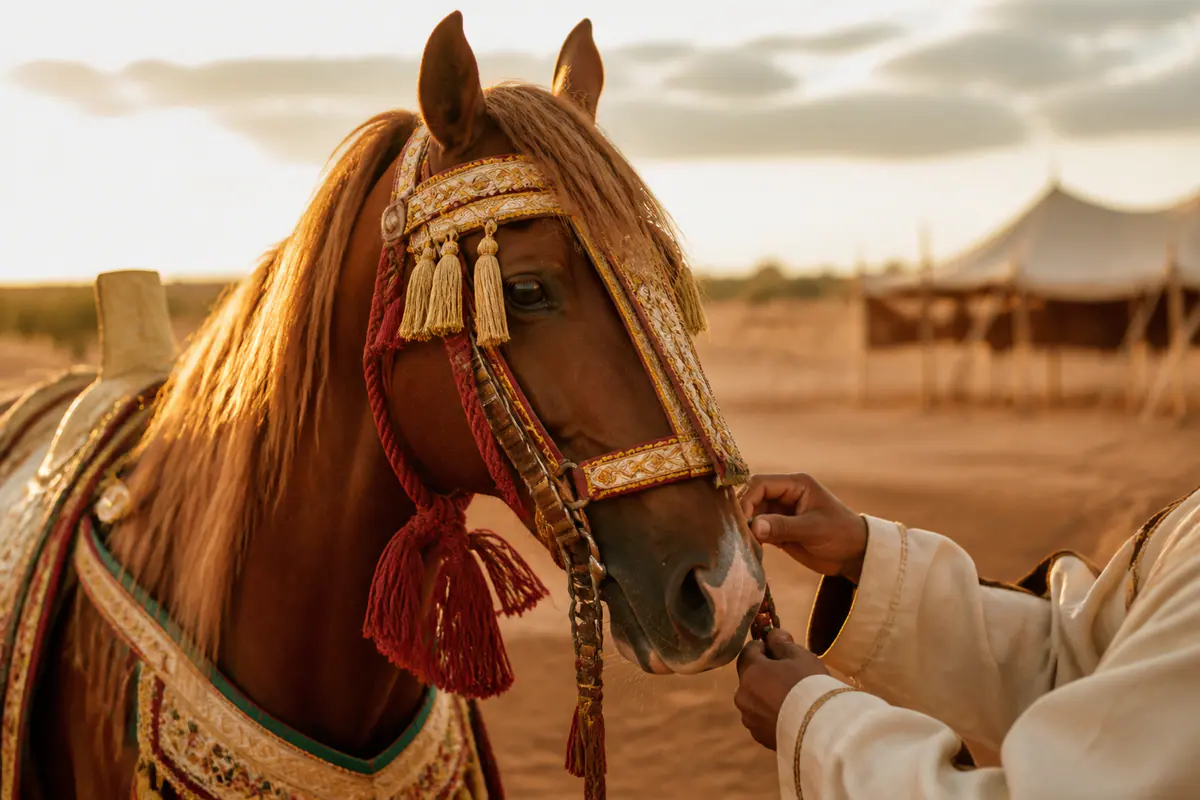
The horse’s bridle, saddle and textiles have both practical and visual functions. UNESCO records that Tbourida horses are bridled and saddled with material sewn and decorated in traditional ways. SOREC also includes the quality of harnachement, or tack, among competition criteria.
That does not mean there is one universal color pattern for all Morocco. Tbourida clothing and equipment can represent a tribe or region, and individual sorbas coordinate their presentation. A richly embroidered textile may catch the eye, but fit and safe use still matter more than ornament alone.
Look without touching. Preparation areas are working spaces, and straps, reins and saddle components should not be moved for a photograph. Our separate guide to Tbourida clothing, saddles and tack explains the visible equipment and the craftsmanship around it in more detail.
How to watch the horses, not only the blast
The final report is so dramatic that first-time spectators often miss everything before it. Try following one section of the line through the complete passage.
- During the entrance, notice whether the horses appear settled and evenly placed.
- At the start, watch whether the line leaves together or stretches immediately.
- During acceleration, look at spacing as well as speed.
- Near the finish, observe whether the horses remain directed rather than scattering.
- After the discharge, watch the regrouping and exit.
A side view usually makes formation easier to read than a position directly behind the finish. Stay in the public area even if a barrier limits the photograph you wanted. Our Saïdia Tbourida festival guide includes a practical checklist for verifying a smaller regional event before travelling.
Noise is a serious consideration. Blank powder creates a powerful report, and horses are moving at speed. Follow barriers and stewards, keep children close, consider suitable hearing protection for young or sound-sensitive visitors, and never use flash around horses.
Common misconceptions about Fantasia horses
“Fantasia horse” is a breed
It is not. In Moroccan Tbourida, the breeds most closely identified with official competition are the Barb and Arab-Barb. “Fantasia horse” describes use or context.
Every decorated horse is competing
Not necessarily. An event may include a formal competition, an exhibition, a ceremonial entrance or other equestrian activity. The organizer’s programme determines what you are seeing.
The fastest horse is the best horse
Tbourida is collective. A horse-rider pair that breaks the line in pursuit of speed can weaken the sorba’s passage even if it looks individually dramatic.
A calm-looking horse needs no safety distance
No. Horses can react to movement, noise or pressure, and Tbourida adds crowds and blank-powder firearms. Respect the controlled perimeter at all times.
Traditional use makes welfare questions disrespectful
Tradition and welfare are not opposites. Respectful spectators can value the cultural practice while expecting competent handling, appropriate preparation and official safety controls.
A better way to understand the horse at Tbourida
Begin with the Barb and Arab-Barb, but do not stop at breed labels. Watch how the horse enters, aligns, accelerates and returns. Notice the communication between riders and the way one pair affects the whole sorba.
The finest passage is not a collection of individual stunts. It is a temporary agreement between many horses and riders to move like one team. Once you see that, the famous blast becomes the punctuation—not the entire story.