Moroccan Tbourida clothing and tack are part of the performance’s meaning, not a costume layer added for tourists. Riders present a shared regional identity through coordinated dress, while saddles, bridles and textiles bring leatherwork, embroidery, weaving and metal decoration into the arena. Even the ceremonial musket belongs to a disciplined sequence rather than functioning as a free-standing prop.
This guide explains what an observer can responsibly identify and where descriptions should remain cautious. There is no single outfit or color scheme worn by every sorba in Morocco. For the performance itself—its hadda, talqa, teams and dates—see our complete Tbourida and Fantasia guide.
| Element | Role in Tbourida |
|---|---|
| Draped garments and turban | Ceremonial rider presentation connected to the sorba’s region |
| Slippers | Part of the period dress described in Morocco’s UNESCO nomination |
| Saddle and saddle textiles | Support the rider and create the horse’s coordinated visual presentation |
| Bridle | Working communication equipment, traditionally decorated for the event |
| Ceremonial musket | Used for the synchronized blank-powder discharge |
| Sword and small Qur’an copy | Accessories documented in UNESCO’s description of the tradition |
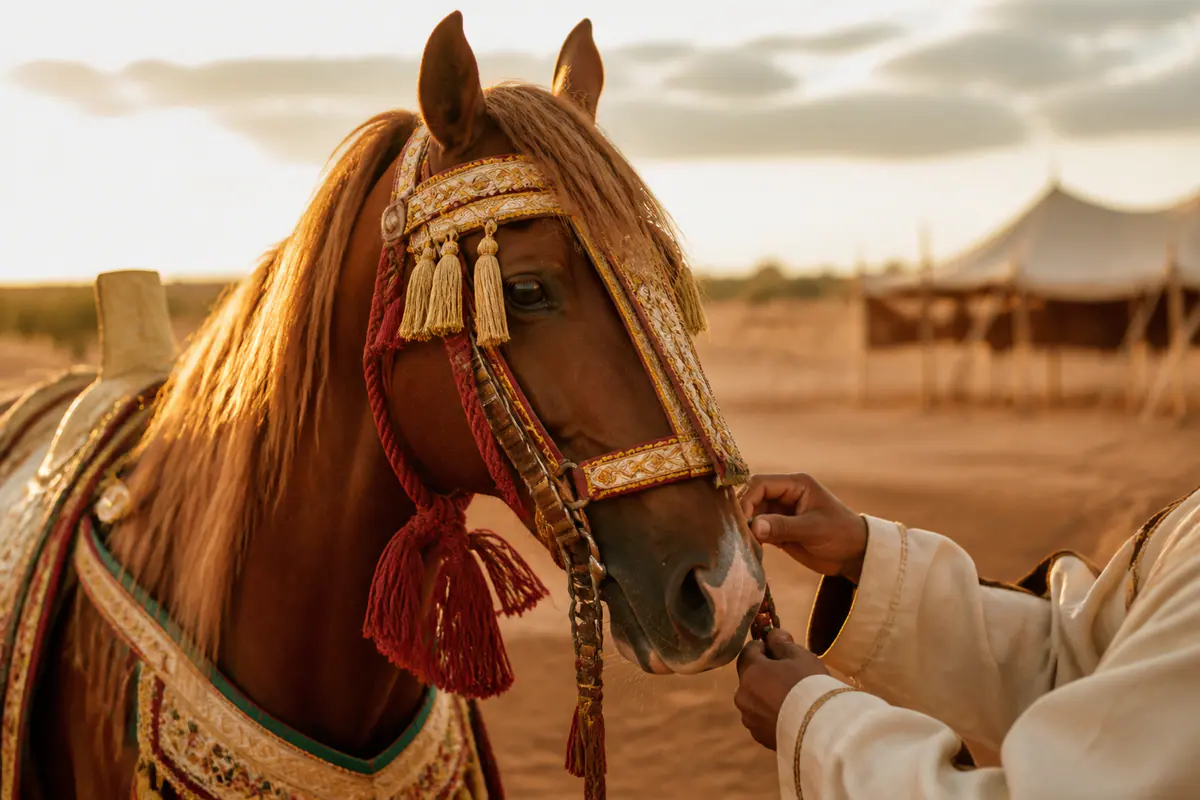
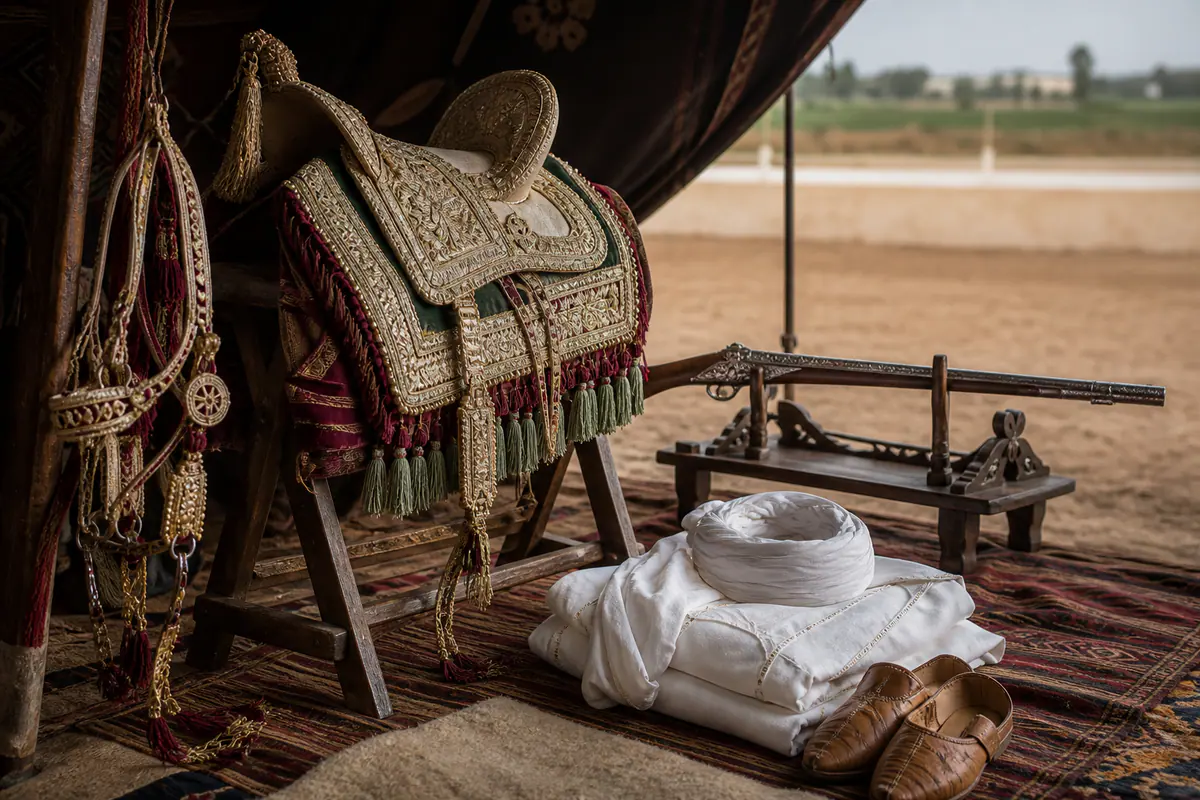
The header image is an original editorial visualization of craft objects. It is not a catalogue of one region’s complete outfit and does not document a named artisan or sorba.
What UNESCO records about Tbourida dress
UNESCO’s official Tbourida heritage entry is the safest starting point because it summarizes the practice submitted by Morocco for inscription in 2021. It describes riders wearing period clothing and accessories that include a turban, draped garments and slippers. It also mentions an old Arab sword and a small copy of the Qur’an carried by riders.
That list should be read as a description of the tradition, not a shopping checklist for visitors. Items have ceremonial and spiritual contexts, and their precise form or placement may differ. It would be especially inappropriate to treat a sacred text as a photo prop or ask a rider to display it for entertainment.
UNESCO also says the riders’ customs and clothing represent their tribe or region. This point matters more than memorizing garment names. A sorba is presenting collective belonging. Coordination of color, cut, textile and accessories makes the group legible before it begins to gallop.
Why there is no universal “Fantasia costume”
Searches for a Fantasia costume often imply that one standardized outfit can represent the whole tradition. Morocco’s Tbourida is more diverse. Sorbas come from different regions, inherit different tariqa or schools of performance and preserve recognizable approaches to presentation.
Some elements recur in official descriptions, but details vary:
- the colors chosen for the sorba;
- the cut and layering of garments;
- embroidery and edging;
- the form of the turban or head covering;
- the decoration of saddle cloths and bridles;
- the style of metalwork on ceremonial equipment.
Without reliable information from the group itself, do not assign a tribe or province based only on color. A red garment, green textile or particular embroidery pattern may look familiar across images without proving identity. Captions should say what is visible rather than invent a regional attribution.
The rider’s clothing: unity before individuality
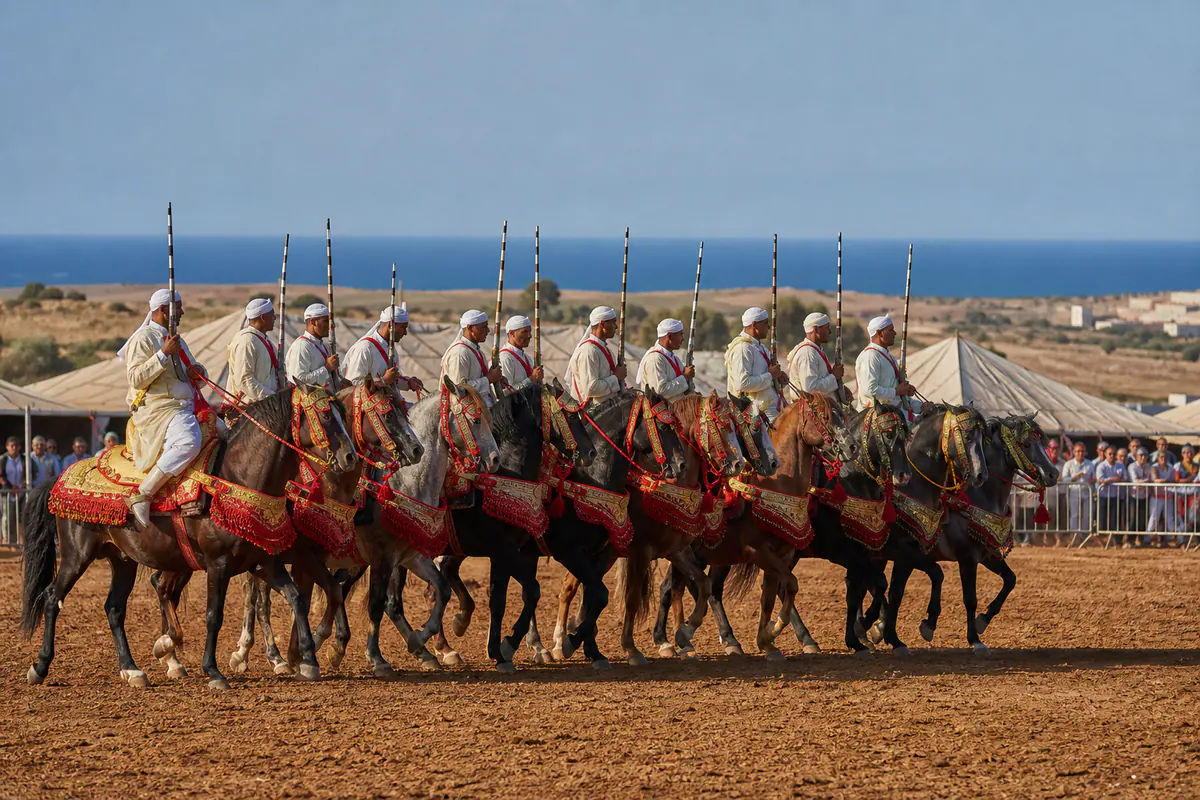
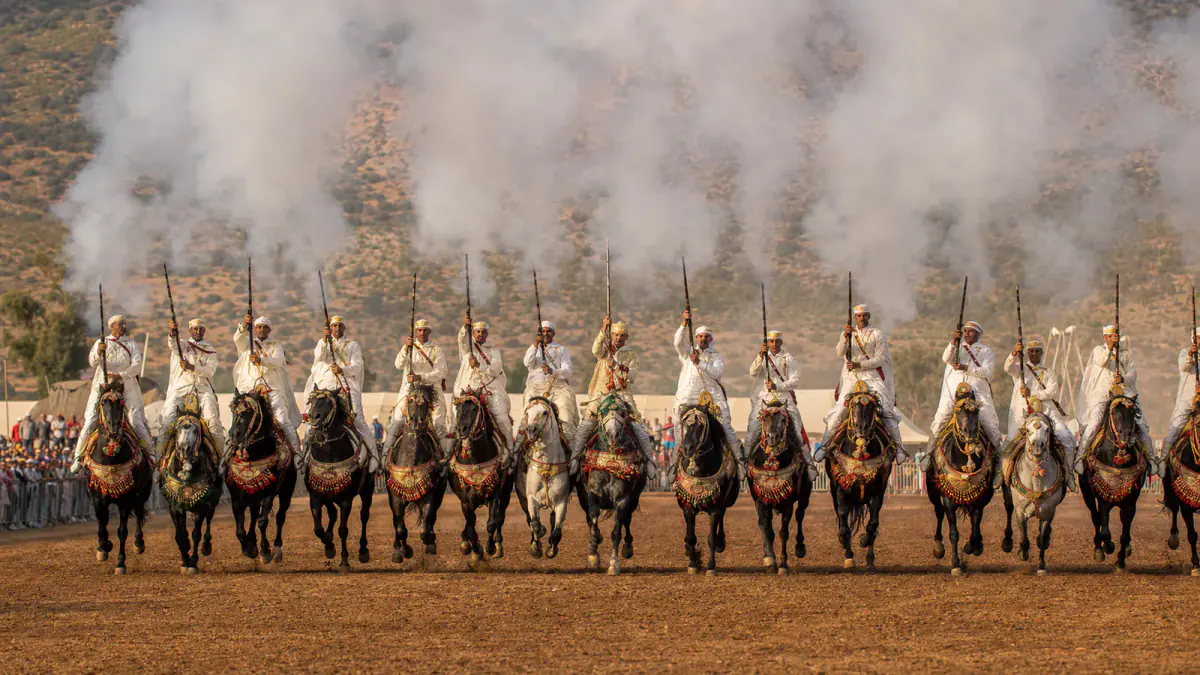
Tbourida is a team discipline, and the clothing reinforces that collective structure. When riders enter side by side during the hadda, the repeated shapes and coordinated colors visually strengthen the line. The central mokaddem may be identifiable through position and leadership, but the group remains the main subject.
The clothing must also coexist with movement. A rider carries reins and a long ceremonial musket, performs a controlled arms sequence and then rides at speed. Garments therefore cannot be understood only as static museum objects. They appear in motion, in dust and under the practical demands of horsemanship.
This is one reason close-up photographs can be misleading. An ornate cuff or turban may suggest that decoration is the entire point. A wider view shows how clothing, posture, horse tack and formation operate together.
Visitors should use respectful language. “Traditional dress” or “ceremonial clothing” is generally more accurate than “disguise.” Calling it a costume is common in English, but it can make a living practice sound theatrical or interchangeable.
The Tbourida saddle and horse textiles
UNESCO describes horses as bridled and saddled with material sewn and decorated in traditional ways. SOREC’s impact report on Morocco’s horse sector goes further, emphasizing that Tbourida brings together artisans who shape, weave, engrave and decorate saddles, horse textiles and ceremonial muskets.
The resulting presentation can include several visible layers: a structured saddle, textile panels, embroidered or woven coverings, leather straps, decorative fringes and metal fittings. Exact terminology varies by language, region and craft practice, so this guide avoids pretending every visible piece has one universal English name.
The saddle remains equipment. Its beauty does not remove the need for appropriate fit, correct placement and inspection by people responsible for the horse. Spectators should never tighten a strap, lift a textile or rearrange tack for a photograph.
For more about the animals beneath this equipment, our guide to Barb and Arab-Barb Fantasia horses explains the breeds used in current official competitions and what the horses do through a passage.
The bridle: decoration and communication
A decorated bridle is among the most recognizable details in Tbourida photography. It frames the horse’s head and may echo the colors and materials used on the saddle. Yet it is first part of the rider’s communication system.
That dual role is important. Evaluating tack only by how much ornament it carries misses its practical function, while describing it only as equipment ignores the artisanship and regional presentation that make Tbourida visually distinctive.
At a public event, look for the preparation sequence from outside the working area. Riders and handlers may check buckles, reins and textiles before the sorba assembles. Those quiet checks often explain more about the tradition than a staged portrait.
Do not feed or touch a bridled horse without permission. Decorative tassels and fittings are not handles, and a horse that appears calm may still react to a stranger approaching its head.
Ceremonial muskets and the meaning of the blank discharge
The long musket is the most sensitive object in the ensemble because it combines heritage, choreography and real risk. During the talqa, riders use traditional firearms for a blank-powder discharge intended to sound as one synchronized report.
“Blank” does not mean harmless. The shot produces intense noise, pressure, smoke and possible debris risk at close range. Firearms remain under the control of riders and event officials. A visitor should never request to hold one, enter a loading area or imitate the firing sequence.
SOREC’s official competition overview lists weapons handling and the precision and simultaneity of detonations among the qualities evaluated in competition. This places the musket within a judged collective technique. It is not random celebratory firing.
If photographing the equipment at rest, ask permission and follow the handler’s directions. Do not touch the trigger, move the musket from a rack or assume it is unloaded because the performance has not started.
The craftspeople behind the arena
Tbourida concentrates multiple crafts in one public image. SOREC’s reporting highlights artisans who weave, shape, engrave and decorate the objects used by horses and riders. Their contribution is easy to overlook because the sorba receives the applause.
A single visual ensemble can depend on:
- tailoring and garment finishing;
- embroidery and textile work;
- leather cutting, shaping and stitching;
- saddle construction and covering;
- weaving and fringe work;
- engraving and metal decoration;
- maintenance and repair between events.
It would be inaccurate to claim that every piece is handmade, antique or produced locally unless its provenance is known. Markets also sell modern decorative objects inspired by equestrian heritage. If you want to buy craft connected to Tbourida, ask who made it, what materials were used and whether it was designed for actual horse use or display.
Avoid buying old sacred, military or functional objects on the assumption that age alone makes them authentic. Export, weapons and heritage rules may apply, and an informal seller’s assurance is not legal documentation.
How presentation is read in competition
Official Tbourida judging does not isolate clothing from the passage. SOREC says competitions reward alignment, the quality of the departure, rider attire, horse tack, the art of weapons handling and the synchronized final report.
That combined standard helps a spectator read what is happening:
- Before the charge, look at whether the sorba presents a coherent line.
- During the salute, notice how clothing and arms movement create a shared rhythm.
- At the start, watch whether tack remains stable as the horses accelerate.
- At the finish, listen for unity while remaining attentive to control.
- After the passage, observe how the group regathers rather than turning away immediately.
The most elaborate saddle does not compensate for a broken formation. The cleanest discharge does not make clothing irrelevant. Tbourida is evaluated as an integrated performance.
Respectful viewing and photography
Clothing and tack invite close photographs, but access is not automatic. Preparation areas may contain horses, firearms, powder, valuable equipment and people concentrating on work.
- Stay behind public barriers unless an official invites you farther.
- Ask before making a close portrait of a rider or artisan.
- Never touch clothing, sacred accessories, tack or weapons.
- Do not use flash around horses.
- Avoid blocking a handler’s route to the arena.
- Caption the image as Tbourida, adding “Fantasia” only when useful for international readers.
- Do not identify a region, tribe, craft technique or antique object unless it has been confirmed.
Our Saïdia Tbourida festival visitor guide applies these principles to a regional event whose annual dates require careful verification.
Frequently asked questions
What do Tbourida riders wear?
UNESCO describes period draped clothing, a turban and slippers, with ceremonial accessories that can include a sword and small Qur’an copy. Exact dress varies by sorba and region.
Is Tbourida clothing the same across Morocco?
No. Shared elements exist, but UNESCO explicitly connects customs and clothing to the riders’ tribe or region. Do not infer a precise identity from color alone.
Are Tbourida saddles only decorative?
No. The saddle and bridle are working horse equipment as well as highly visible expressions of traditional craft. Fit and safe use remain essential.
Are the muskets real?
They are traditional ceremonial firearms used for a blank-powder discharge. The noise and close-range risk are real, so only riders and authorized personnel should handle them.
Can visitors try on the clothing or hold a musket?
Do not assume permission. Clothing may be personal or ceremonial, and firearms require strict control. Only follow an explicit, safely managed invitation from the responsible people.
See the craft as part of a living system
The most useful way to view Tbourida clothing and tack is not as a row of isolated objects. Dress gives the sorba a collective visual identity. The saddle and bridle connect craft to horsemanship. The musket turns individual timing into a shared sound. Artisans, riders, horses and families all sustain the result.
Look closely, but keep the whole formation in mind. The craft becomes meaningful when it moves with the horse and the community that continues to use it.