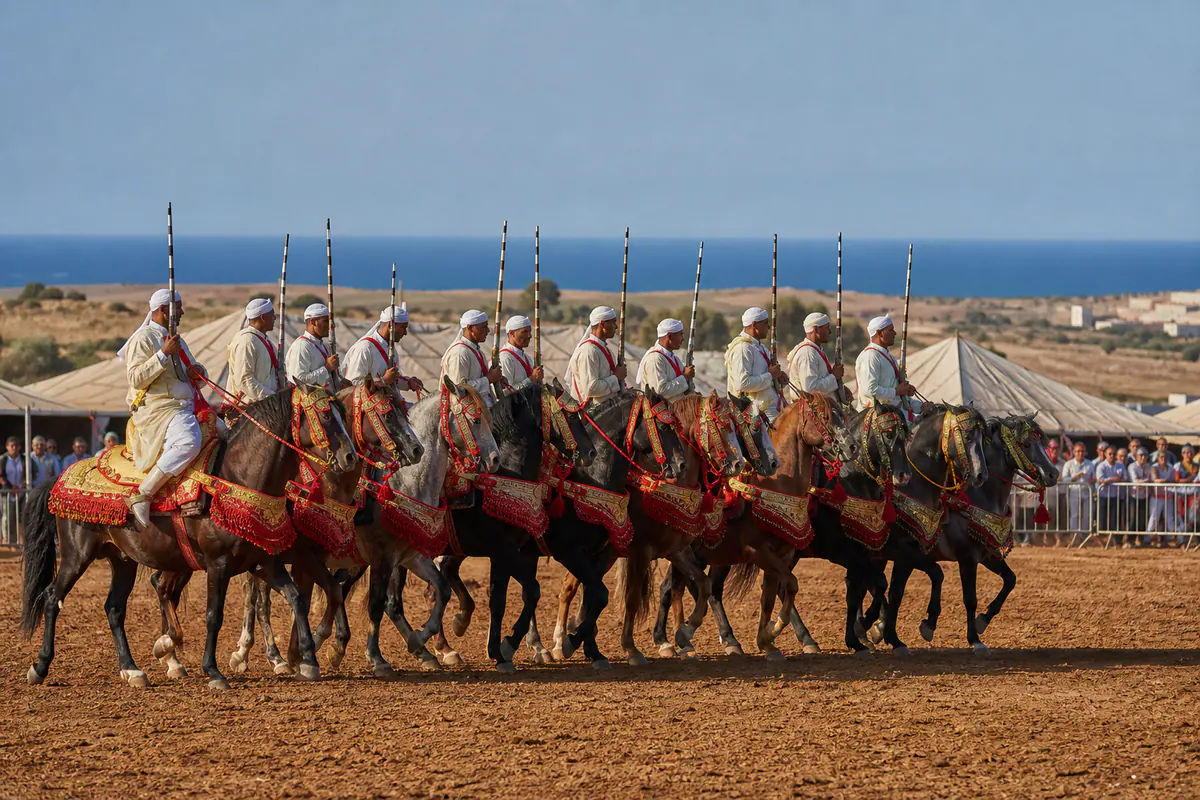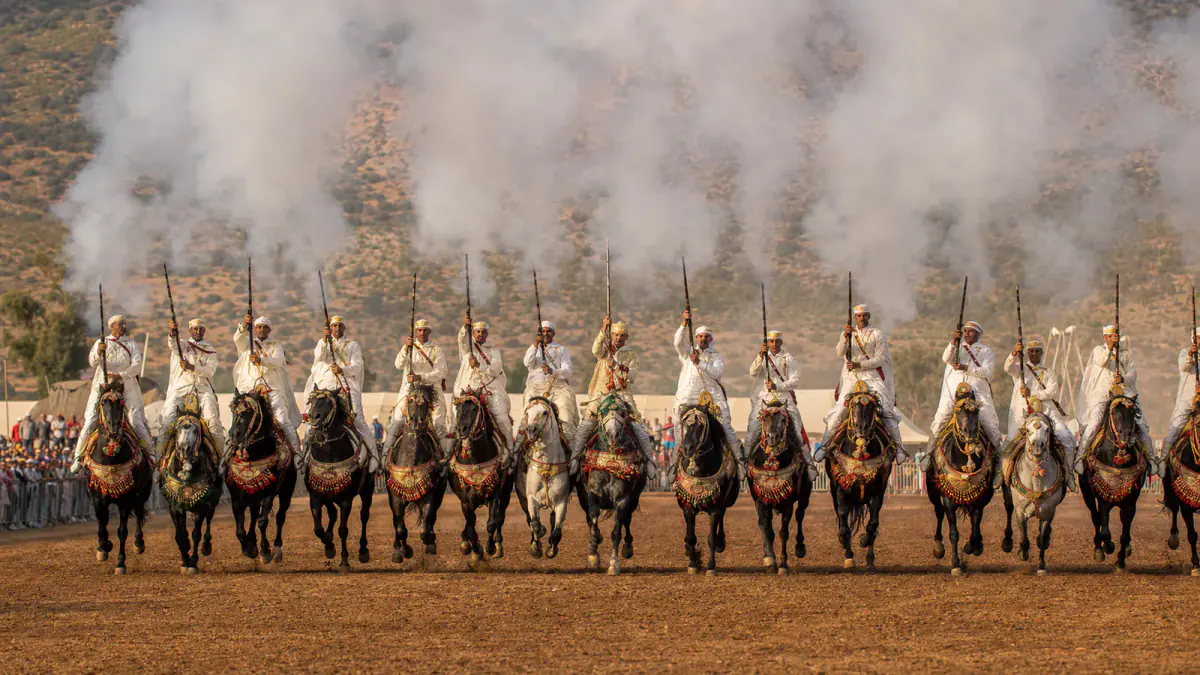
Tbourida is Morocco’s traditional equestrian charge: a line of riders advances in formation, accelerates together and ends with a single synchronized blast from ceremonial muskets loaded with blank powder. Outside Morocco it is often called Fantasia, but Tbourida is the name used by riders, Moroccan institutions and UNESCO.
It is thrilling to watch, yet the noise is only the final second of a much deeper performance. The quality lies in the horses’ control, the riders’ alignment, the shared pace and the precision of the final talqa. Tbourida also carries the visual identity of a tribe or region through clothing, saddles, bridles and inherited practice.
For travellers who want a confirmed date, the next major opportunity is the Salon du Cheval d’El Jadida, October 13–18, 2026, where official programming includes daily Tbourida competition or exhibition. Smaller moussems across Morocco may also feature it, but their dates are often announced locally and can change.
Quick distinction: “Fantasia festival” is a useful search term, but there is no single nationwide festival with one permanent date. Tbourida appears at horse shows, national competitions, agricultural fairs, local moussems and some family or national celebrations.
What does Tbourida mean?
The word is linked to baroud, Arabic for gunpowder. UNESCO describes Tbourida as a Moroccan equestrian performance that simulates successive military parades according to ancestral Arab-Amazigh conventions and rituals. It traces the practice to at least the sixteenth century.
Morocco’s official tourism office notes that international visitors often use “Fantasia,” a term associated with spectacle or entertainment. That label is widely understood, but it can make the event sound like a theatrical show invented for tourists. Tbourida better reflects the living practice and the terminology used by its communities.
In 2021, UNESCO inscribed Tbourida on the Representative List of the Intangible Cultural Heritage of Humanity. The listing recognises the knowledge, customs, equipment and transmission surrounding the practice—not just the moment of gunfire.
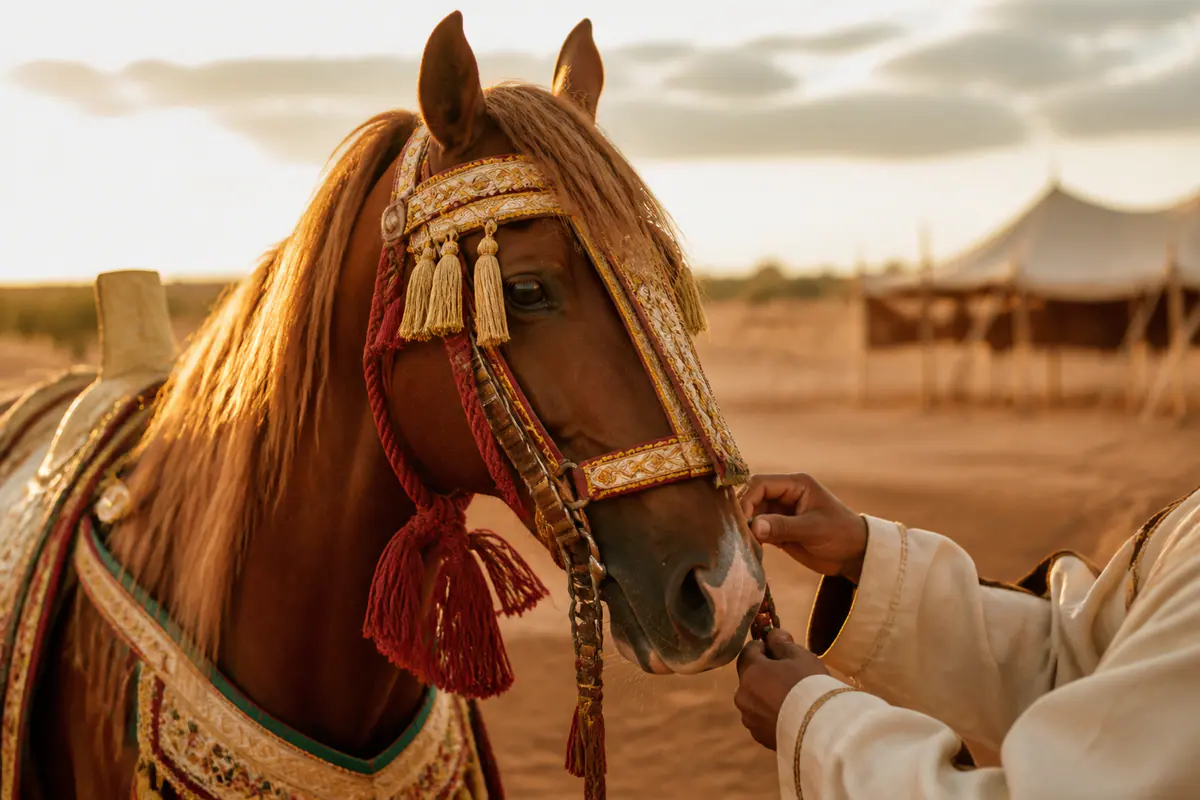
The header image is an original editorial visualization created for this guide, not a photograph of a named competition or sorba.
The people and terms to know
| Term | Meaning |
|---|---|
| Sorba | The troupe of horses and riders performing together |
| Mokaddem | The sorba’s leader, positioned at the centre of the line |
| Hadda | The ceremonial entrance or salute before the charge |
| Talqa | The galloping run ending in a synchronized discharge |
| Baroud | Gunpowder; the linguistic root commonly associated with Tbourida |
| Moussem | A local gathering or festival, often tied to religious, agricultural or community tradition |
According to UNESCO’s description, a sorba is made up of an odd number of riders and horses, generally 15 to 25. The mokaddem holds the line together and gives the signals that coordinate the performance.
How a Tbourida performance unfolds
A full passage has more structure than the few seconds usually shown in travel videos.
1. Preparation
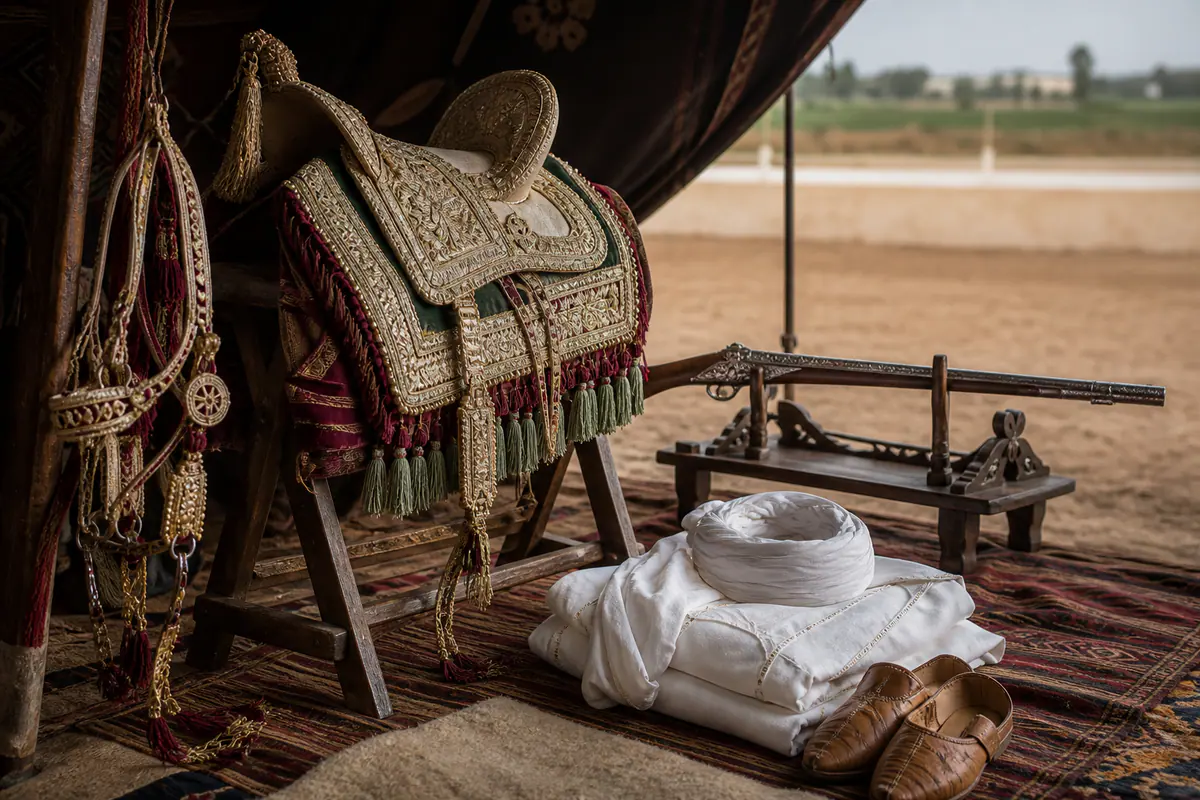
Long before the line enters the track, riders inspect tack, prepare ceremonial dress and settle their horses. The traditional saddle and bridle are not background decoration; their embroidery, colours and workmanship can express regional identity. Training the horse to remain responsive amid crowds, dust and sudden sound is also part of the skill.
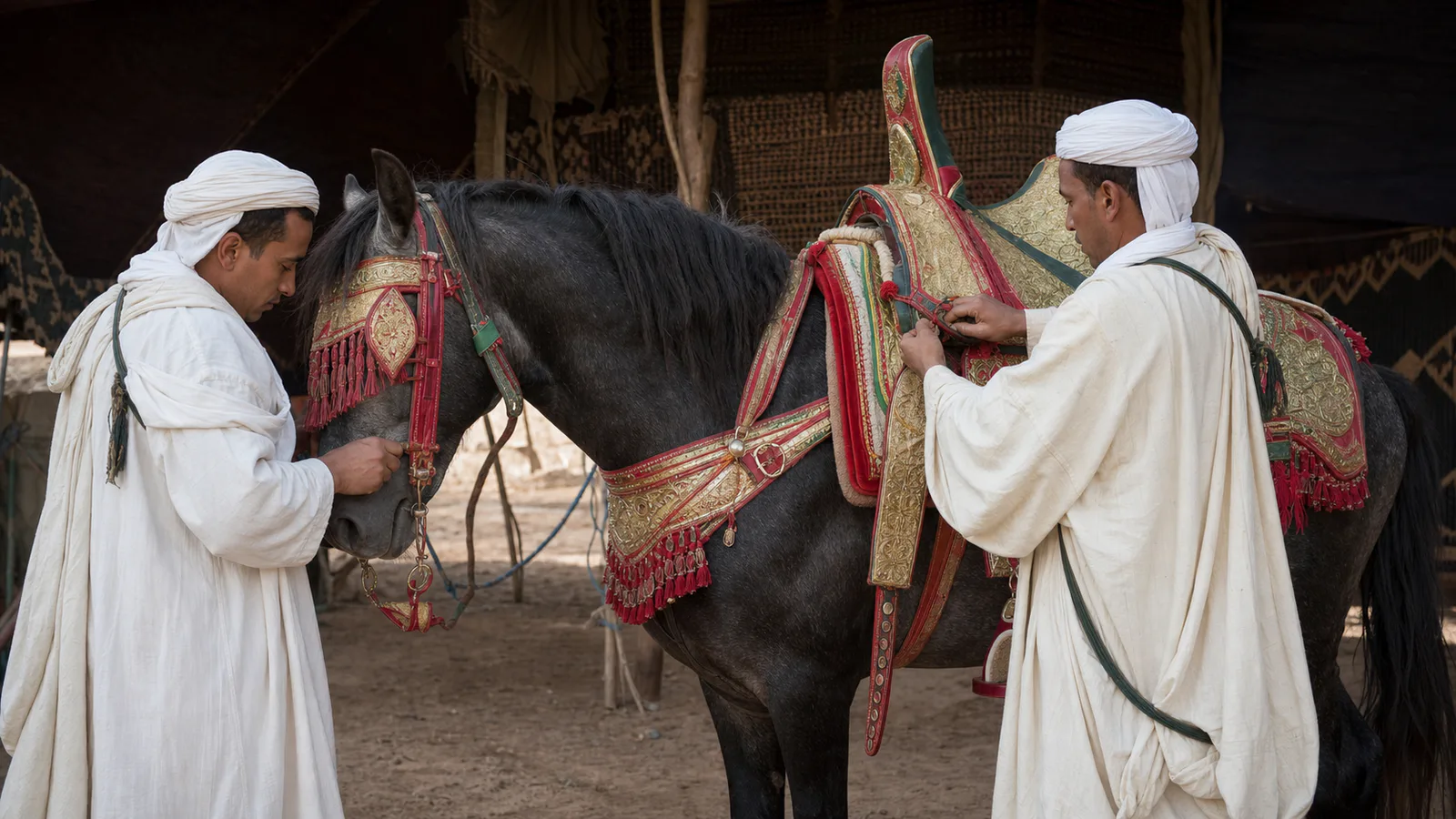
Editorial visualization of pre-performance preparation; it does not document a specific team or event.
2. The hadda
The sorba enters at a controlled pace and presents a salute. Riders may perform a coordinated arms movement before returning to the starting position. This slower phase lets spectators notice the line, traditional clothing, tack and authority of the mokaddem.
3. The talqa
The riders set off together, moving from a controlled start into a gallop. They must keep the horses aligned rather than letting the line stretch into a race. Near the end, the muskets are discharged with blank powder as close to one instant as possible.
The ideal result is perceived as one sound, not a scattered series of shots. The shared blast is the climax, but it only succeeds when the approach is disciplined.
4. Return and reset
After the charge, the sorba slows, regroups and leaves the track. At a competition, teams make repeated passages and are evaluated over several criteria. At a local celebration, the sequence may be less formal, but organisers still control access to the track and preparation areas.
What judges and experienced spectators watch
Visitors naturally react to the sound. Experienced spectators look earlier:
- Is the line straight and evenly spaced?
- Do the horses begin and accelerate together?
- Does the mokaddem keep the centre and control the pace?
- Do the riders handle their muskets in a unified sequence?
- Does the discharge merge into one clean blast?
- Does the sorba remain composed after the shot?
- Are traditional dress, tack and presentation complete and coherent?
SOREC, Morocco’s national horse-sector organisation, describes the Hassan II Tbourida Trophy as the national championship for sorbas that qualify through interregional competitions. Its official Tbourida competition page publishes the current rules and competition framework.
Scoring details can evolve, so a casual visitor does not need to memorise a rulebook. Watching formation, control and synchronization is enough to transform the experience from “a loud horse show” into a readable team discipline.
Tbourida, horses and regional identity
Tbourida recalls cavalry display, but it now lives through community pride, breeding, craftsmanship and intergenerational learning. UNESCO notes that customs and costumes represent the troupe’s tribe or region and that skills are transmitted within families through oral teaching and observation.
The horse is central. Barb and Arab-Barb horses are closely associated with Moroccan equestrian traditions, valued for endurance, agility and partnership with the rider. Elaborate tack may include embroidered saddle cloths, leatherwork and polished fittings produced by specialist craftspeople; our guide to Tbourida clothing and tack explains how those working objects also carry regional craft and presentation.
The result brings together several forms of heritage:
- horsemanship and horse care;
- oral instruction and team discipline;
- traditional tailoring;
- saddlery, embroidery and metalwork;
- regional music and celebration around the arena;
- community organisation through moussems and competitions.
That is why reducing Tbourida to gunpowder misses most of its meaning.
Where can you see Fantasia in Morocco?
Tbourida does not operate like a nightly attraction with a universal timetable. The most reliable options are organised national events; regional moussems require more local checking.
El Jadida Horse Show
The Salon du Cheval d’El Jadida is the easiest major event for an international visitor to verify in advance. The official 2026 programme confirms the 17th edition for October 13–18, 2026 at the Mohammed VI Exhibition Centre in El Jadida.
The published programme lists:
| Date | Announced Tbourida programme |
|---|---|
| Tuesday, October 13 | First Grand Prix competition |
| Wednesday, October 14 | Second competition |
| Thursday, October 15 | Third competition |
| Friday, October 16 | Fourth competition |
| Saturday, October 17 | Grand Prix final |
| Sunday, October 18 | Tbourida exhibition |
The event website currently places Tbourida sessions in the afternoon, but timetables can be revised. Recheck the official programme before travel and use its access and ticket information rather than an unofficial reseller.
El Jadida is on the Atlantic coast southwest of Casablanca. If you are arriving internationally, compare gateways in our Morocco airport guide and avoid building a non-refundable itinerary around a schedule you have not reconfirmed.
Hassan II Tbourida Trophy in Rabat
The Royal Moroccan Equestrian Federation held the 25th Hassan II Trophy from June 15–21, 2026 at the Dar Es Salam complex in Rabat. That edition has already passed, but the championship is an important event to monitor in future years. Check the Royal Moroccan Equestrian Federation and SOREC rather than assuming the same week repeats annually.
Our Rabat travel guide can help if a future edition aligns with your trip.
Regional moussems and agricultural festivals
Tbourida is performed around the country during some moussems, agricultural fairs and heritage celebrations. A moussem can honour a local saint, mark a harvest or bring a community together around a long-established tradition. Not every moussem includes horses, and not every Tbourida gathering is marketed in English.
If a smaller event is your priority:
- Ask the regional tourism office or your accommodation one or two weeks before arrival.
- Request the exact town, arena and start time—not just a festival name.
- Confirm again the day before travelling.
- Keep transport flexible because rural finishing times may be approximate.
- Do not enter preparation or track areas without permission.
Our guide to the Imilchil marriage festival explains another type of moussem and why advertised festival dates deserve careful verification.
For a concrete regional example, the Saïdia Tbourida festival guide separates the documented 2025 Tbourida de l’Oriental from the still-unverified 2026 schedule.
Best time to look for Tbourida
There is no single national Tbourida season. Outdoor gatherings are easier to stage outside periods of heavy rain or extreme heat, and many agricultural or community celebrations follow local calendars rather than fixed international tourism seasons.
For a trip designed around a guaranteed large event, use a date published by the organiser, such as El Jadida in October 2026. For spontaneous local encounters, spring and autumn are comfortable travel periods, but they do not guarantee that a performance will occur.
Compare temperatures and regional conditions in our best time to visit Morocco guide.
Safety and respectful viewing
Tbourida combines galloping horses, crowds, dust and blank-powder firearms. Treat the marked boundary as a safety line, not a photo suggestion.
- Stay behind barriers and follow officials immediately.
- Never step onto the track, even when riders appear far away.
- Keep children close and explain the sudden noise before the first run.
- Consider hearing protection for young children or sound-sensitive visitors.
- Do not use flash around horses.
- Avoid drones unless the organiser has explicitly authorised them.
- Do not touch horses, tack or weapons without permission.
- Expect dust; protect cameras and bring water and sun protection.
Blank powder still produces a powerful pressure wave, smoke and debris risk at close range. A long lens is safer and usually gives better images than moving toward the finish line.
How to photograph Tbourida well
The obvious photograph is the synchronized blast, but preparation often produces more meaningful images.
Arrive early and look for:
- the sorba assembling into a line;
- hands checking an embroidered bridle;
- the mokaddem communicating with riders;
- horses and riders settling before the course;
- dust behind the gallop;
- the regrouping after the shot.
Ask before making close portraits in the preparation area. A public performance does not erase a person’s right to decline an intimate photograph. For the charge, use continuous autofocus, a fast shutter and a position assigned to spectators. Never cross a barrier for a cleaner frame.
Frequently asked questions
Is Fantasia the same as Tbourida?
They usually refer to the same Moroccan equestrian tradition. “Fantasia” is the internationally familiar label; “Tbourida” is the local and official name and is derived from the word associated with gunpowder.
Is Tbourida a festival?
Tbourida is a performance and competitive equestrian tradition, not one festival. It appears within moussems, horse shows, agricultural fairs, national championships and other celebrations.
Are the rifles real?
Riders use traditional ceremonial muskets loaded for a blank-powder discharge during the performance. The sound is real and extremely loud, which is why spectators must remain within designated areas.
Do women perform Tbourida?
Yes. Women participate in Moroccan equestrian life and female sorbas have performed Tbourida. Participation and competition categories depend on the event, so consult the organiser’s current programme.
Where is the best place for a visitor to see it?
For advance planning, the El Jadida Horse Show is one of the clearest options because it publishes dates and a programme. For a more local setting, ask about verified regional moussems after arriving, while keeping plans flexible.
When is the 2026 Fantasia festival in Morocco?
There is no single national “Fantasia Festival.” A confirmed major event is the El Jadida Horse Show from October 13–18, 2026, with Tbourida programmed across the event. Always recheck the organiser’s latest timetable.
Why Tbourida is worth understanding
The final gunshot lasts an instant. The heritage lies in everything required to make that instant possible: trained horses, inherited knowledge, a disciplined sorba, a trusted mokaddem, skilled craftspeople and a community that continues to give the performance meaning.
Call it Fantasia when searching if that helps you find the event. Once you arrive, watch it as Tbourida—and pay attention to the line before the sound.