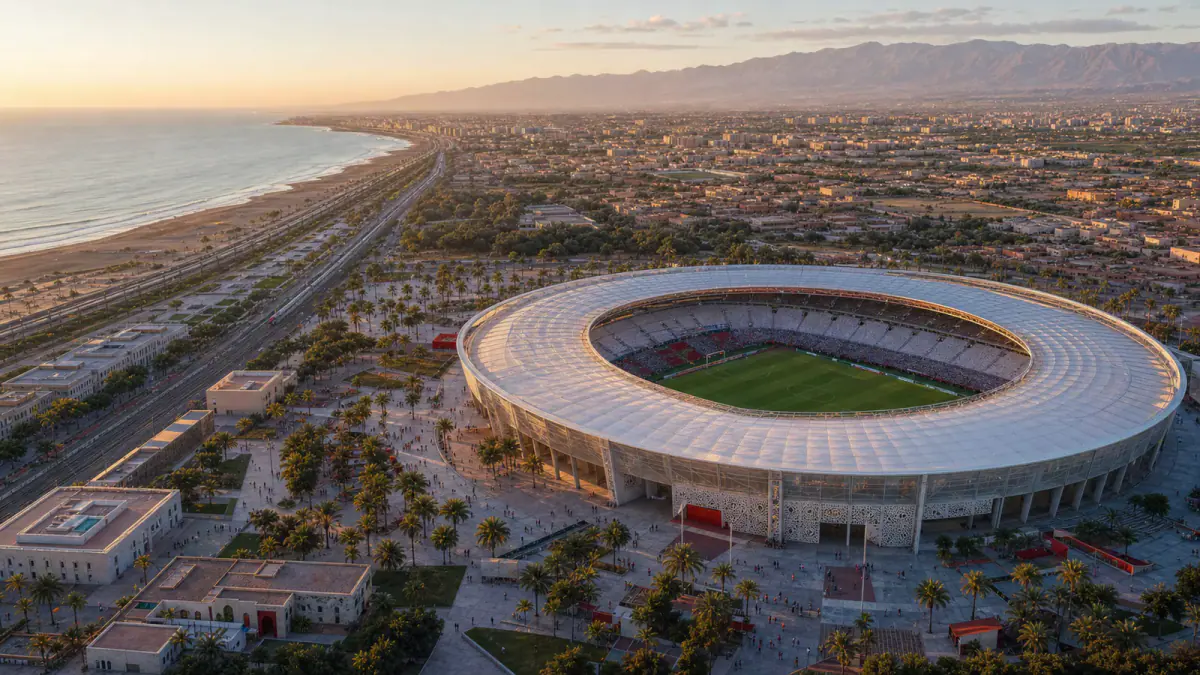
Grand Stade Hassan II is Morocco’s planned 115,000-seat flagship stadium near Benslimane, north of Casablanca. It is designed for FIFA-level competition and is capable on paper of hosting the 2030 World Cup final, but FIFA has not yet confirmed the tournament’s final venue.
This guide separates published project facts from speculation. It covers the official capacity, exact regional location, architectural idea, construction timeline, accessibility and the transport questions that still need answers.
Quick answer: Grand Stade Hassan II is under construction at El Mansouria in Benslimane province, about 38 kilometres north of Casablanca. The bid lists 115,000 gross seats and 108,800 net tournament seats. Public sources currently give 2027-2028 as the target completion period.
Grand Stade Hassan II Facts
| Detail | Published project information |
|---|---|
| Project name | Grand Stade Hassan II |
| Location | El Mansouria, Benslimane province, Casablanca-Settat region |
| Distance from Casablanca | Approximately 38 km north |
| Gross 2030 capacity | 115,000 |
| Net 2030 capacity | 108,800 |
| Owner | Ministry of National Education, Preschool and Sports |
| Planned operator | SONARGES |
| Lead architects | Oualalou + Choi and Populous |
| Site area reported by designers | 100 hectares |
| Construction status | Ongoing |
| Public target | Government: December 2027; designer’s later overview: 2028 |
| World Cup role | Candidate venue capable of hosting the final; allocation not confirmed |
The capacity and operational figures appear in the country’s official Grand Stade Hassan II bid sheet. The location, site and design team are detailed by Populous.
Where Is Grand Stade Hassan II?
The stadium is not in central Casablanca. It is planned for El Mansouria in Benslimane province, within the wider Casablanca-Settat region. Populous places the 100-hectare site about 38 kilometres north of Casablanca.
That distinction matters for future visitors. A hotel near Casablanca’s Old Medina, Casa-Port or the Corniche will not automatically be “near the stadium.” The real travel time will depend on roads, rail or shuttle infrastructure available when the venue opens.
It also explains why the project is described in several ways online:
- Grand Stade Hassan II de Casablanca
- Hassan II Stadium Benslimane
- New Casablanca stadium
- Grand Stade de Casablanca
These names usually refer to the same flagship project, not four separate stadiums.
How Large Will the Stadium Be?
The official bid lists:
- 115,000 gross seats
- 108,800 net seats for tournament operation
- 2,533 skybox seats
- 548 wheelchair spaces
- 426 easy-access seats
- 325 accessible parking spaces
The difference between gross and net capacity accounts for event operations, media positions, security separation and other tournament requirements. It is therefore possible for an article to cite 115,000 while a match-day planning document uses a lower available-seat figure.
At 115,000 planned seats, Grand Stade Hassan II would be among the largest football stadiums in the world. Claims that it is already the world’s largest operating stadium are premature because the project is not yet complete.
The Moussem and Tent-Inspired Design
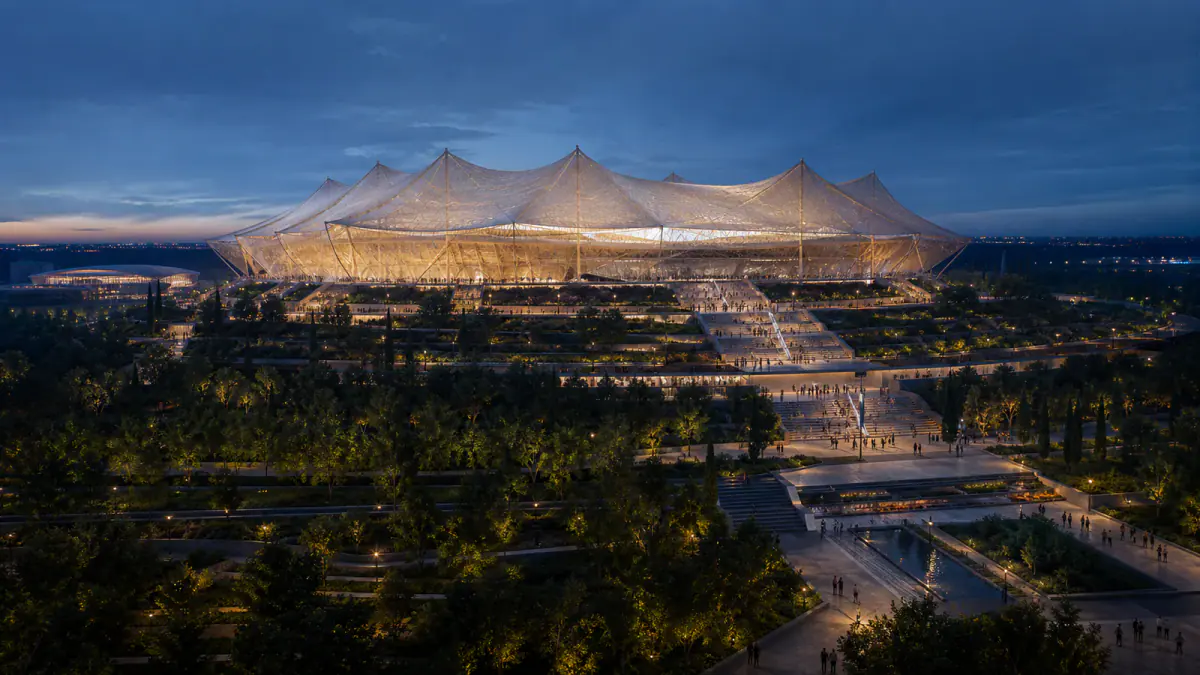
The design is rooted in the Moroccan moussem, a communal gathering that can combine celebration, ceremony, markets and large tents. Populous and Oualalou + Choi translated that idea into a broad translucent canopy over the stadium bowl and surrounding public spaces.
The published design description includes:
- a lightweight aluminium-lattice roof
- three steep, compact tiers behind each goal
- capacity for 29,500 general-admission spectators at each end
- hospitality levels along both side stands
- 32 monumental stairways supporting movement into the venue
- elevated gardens and landscaped public areas beneath the canopy
This is more specific than saying the stadium is “inspired by a tent.” The tent form organizes shade, arrival, circulation and the visual identity of the whole campus.
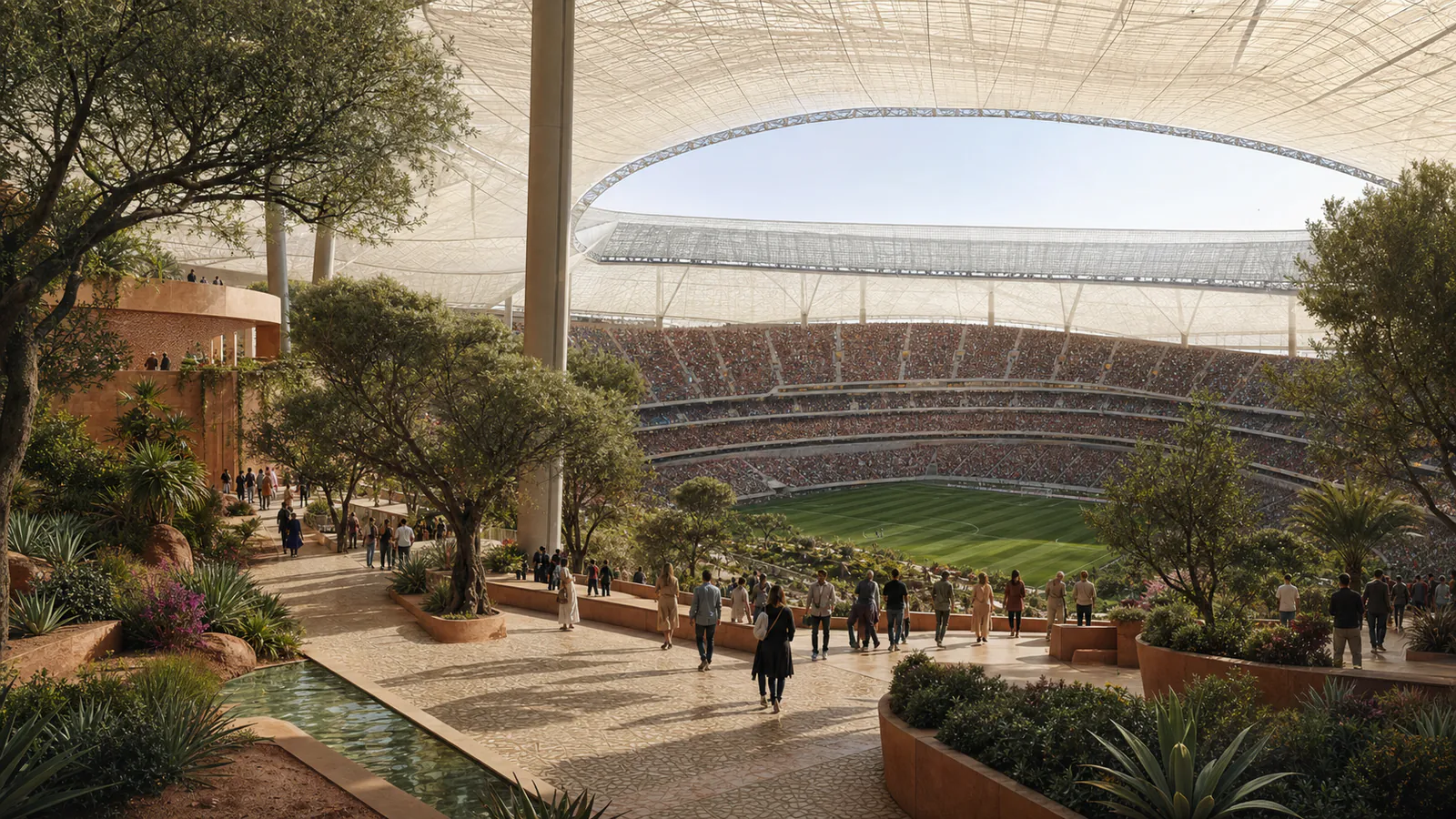
The image above is an original editorial interpretation based on published design themes; it is not an official project render or a photograph of a completed stadium.
Is Grand Stade Hassan II Finished?
No. The stadium is under construction.
Morocco’s government reported in February 2025 that the project would be ready in December 2027. A Populous article published in 2026 described the stadium as due for completion in 2028. Those targets are close, but not identical.
The responsible conclusion is that the project has a 2027-2028 target window, not a guaranteed public opening date. Construction completion, safety testing, event certification and the first full-capacity match are separate milestones.
This page will keep the original indexed URL and update the status when an official handover or opening date is published.
Will It Host the 2030 World Cup Final?
It can host the final under the design and bid specification, but it is not confirmed as the final venue.
The stadium’s scale makes it Morocco’s strongest candidate for the 2030 showpiece. Populous describes it as capable of hosting the final. However, the World Cup is shared with Spain and Portugal, both of which also have major candidate venues.
FIFA’s 2030 tournament organization page confirms the joint hosts and publishes the bid documents. It does not assign the final to Casablanca. Until FIFA releases the match allocation, “candidate” is the accurate word.
Is It the Same as Stade Mohammed V?
No. Stade Mohammed V is an operating stadium in Casablanca. Grand Stade Hassan II is a new project outside the central city, near Benslimane.
The two venues have different locations, capacities and roles:
| Venue | Status | Location | Approximate capacity context |
|---|---|---|---|
| Stade Mohammed V | Operating, renovated | Central Casablanca | More than 44,000 after renovation |
| Grand Stade Hassan II | Under construction | El Mansouria, Benslimane province | 115,000 gross planned |
Confusing them can lead to the wrong hotel or transport assumption. A visitor planning for a future Hassan II match should not use directions to Stade Mohammed V.
Will Raja and Wydad Play There?
The design team says the stadium will serve as the home of two local clubs. This is widely understood as a reference to Casablanca’s major clubs, Raja CA and Wydad AC.
However, future tenancy, scheduling and which matches move from Stade Mohammed V should be confirmed by the clubs, league, federation or operator. A design announcement is evidence of intent, not a complete match calendar.
What Is Planned Around the Stadium?
Grand Stade Hassan II is conceived as part of a wider sports campus. The 100-hectare setting gives room for training, event operations, landscaped spaces and the large movement zones required by a crowd exceeding 100,000.
The stadium’s raised gardens are not only decorative. They are part of the arrival sequence beneath the canopy, softening an enormous structure and providing shaded public space.
The long-term test will be year-round use. A giant venue needs more than several international matches: it needs club fixtures, events, training activity and transport that works when the crowd is smaller as well as when it is full.
Transport: The Biggest Unanswered Fan Question
Current project descriptions confirm the regional location but do not yet provide a final public 2030 match-day transport plan. For a 115,000-seat stadium, that plan will be decisive.
Future supporters should watch for:
- dedicated rail or high-capacity public transport connections
- park-and-ride sites
- tournament shuttle routes from Casablanca and other hubs
- controlled taxi and ride-hailing zones
- pedestrian separation around the campus
- departure plans after night matches
Driving time measured on an ordinary day is not a reliable World Cup estimate. Security perimeters, road closures and staged exits can change the route significantly.
Until official transport is published, do not book a hotel solely because a map labels it “Casablanca.” Use our Casablanca city guide for the differences between city districts and transport hubs.
International visitors can also compare Casablanca, Rabat and Marrakech arrival options in our Morocco airports guide.
Accessibility and Fan Experience
The bid specification includes 548 wheelchair places, 426 easy-access seats, 99 accessible and wheelchair toilets, and 325 accessible parking places.
Those numbers show that accessibility is part of the design. The real experience will depend on details that must be tested in operation: step-free routes from transport, lift capacity, accessible ticketing, sightlines, steward training and the time required to leave after a full event.
For all supporters, the three most important practical features will be:
- clear separation of arrival routes and stadium gates
- enough shade, water and waiting space around the campus
- reliable high-capacity departure after the final whistle
Frequently Asked Questions
What is Grand Stade Hassan II’s capacity?
The planned gross capacity is 115,000. The bid lists a net 2030 tournament capacity of 108,800.
Where is the new Casablanca stadium?
It is at El Mansouria in Benslimane province, about 38 kilometres north of Casablanca.
When will Grand Stade Hassan II open?
Public sources currently indicate a 2027-2028 completion target. A confirmed public opening match has not been announced.
Is Hassan II Stadium already the biggest stadium in Morocco?
It is the biggest planned Moroccan football stadium by capacity. It should not be described as the biggest operating stadium until it is complete and open.
Is the 2030 World Cup final confirmed there?
No. The stadium is designed to be capable of hosting the final, but FIFA has not confirmed the final venue.
Can I buy tickets for the stadium or 2030 final now?
No official general 2030 match-ticket sale is open. Avoid third parties claiming guaranteed final tickets years in advance.
Final Takeaway
Grand Stade Hassan II is a genuinely exceptional project: 115,000 planned seats, a tent-inspired canopy, steep end stands and a landscaped campus north of Casablanca. Its scale makes it central to Morocco’s 2030 World Cup story.
The facts to keep separate are equally important. It is in Benslimane province rather than central Casablanca, it is still under construction, and the 2030 final has not been assigned. For the complete national venue list, continue to our Morocco 2030 World Cup stadium guide.