Morocco’s 2030 World Cup stadium plan covers six host-city areas: Benslimane-Casablanca, Tangier, Rabat, Fez, Agadir and Marrakech. The official bid portfolio lists one new flagship venue and five major stadium projects with planned gross capacities from 45,860 to 115,000.
Morocco will co-host the tournament with Portugal and Spain. Argentina, Paraguay and Uruguay will each stage a centenary celebration match. FIFA formally appointed the hosts on December 11, 2024, but the individual 2030 match schedule and final venue allocation remain future decisions.
Quick answer: Morocco’s six proposed 2030 venues are Grand Stade Hassan II, Grand Stade de Tanger, Prince Moulay Abdellah Stadium, Fez Stadium, Grand Stade d’Agadir and Grand Stade de Marrakech. Grand Stade Hassan II is the largest planned venue at 115,000 gross seats.
Morocco 2030 Stadiums at a Glance
The capacity figures below come from Morocco’s YallaVamos bid material, republished in the country’s official 2030 stadium portfolio.
| Host-city area | Stadium | Gross capacity for 2030 | Net capacity for 2030 | Project type |
|---|---|---|---|---|
| Benslimane-Casablanca | Grand Stade Hassan II | 115,000 | 108,800 | New construction |
| Tangier | Grand Stade de Tanger | 75,600 | 71,000 | Major expansion and upgrade |
| Rabat | Prince Moulay Abdellah Stadium | 68,700 | 63,900 | Rebuilt major venue |
| Fez | Fez Stadium | 55,800 | 49,200 | Upgrade and expansion |
| Agadir | Grand Stade d’Agadir | 46,000 | 42,800 | Upgrade |
| Marrakech | Grand Stade de Marrakech | 45,860 | 42,800 | Upgrade |
Gross capacity is the full venue figure. Net capacity reflects seats expected to be available for tournament use after operational, media and other requirements. That distinction is why two different numbers may appear in otherwise accurate reports.
1. Grand Stade Hassan II: Benslimane-Casablanca
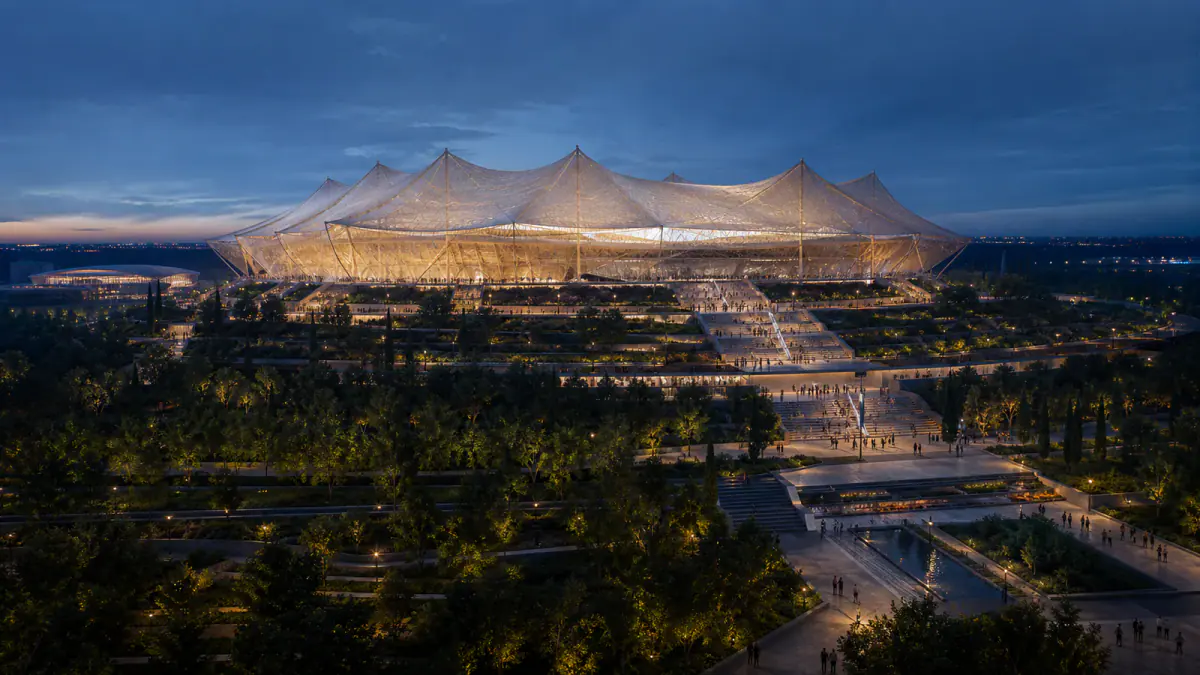
Grand Stade Hassan II is Morocco’s headline 2030 project. The official bid specification lists 115,000 gross seats and 108,800 net seats, making it by far the largest proposed Moroccan venue.
The site is in El Mansouria, Benslimane province, roughly 38 kilometres north of Casablanca. It should therefore be understood as a Casablanca-region stadium, not a walkable central-Casablanca venue.
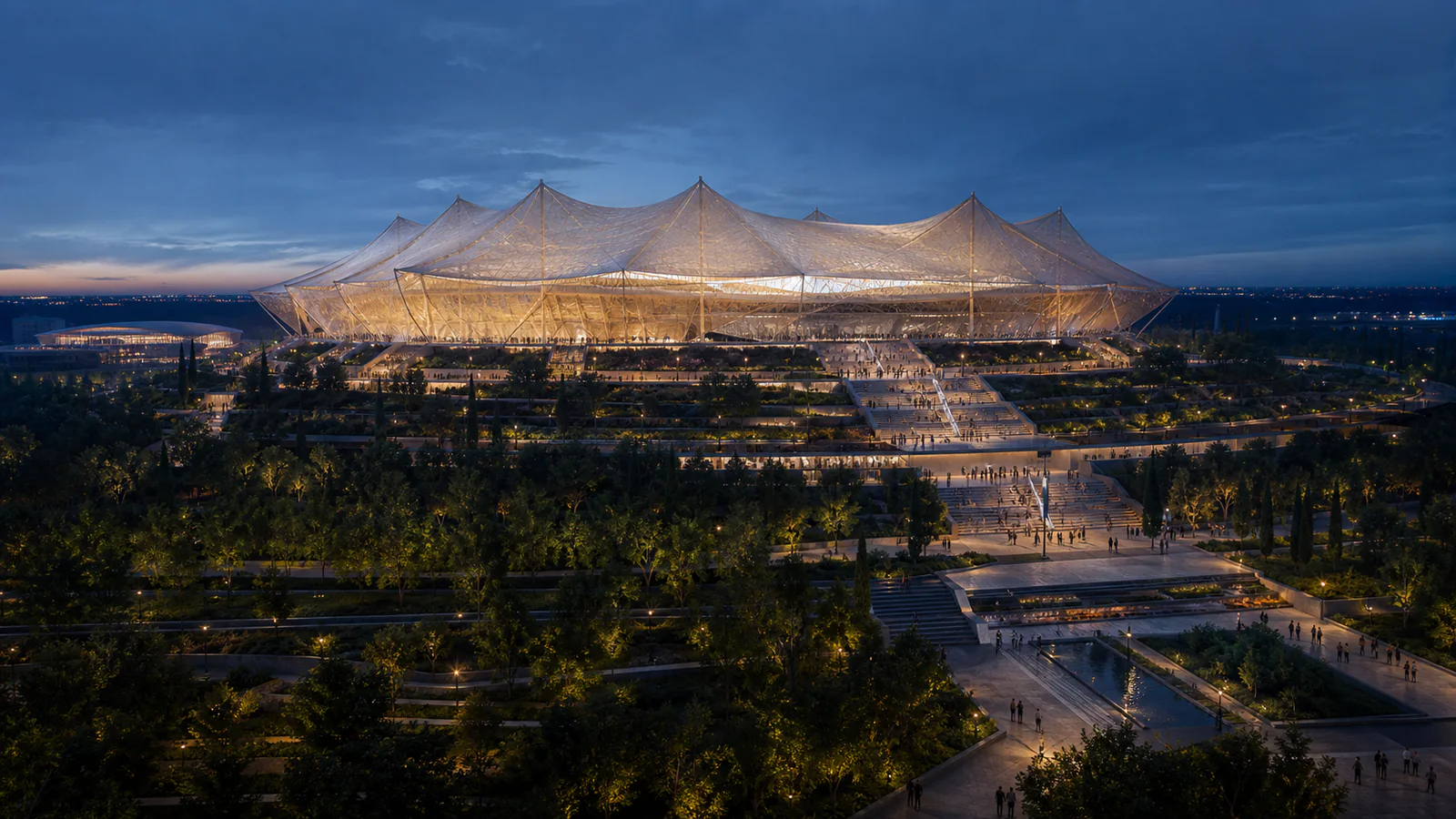
Populous and Oualalou + Choi describe a roof inspired by the Moroccan moussem: a communal gathering associated with tents and ceremony. The stadium is planned within a forested sports campus rather than as an isolated city-centre bowl.
Morocco’s government reported in February 2025 that the venue was targeted for readiness in December 2027. A later 2026 design overview from Populous described completion in 2028. Because those public milestones differ, fans should treat the opening date as a project target until the operator announces a completed and tested venue.
Our dedicated Grand Stade Hassan II guide covers the design, location, capacity, transport questions and completion timeline without repeating all six host cities.
2. Grand Stade de Tanger
Tangier’s stadium is the second-largest Moroccan venue in the bid portfolio, listed at 75,600 gross and 71,000 net seats for 2030.
Unlike Grand Stade Hassan II, this is an established venue with a major expansion story. Morocco’s official sports portal reported that the renovated stadium reopened in November 2025 with approximately 75,500 seats, three seating tiers, upgraded hospitality, a hybrid pitch and expanded media and security facilities.
Tangier is also strategically important as Morocco’s northern gateway. The city has international air connections, ferry links and an existing high-speed rail connection toward Kenitra, Rabat and Casablanca. Exact World Cup shuttle arrangements, road closures and match-day access rules will be published much closer to 2030.
For the visitor experience, Tangier pairs football with the medina, Kasbah, Atlantic-Mediterranean viewpoints and an easy link into northern Morocco.
3. Prince Moulay Abdellah Stadium, Rabat
Rabat’s main venue is listed at 68,700 gross and 63,900 net seats for 2030. The bid documents expected it to be capable of hosting matches through the semifinal stage, but that is a bid-planning category rather than a final FIFA match allocation.
The stadium has already become an important modern national-team venue. It hosted major matches during the AFCON 2025 period and continued to feature in Morocco’s senior football calendar.
Rabat may be one of the easier bases for visitors who want a large-city transport network without Casablanca’s scale. It also offers a strong non-football itinerary: the Kasbah of the Udayas, Hassan Tower, the Chellah and the Atlantic waterfront.
Our Rabat travel guide explains how to combine the capital’s heritage and coast.
4. Fez Stadium
Fez Stadium is listed at 55,800 gross and 49,200 net seats for 2030. It gives the Moroccan host map an inland cultural anchor rather than concentrating every venue on the Atlantic corridor.
Fez requires different travel planning from Casablanca or Rabat. The historic medina is the city’s main draw, but it is not beside the stadium, and its narrow pedestrian lanes are not designed for match-day vehicle traffic. Fans should plan the stadium trip and medina visit as separate movements.
The city demonstrated its ability to host a senior international crowd during Morocco’s 2-0 friendly victory over Tunisia in June 2025. Our Morocco vs Tunisia recap records that match and the Fez venue context.
For cultural planning, use our Fes medina guide.
5. Grand Stade d’Agadir
Agadir’s venue is listed at 46,000 gross and 42,800 net seats. It opened in 2013 and has already hosted major football, so its 2030 story is based on upgrading an operating stadium rather than creating a new destination from scratch.
Agadir brings a different atmosphere to the host-city list. It has a large hotel base, broad modern roads, a long beach and access to Taghazout and the Souss-Massa region. That could make it attractive to supporters building a holiday around one or two matches.
The main practical question will be match-day movement between resort areas, the city and the stadium. Special tournament buses and traffic plans have not been finalized publicly, so current city transport should not be presented as the 2030 solution.
See our Agadir travel guide for beaches, Souk El Had, the marina and day-trip planning.
6. Grand Stade de Marrakech
The Marrakech venue is listed at 45,860 gross and 42,800 net seats. It opened in 2011 and has experience from previous international club tournaments and Moroccan football events.
Marrakech will likely attract visitors even on days without a match. The medina, gardens, restaurants, riads and Atlas day trips create strong demand independent of football. That is an advantage for the destination but a warning for accommodation prices.
Staying inside the medina can be excellent for sightseeing, yet it is not automatically the simplest option for stadium transport. Fans should compare an atmospheric riad with a modern hotel near a practical road corridor once the final match schedule and shuttle routes are known.
Our Marrakech guide gives the wider city context.
Which Is Morocco’s Biggest Stadium?
By the 2030 bid figures, Grand Stade Hassan II will be Morocco’s biggest stadium if delivered at its planned 115,000 gross capacity. Grand Stade de Tanger is the next largest proposed World Cup venue at approximately 75,600.
That answer needs one qualification: Hassan II is still a construction project, while Tangier and the other host-city venues are established or rebuilt stadiums. “Biggest planned stadium” and “biggest operating stadium today” are not always the same question.
Is the 2030 World Cup Final Confirmed for Casablanca?
No. Grand Stade Hassan II is designed to be capable of hosting a World Cup final, and its capacity makes it an obvious candidate. That does not mean FIFA has already assigned the 2030 final to Morocco or Casablanca.
Spain and Portugal also have major candidate venues. Final match allocations depend on the tournament organizers and FIFA. Articles treating a bid aspiration as a confirmed final should be read cautiously.
Travel Between Morocco’s Host Cities
A useful way to understand the six-city map is by corridor:
- Northern and central corridor: Tangier, Rabat and the Casablanca region are linked by the strongest existing intercity rail axis.
- Inland cultural route: Fez connects well with Rabat and other major cities but sits outside the Atlantic line.
- Southern route: Marrakech and Agadir work naturally as a paired tourism itinerary, though the current rail network ends in Marrakech and onward travel to Agadir relies on road connections.
This is present-day context, not a promise about 2030 operations. Morocco is investing in rail, roads and airports, but fans should wait for official tournament transport plans before booking tight same-day connections between cities.
For a broader route comparison, see our Morocco cities guide and first-time Morocco travel guide.
What Is Confirmed and What Can Still Change?
Confirmed
- Morocco, Portugal and Spain are the appointed primary hosts.
- Argentina, Paraguay and Uruguay will each stage a centenary celebration match.
- Morocco’s bid portfolio contains six stadiums in six host-city areas.
- Official bid documents publish gross and net planned capacities for each venue.
Still subject to future decisions
- Which city hosts the opening match, semifinals and final
- The exact match calendar for each Moroccan stadium
- Ticket prices and sales phases
- Fan-zone locations
- Match-day shuttle routes and road restrictions
- Final tested operational capacities
- Completion and handover dates for works still in progress
Frequently Asked Questions
How many 2030 World Cup stadiums are planned in Morocco?
Six stadiums are in Morocco’s official 2030 bid portfolio.
Which Moroccan cities will host the 2030 World Cup?
The six proposed areas are Benslimane-Casablanca, Tangier, Rabat, Fez, Agadir and Marrakech.
What is the capacity of Grand Stade Hassan II?
The official bid specification lists 115,000 gross seats and 108,800 net tournament seats.
Can I buy 2030 World Cup tickets now?
No official general ticket sale is open this far in advance. Ignore third-party pages implying that ordinary match tickets are already guaranteed.
Are all six stadiums new?
No. Grand Stade Hassan II is new construction. Tangier, Rabat, Fez, Agadir and Marrakech are established stadium sites undergoing or having undergone major redevelopment and upgrades.
Final Takeaway
Morocco’s 2030 venue strategy combines scale with geographic variety: a 115,000-seat flagship near Casablanca, major northern and capital stadiums, an inland Fez venue, and southern host cities in Marrakech and Agadir.
The useful facts today are the six-city list and official planned capacities. Match allocations, ticketing and tournament transport are not yet final. Keeping that line clear makes this guide more reliable as the projects move from bid documents to operating venues.