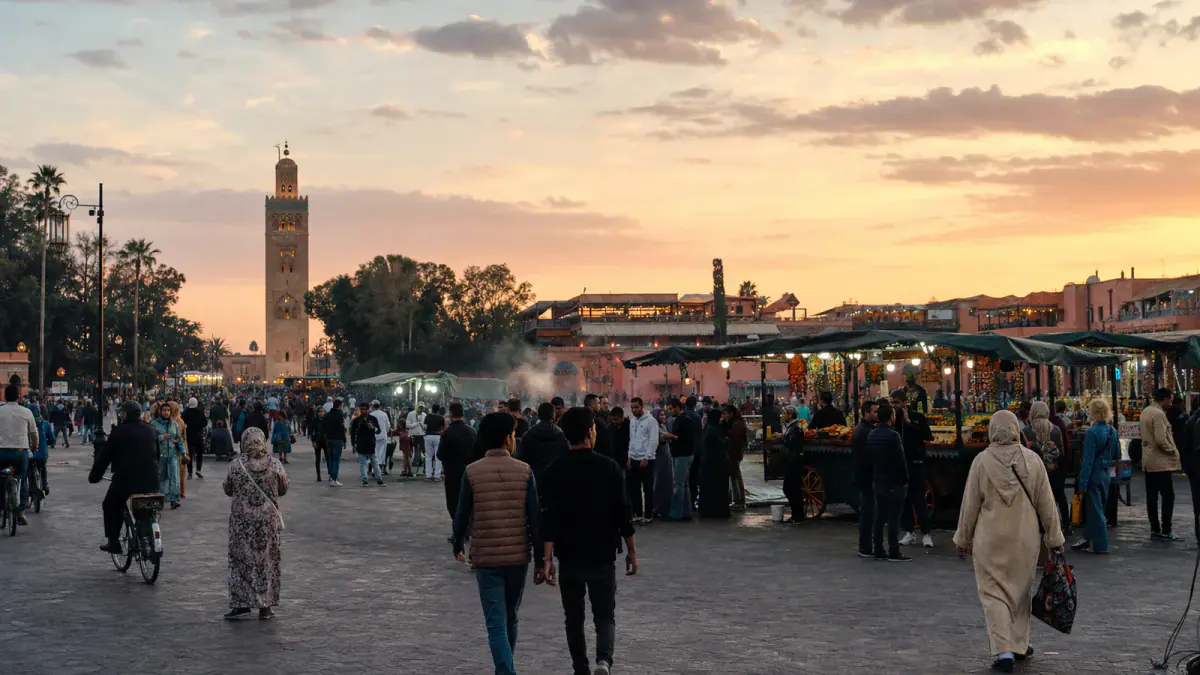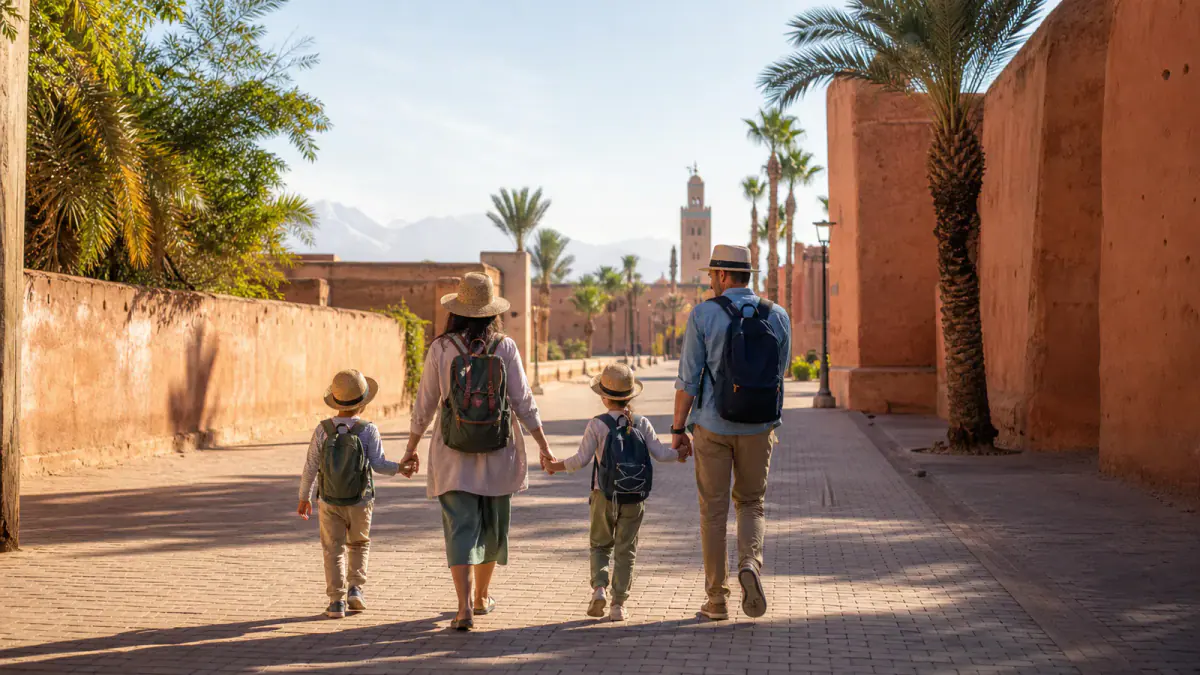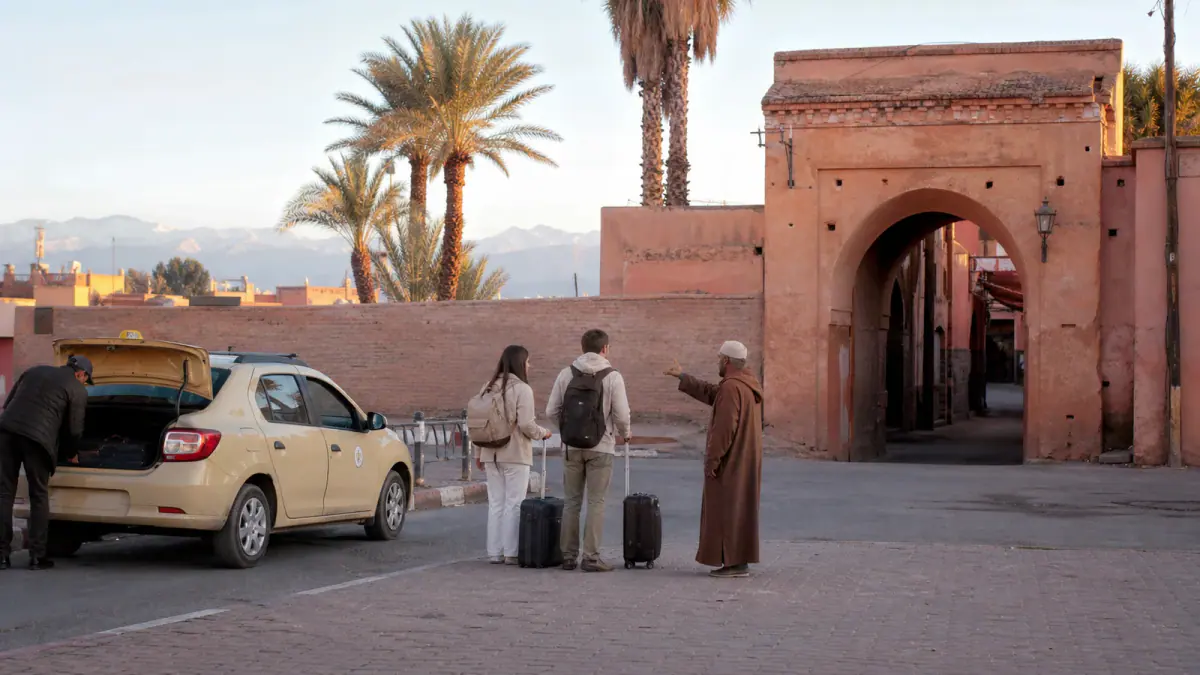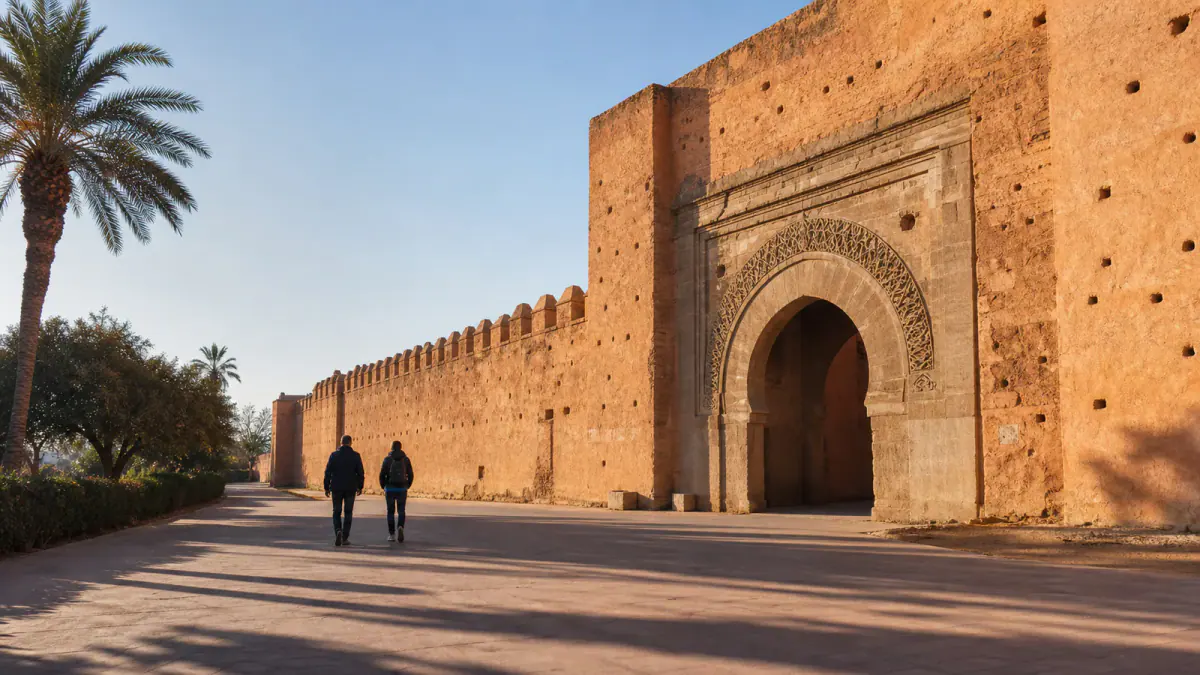
Marrakech architecture makes more sense when you read it as a sequence of power, defense, water and private space. The ochre ramparts establish the old city’s boundary; monumental gates control the transition; mosques and kasbahs express dynastic authority; palaces hide decorated courtyards behind plain exterior walls.
This guide focuses only on that built history. It connects the Koutoubia, Bab Agnaou, Saadian Tombs, El Badi Palace, Bahia Palace and the northern medina into two practical walks, while explaining what to look for at each stop.
Quick answer: For one architecture day, begin at the Koutoubia exterior, follow the walls to Bab Agnaou, visit the Saadian Tombs and El Badi Palace, then finish at Bahia Palace if time and opening hours allow. Use a second morning for Ben Youssef Madrasa, a restored riad museum and the northern medina’s smaller architectural details.
Marrakech Architecture at a Glance
| Place | Main period or layer | What it reveals |
|---|---|---|
| Ramparts | Almoravid foundation and later change | Defensive urban boundary and earthen construction |
| Koutoubia Mosque | Almohad | Monumental religious architecture and city orientation |
| Bab Agnaou | Almohad | Ceremonial entrance to the Kasbah |
| Saadian Tombs | Saadian | Royal burial, carved plaster, cedar and marble |
| El Badi Palace | Saadian | Ruined scale, court ceremony and palace planning |
| Bahia Palace | 19th-century Alawite-era court | Domestic and reception courtyards, painted wood and zellige |
| Ben Youssef Madrasa | Marinid/Saadian layers and restoration | Scholarly courtyard architecture and ornament |
| Medina riads | Multiple periods | Inward-facing domestic design around light, water and garden |
Dates and labels simplify buildings that were repaired, altered and reused. Treat each site as a layer rather than a frozen object from one year.
UNESCO’s Medina of Marrakesh listing recognizes the ramparts, monumental gates, Koutoubia, Saadian Tombs, El Badi ruins and Bahia Palace as central parts of the city’s architectural value.
A Short Dynastic Timeline
Almoravid Foundation
Marrakech was founded in the eleventh century under the Almoravids and developed as a political and cultural centre. The early city established the relationship between settlement, water, gardens and fortification.
The ramparts began as practical defense, but they also made the medina legible as a bounded urban world. Their form has been repaired and altered over centuries; a wall still standing does not mean every visible surface is untouched medieval material.
Almohad Monumentality
The Almohads transformed the capital’s ceremonial and religious architecture. The Koutoubia, kasbah district and Bab Agnaou belong to this story.
Look for scale and urban position. The Koutoubia minaret is not merely an isolated landmark: it orients movement from gardens, square and medina approaches. Bab Agnaou announces a controlled transition into the royal kasbah.
Saadian Display
The Saadian period left two dramatically different experiences. The tombs preserve concentrated royal ornament; El Badi Palace survives largely as a vast ruined plan.
One asks you to examine fine surfaces. The other asks you to reconstruct missing volume.
Later Courtly Marrakech
Bahia Palace belongs to a later courtly world of reception spaces, family apartments, courtyards and gardens. Its value is not being “more beautiful” than El Badi. It shows a different relationship between architecture, administration, privacy and decoration.
The city continued changing after every celebrated dynasty. Restoration, tourism, housing and contemporary use are now part of its architectural life.
Walk One: Koutoubia to Bahia Palace
This southern-medina route can fill a day. It looks compact on a map, but interiors, queues, heat and lunch add time.
Stop 1: Koutoubia Mosque Exterior and Gardens
Begin outside the Koutoubia while the morning is cool. Non-Muslim visitors should expect the prayer interior to be closed. The exterior, minaret and urban setting still provide an essential lesson.
Stand far enough away to see the minaret as a complete composition. Then move closer to notice material, openings, proportions and the transition from the garden edge toward Jemaa el-Fna.
The building helps explain three ideas:
- a minaret can orient the whole city;
- monumental surfaces depend on changing light;
- religious architecture cannot be reduced to an interior visit.
Keep pathways clear and follow any access restrictions around prayer times. Do not photograph worshippers at close range.
Stop 2: Follow a Section of the Ramparts
Move toward the kasbah along a safe public route rather than trying to walk the entire wall. The official Marrakech tourism board says construction of the Marrakech ramparts began in the Almoravid period and extended over decades.
Walls demand distance. From directly beneath them, they look like blank ochre surfaces. Cross where safe and view:
- changes in color after repair;
- square towers and wall rhythm;
- vegetation and roads outside;
- gates as interruptions in the defensive line;
- how modern traffic now uses historic boundaries.
Do not mistake every hole or surface mark for battle damage. Earthen architecture weathers, receives scaffolding and needs maintenance.
Stop 3: Bab Agnaou
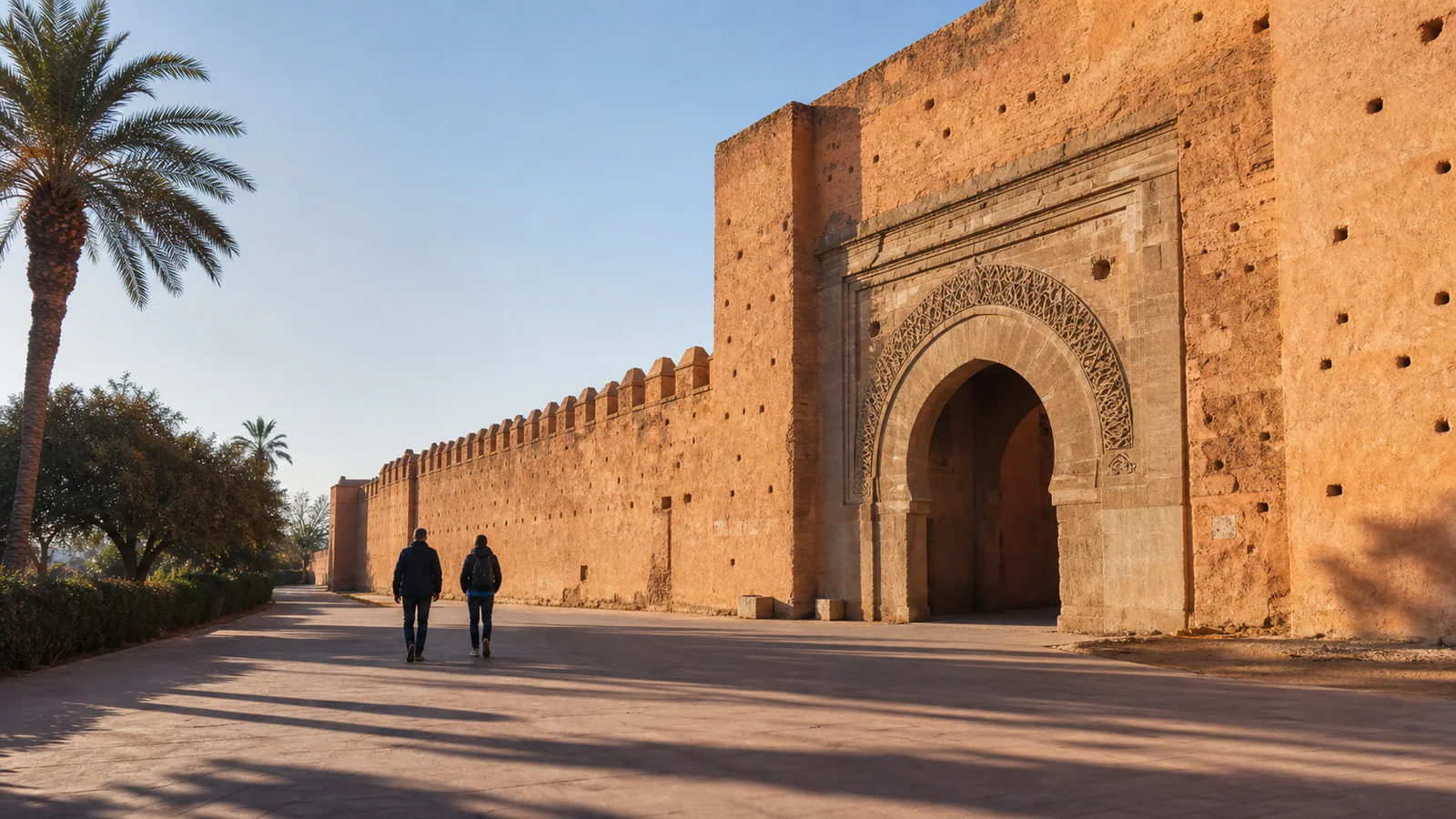
Bab Agnaou is the ceremonial entrance to the kasbah and one of Marrakech’s most important gates. The regional tourism board’s guide to the city gates distinguishes it from practical access points such as Bab Doukkala and the bent entrance of Bab Debbagh.
Study the gate as a threshold:
- the deep arch creates shadow before entry;
- carved bands frame the opening;
- stone contrasts with long earthen walls;
- scale marks the kasbah as a special district.
Traffic, barriers and restoration may affect the best viewing position. Use the public pavement and never step into a road for a symmetrical photograph.
The gate’s current appearance is the result of age, weather and conservation. Historic architecture is not diminished because it has been repaired; survival often depends on intervention.
Stop 4: Saadian Tombs
The Saadian Tombs offer the most concentrated ornamental stop on this route. Small spaces, delicate surfaces and visitor flow make them feel different from a palace.
Look for:
- carved plaster patterns;
- cedar ceilings;
- marble elements;
- tile geometry at lower levels;
- light entering burial chambers;
- transitions between garden, passage and interior.
The famous chamber can create a queue. Decide whether the close view is essential or whether the surrounding complex already answers your interest. Do not use flash where prohibited, and keep moving after viewing so the line functions.
The tombs are a burial place before they are a decorative attraction. Keep voices low and avoid comic posing.
Stop 5: El Badi Palace
El Badi is often described as empty because much of its former richness is gone. That absence is precisely why the site matters.
Instead of searching for intact rooms, reconstruct the palace from:
- the scale of the central court;
- sunken garden or basin areas;
- surviving walls and passage levels;
- views between ceremonial zones;
- traces of material removal and later reuse.
Move slowly around the perimeter before entering every small display. A wide view helps the plan become readable.
Strong sun can make the site demanding. Bring water, hat and sun protection, and avoid exposed midday periods in hot months. Follow barriers; ruined walls are not climbing platforms.
El Badi answers the question “how was power staged at large scale?” It should not be judged by the same criteria as Bahia Palace.
Stop 6: Place des Ferblantiers and Lunch
Place des Ferblantiers connects El Badi, Bahia Palace and the Mellah. Use it as a break rather than another attraction.
Metal shops around the square create a living relationship between craft, trade and architecture. Watch without blocking work, ask before close-up photographs and do not assume every displayed lantern is handmade locally.
Have lunch before Bahia. Palace decoration requires attention, and architectural fatigue is real.
Stop 7: Bahia Palace
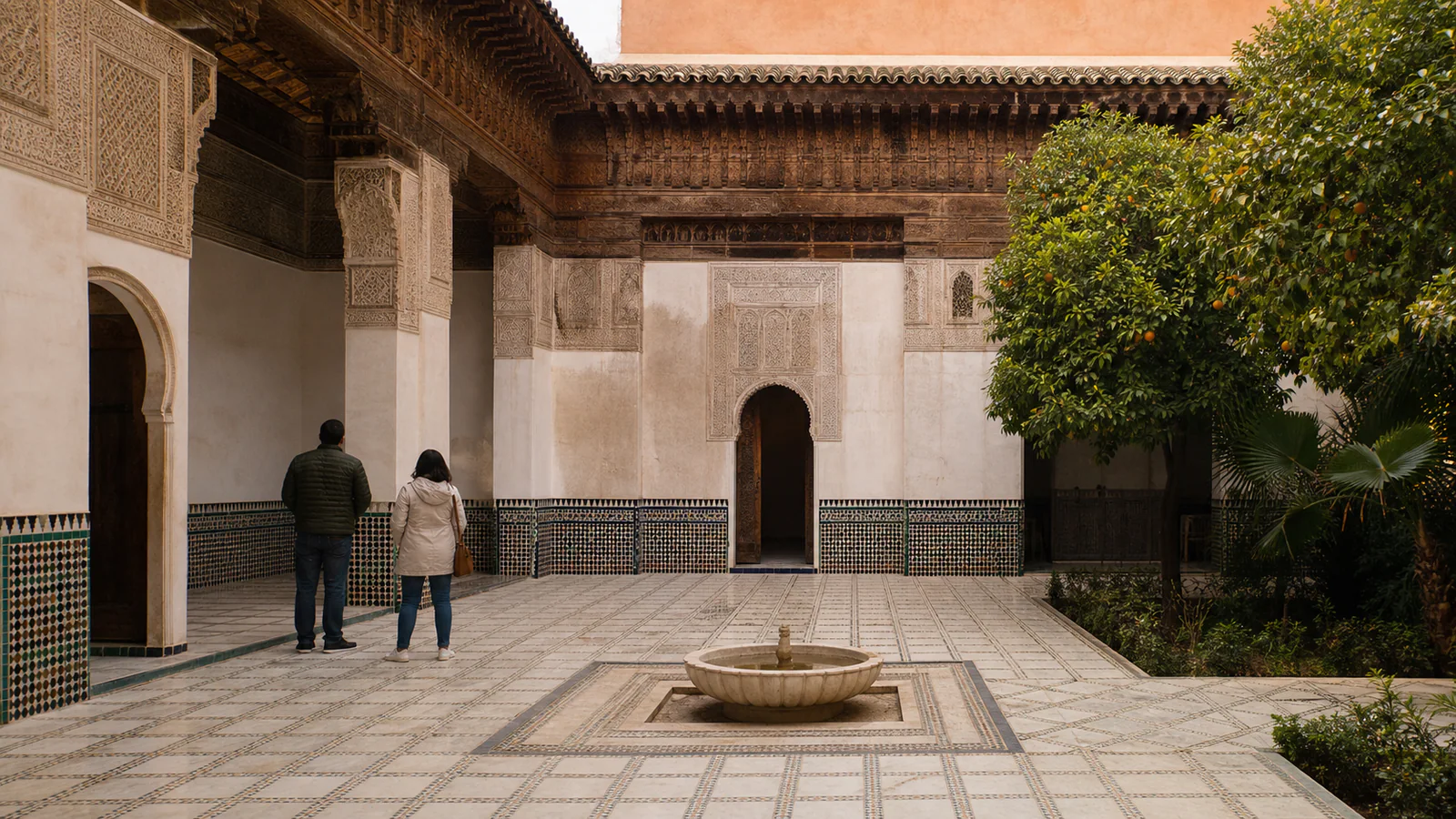
Bahia Palace presents a sequence of courtyards, reception rooms, gardens and private spaces. Its nineteenth-century setting differs from the medieval and Saadian stops earlier in the day.
The official tourism board’s Marrakech history itinerary identifies Bahia as an example of nineteenth-century Moroccan architecture.
Do not race toward the largest courtyard. Follow the sequence and notice how:
- plain passages control the reveal of decorated rooms;
- courtyards distribute air and light;
- painted cedar ceilings differ from carved plaster;
- zellige protects and animates lower wall surfaces;
- gardens soften transitions between formal spaces.
Rooms may close for maintenance or official use. Check current access rather than relying on a map that assumes every wing is open.
Should You Visit All Three Palace Sites?
Use this comparison:
| Site | Choose it for | Main limitation |
|---|---|---|
| Saadian Tombs | Fine royal ornament in compact spaces | Queues and limited viewing rooms |
| El Badi Palace | Ruined scale and palace planning | Exposed sun and missing decoration |
| Bahia Palace | Courtyard sequence and intact decorative craft | Crowds and partial closures |
If time is limited:
- choose El Badi + Bahia for the clearest contrast;
- choose Saadian Tombs + El Badi for a Saadian-focused morning;
- choose Bahia only for detailed courtyard craft;
- skip one rather than spending the day watching the clock.
Architecture is understood through comparison, not collection.
Walk Two: Northern Medina Architecture
Use a separate morning for Ben Youssef Madrasa and one riad-based museum. Do not bolt this route onto the southern palace day.
Ben Youssef Madrasa
The madrasa allows close study of a scholarly courtyard: student cells, central space, calligraphy, zellige, carved plaster and cedar.
Arrive near opening if possible. The courtyard’s proportions are easier to understand before it fills with people.
Look up into upper galleries and then enter a student cell. The contrast between richly articulated common space and small living quarters reveals more than a single centred photograph.
Access and pricing can change. Verify current details locally and respect closed areas.
A Riad Museum
A restored riad museum helps translate palace design into domestic scale. Choose one collection that interests you—photography, decorative arts, carpets or regional culture.
The building itself may explain:
- an inward-facing plan;
- privacy from the street;
- vertical cooling and light;
- central water or garden;
- room openings around a court;
- roof use.
This is also why accommodation photographs can be misleading. A riad’s calm courtyard may sit behind a busy lane with difficult vehicle access.
Our where-to-stay Marrakech guide compares those architectural benefits with luggage, noise and accessibility tradeoffs.
Street Details Between Monuments
The northern medina contains architecture at smaller scale:
- public fountains;
- wooden lintels and awnings;
- fondouk entrances;
- mosque thresholds;
- workshop fronts;
- passages that bend before opening into a court or square.
Do not photograph through residential doors. A glimpse of carved plaster does not make a home public.
How Marrakech Walls Were Built and Maintained
The ramparts are commonly described through earth, clay and lime. The exact composition and repair method can vary by period and intervention.
Earthen construction offers:
- locally available material;
- thermal mass;
- thick protective walls;
- a color linked to surrounding soil.
It also requires maintenance. Rain, drainage failure, traffic vibration and inappropriate repair can damage earthen fabric. Fresh-looking sections are not automatically fake; they may be necessary conservation work.
The architectural lesson is continuity of technique and care, not a fantasy of untouched walls.
What to Notice in Moroccan Palace Craft
Zellige
Zellige uses cut tile pieces to build geometric compositions. Examine joins, color rhythm and the relationship to wall height. Do not reduce it to a flat printed pattern.
Carved Plaster
Plaster can hold extremely fine vegetal, geometric and calligraphic work. Side light reveals depth better than direct flash.
Cedar Wood
Ceilings, doors and screens use carved or painted wood. Age, smoke, restoration and light affect color.
Courtyard Proportion
Decoration works because of space. Measure visually: how high are walls relative to court width, where does shade fall and how do rooms open toward the centre?
Water and Garden
Fountains and planted courts support comfort, sound, reflection and symbolism. They are architectural systems, not decorative accessories.
Souks as Architecture, Not a Shopping Detour
This page does not cover bargaining or a full shopping route. Still, the souks belong to the built city.
Notice how:
- shade structures reduce heat;
- related crafts cluster by lane;
- shops use very shallow frontage;
- goods move through narrow passages;
- larger fondouks create storage and courtyard space behind small doors.
The souk’s value is the relationship between architecture and work. Keep doorways and cart routes clear.
For an exact day-by-day plan that integrates souks, food and gardens, use the Marrakech three-day itinerary.
Practical Planning
Start Early
Major sites become hotter and busier later. Put exposed El Badi and compact Tombs near the beginning of the day when possible.
Check Current Openings
Hours, weekly closures, prayer access, restoration and ticket rules change. Verify official venue information shortly before visiting.
Buy Tickets at Official Entrances
Ignore claims that a monument is closed when the entrance is visibly operating. Use authorized ticket points.
Dress for Sacred and Memorial Spaces
Cover shoulders and knees, follow guards and keep voices low. The Koutoubia remains an active mosque.
Carry Water
Palaces can be exposed and walking between them adds heat. Use refill options where safe and available.
Use a Licensed Guide for Depth
A good architecture guide can connect dynasties, materials and urban history. Agree on duration, language, price and shopping expectations.
Photography
Architecture rewards patience more than ultra-wide distortion.
Try:
- side light on plaster carving;
- a door framing a second courtyard;
- hands or scale figures only with permission;
- details after taking a wide context frame;
- vertical lines kept realistic;
- one viewpoint held until crowds move.
Do not use flash where prohibited. Avoid tripods in circulation paths. Never climb ruins or walls for a cleaner angle.
Readable religious inscriptions deserve respect. Do not turn sacred calligraphy into a fashion backdrop.
Accessibility and Heat
Historic sites include uneven paving, thresholds, steps and upper levels. Accessibility varies by zone and can change during restoration.
Travelers with limited mobility should:
- contact each site directly;
- use a taxi between Koutoubia/Kasbah and Bahia zones;
- prioritize Bahia’s main accessible courts if confirmed;
- consider El Badi’s exposure and distances;
- skip upper terraces;
- start early and use seated breaks.
In summer, reduce the route to one or two interiors and move rest into the hottest hours. Heat affects interpretation: no architectural detail is worth illness.
How This Page Fits the Marrakech Guides
This URL owns walls, gates, dynastic architecture and palace comparison.
Use the quiet Marrakech route for small museums, slower lanes, the Mellah, hammam and Gueliz.
Use the Marrakech accommodation guide to choose between medina, Kasbah edge, Gueliz, Hivernage and Palmeraie.
Keeping these intents separate prevents four Marrakech pages from repeating the same generic top-ten list.
Frequently Asked Questions
Which Marrakech palace is best?
Bahia is best for decorated courtyards, El Badi for ruined scale and Saadian history, and the Saadian Tombs for compact royal ornament. Choose according to interest.
Can non-Muslims enter the Koutoubia Mosque?
Non-Muslims should expect the prayer interior to be closed. The exterior, minaret and gardens remain architecturally important.
Is Bab Agnaou inside the medina?
It marks the historic entrance into the kasbah district within the walled city.
Can you walk the entire Marrakech wall?
Roads, traffic, heat and discontinuous pedestrian conditions make a complete wall walk impractical for many visitors. Choose one safe representative section and several gates.
Are Bahia Palace and El Badi Palace the same?
No. El Badi is a largely ruined Saadian palace complex; Bahia is a later palace known for courtyards, rooms and surviving decorative work.
Is a guide necessary?
No, but a licensed guide adds value when dynastic sequence, conservation and craft technique matter more than photographs.
How much time should an architecture day take?
Allow a full day for Koutoubia, Bab Agnaou, two southern sites and lunch. Move Ben Youssef and northern riad architecture to another morning.
Final Takeaway
Marrakech’s architecture is not one style. It is a conversation between Almoravid walls, Almohad monumentality, Saadian ceremony, later courtly courtyards and the working medina that surrounds them.
Walk one district at a time, compare rather than collect palaces and look at transitions as carefully as decoration. The Red City becomes clearer when its gates, walls and hidden courtyards are read as one urban system.