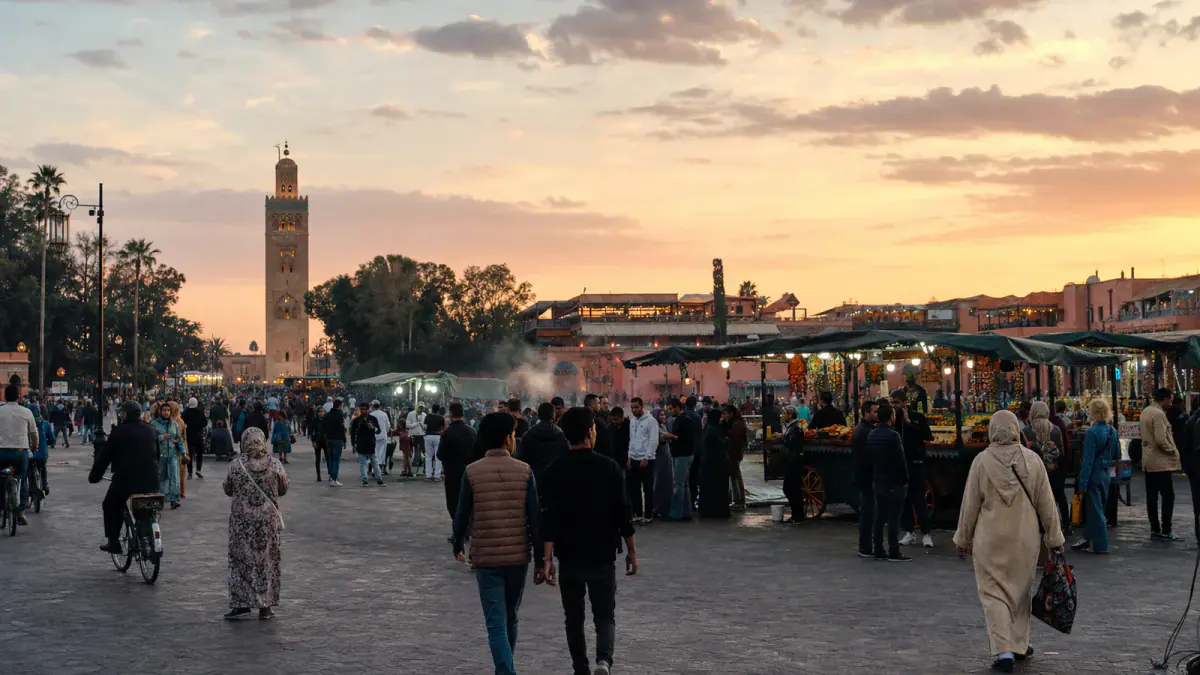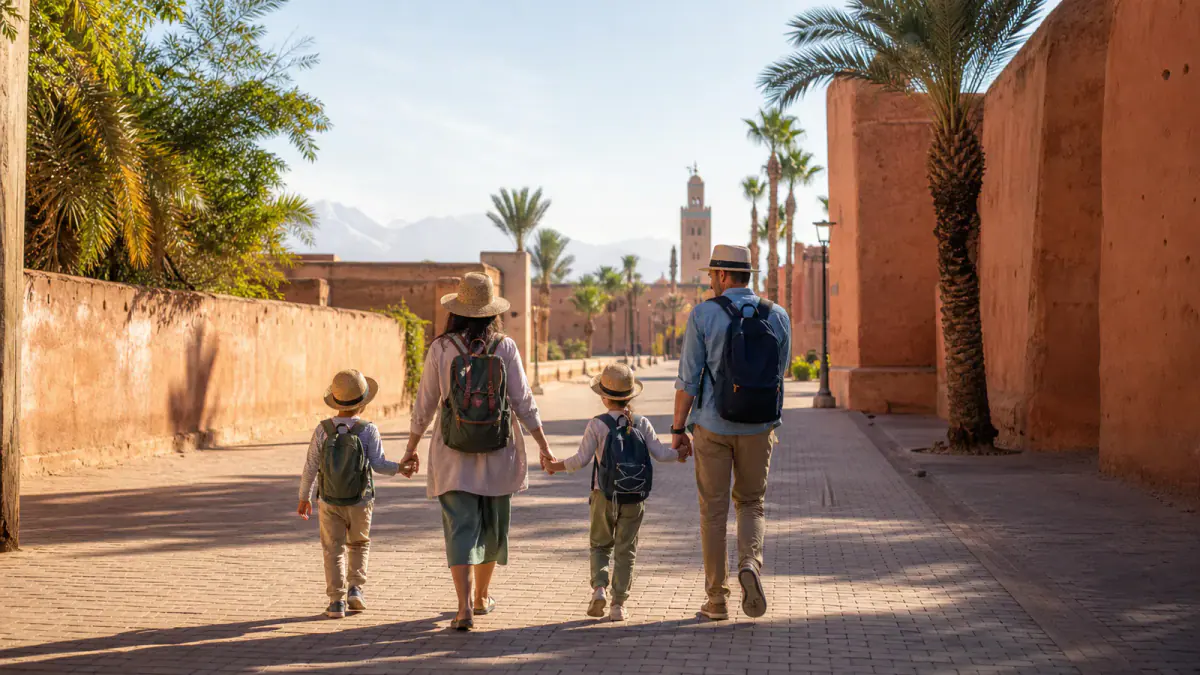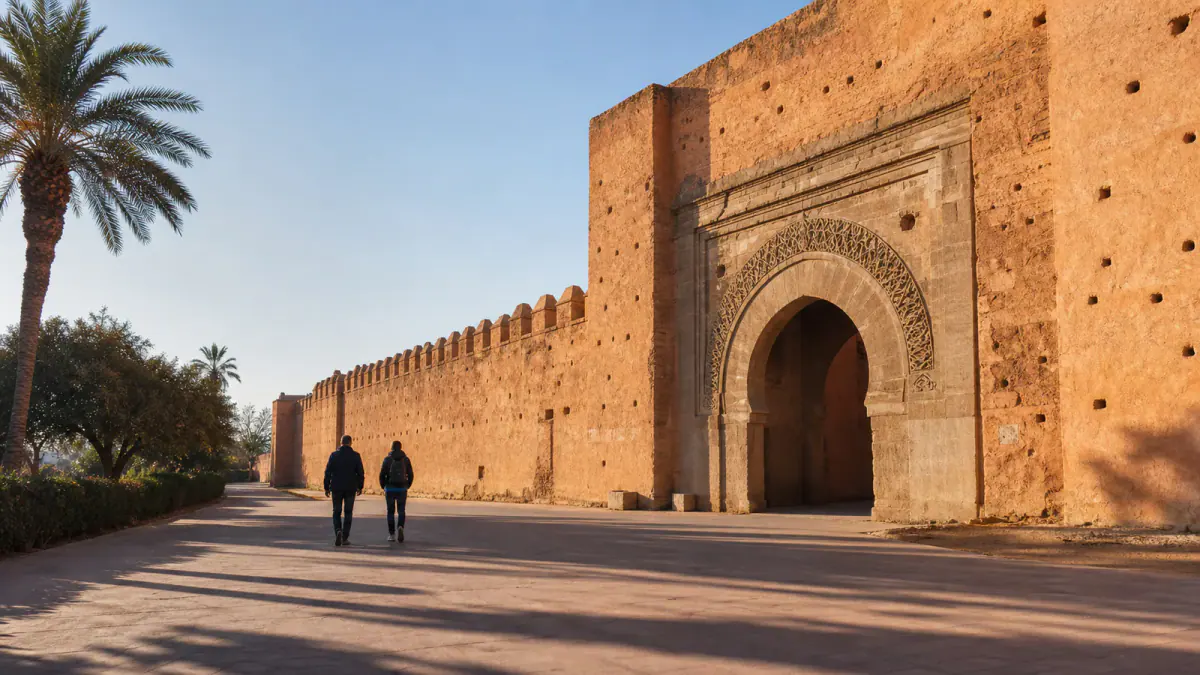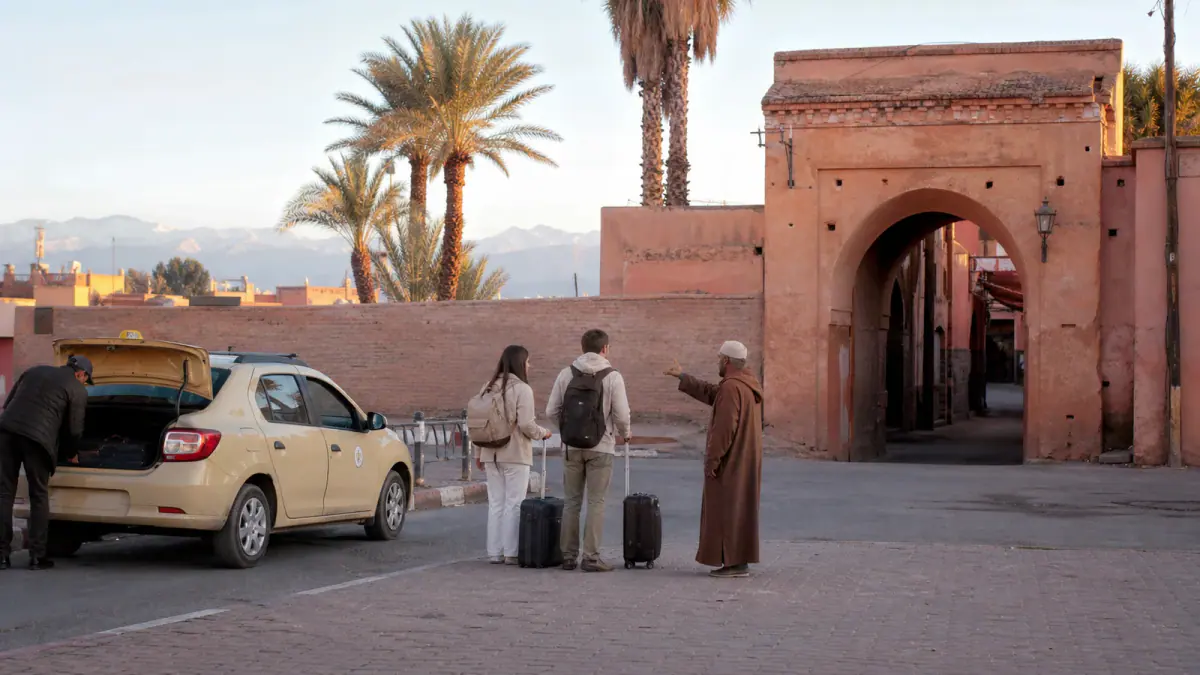
The best area to stay in Marrakech depends on how you want the city to feel after a long day. Choose the Medina for riads, souks and walking access; Kasbah or the Mellah edge for historic atmosphere with somewhat simpler orientation; Gueliz for cafes, restaurants and easier vehicle access; Hivernage for resort-style hotels and nightlife; or the Palmeraie for space and a pool away from the center.
For most first-time visitors staying three nights, a riad near an accessible medina gate or a hotel in central Gueliz is the safest general recommendation. The right answer changes with luggage, mobility, late arrival, children, sleep sensitivity and whether the trip is about historic Marrakech or hotel time.
This guide owns that neighborhood decision. For a day-by-day sightseeing sequence, use our separate Marrakech three-day itinerary.
Marrakech Areas at a Glance
| Area | Best for | Main advantage | Main tradeoff |
|---|---|---|---|
| Central Medina | First visit, riads, walking | Historic atmosphere near major sights | Pedestrian lanes, noise and difficult luggage access |
| Kasbah / Mellah edge | History, food, simpler orientation | Near southern monuments and gates | Still busy; exact access varies street by street |
| Gueliz | Restaurants, transport, modern hotels | Vehicle access and practical city services | Less old-city atmosphere |
| Hivernage | Larger hotels, nightlife, comfort | Pools, gardens and polished service | Higher prices and regular taxi use |
| Palmeraie | Resort break, families wanting space | Large grounds, quiet and pools | Remote from medina; transfers shape every day |
| Medina edge | Mixed priorities | Walkable heritage plus easier pickups | Quality and atmosphere vary by gate and road |
No district is automatically quiet, safe, luxurious or authentic. A peaceful room faces an internal courtyard, not a nightclub; an “accessible” riad may still have stairs; and a Palmeraie property may be farther from the center than its marketing suggests.
First Decide: Riad or Hotel
Choose a riad for atmosphere
A traditional riad is organized around an interior courtyard, often with a roof terrace and a small number of rooms. Inside the medina, it can turn accommodation into part of the cultural experience.
A riad is a good fit when you:
- enjoy small properties and personal hosting;
- can manage steps and uneven lanes;
- want to walk to souks and historic sites;
- accept that taxis may stop several minutes away;
- value atmosphere more than a large pool or gym.
Do not assume every property using “riad” in its name is a restored historic residence or located inside the medina. Check the map and photographs carefully.
Choose a hotel for predictable logistics
Modern hotels are common in Gueliz, Hivernage and outer districts. They usually provide direct vehicle access, lifts, larger public areas and more conventional reception service.
A hotel is often better for:
- late-night airport arrivals;
- travelers with heavy luggage;
- step-free needs;
- families wanting a larger pool;
- business trips or events;
- anyone who sleeps better away from dense pedestrian lanes.
The category label does not prove service quality. Read recent reviews for the exact room type and check renovation dates, air conditioning, construction noise and pool access.
Staying in the Marrakech Medina
UNESCO describes the Medina of Marrakesh as a living historic town of lanes, homes, souks, fondouks, workshops and monumental heritage. Staying inside gives immediate access to that environment, but the qualities that make it special also complicate arrival.
Who should choose the medina?
Stay here if your ideal morning begins with a rooftop breakfast and a walk to a palace, madrasa or souk before traffic builds outside the walls. It is especially rewarding for a short first trip centered on history, food and craft.
The medina is broad. A pin “in the Medina” does not tell you whether the property is beside Jemaa el-Fna, deep in a northern lane, near Bab Doukkala or on the quieter southern side.
Ask about the exact drop-off point
Many lanes are pedestrian-only or impractical for cars. Before booking, ask:
- What is the name of the closest vehicle-access point?
- How many minutes is the walk with luggage?
- Is porter help included, arranged or paid separately?
- Will someone meet a late arrival?
- Does the route include stairs, steep ramps or unlit passages?
- Can the property send a map pin and current arrival instructions?
A vague answer such as “very close to the square” is insufficient. Five minutes in a clear lane and five minutes through multiple turns feel different after midnight.
Choose your medina micro-location
Near Jemaa el-Fna: convenient for first-time orientation and evening activity, but potentially noisy and crowded.
Mouassine / central-northern lanes: attractive for souks, courtyards and design-focused stays; lane complexity varies.
Bab Doukkala side: useful for pickups and food access when the property sits near a gate.
Southern Medina / Kasbah side: practical for Saadian and palace areas, with its own busy streets and local rhythm.
Do not select a riad solely from rooftop photographs. The walk from the nearest road matters every day.
Kasbah and Mellah Edge
The southern medina around the Kasbah and Mellah works well for travelers who want historic Marrakech without basing every outing around Jemaa el-Fna. The area places you near southern monuments, food markets and gates that can simplify some taxi pickups.
Best for
- repeat visitors;
- travelers interested in palace and Kasbah history;
- food-focused stays;
- people who prefer a recognizable gate or main street nearby;
- a calmer-feeling riad that still remains within the old city.
Check before booking
The Mellah and Kasbah contain busy commercial streets, quiet residential turns and major visitor routes. Ask about evening noise, nearby vehicle access and whether the walking route remains active after dark. “Kasbah area” is not a guarantee of silence.
For deeper monument and architectural context, our Marrakech walls, palaces and souks guide keeps that historic focus separate from this accommodation planner.
Gueliz: Modern and Practical
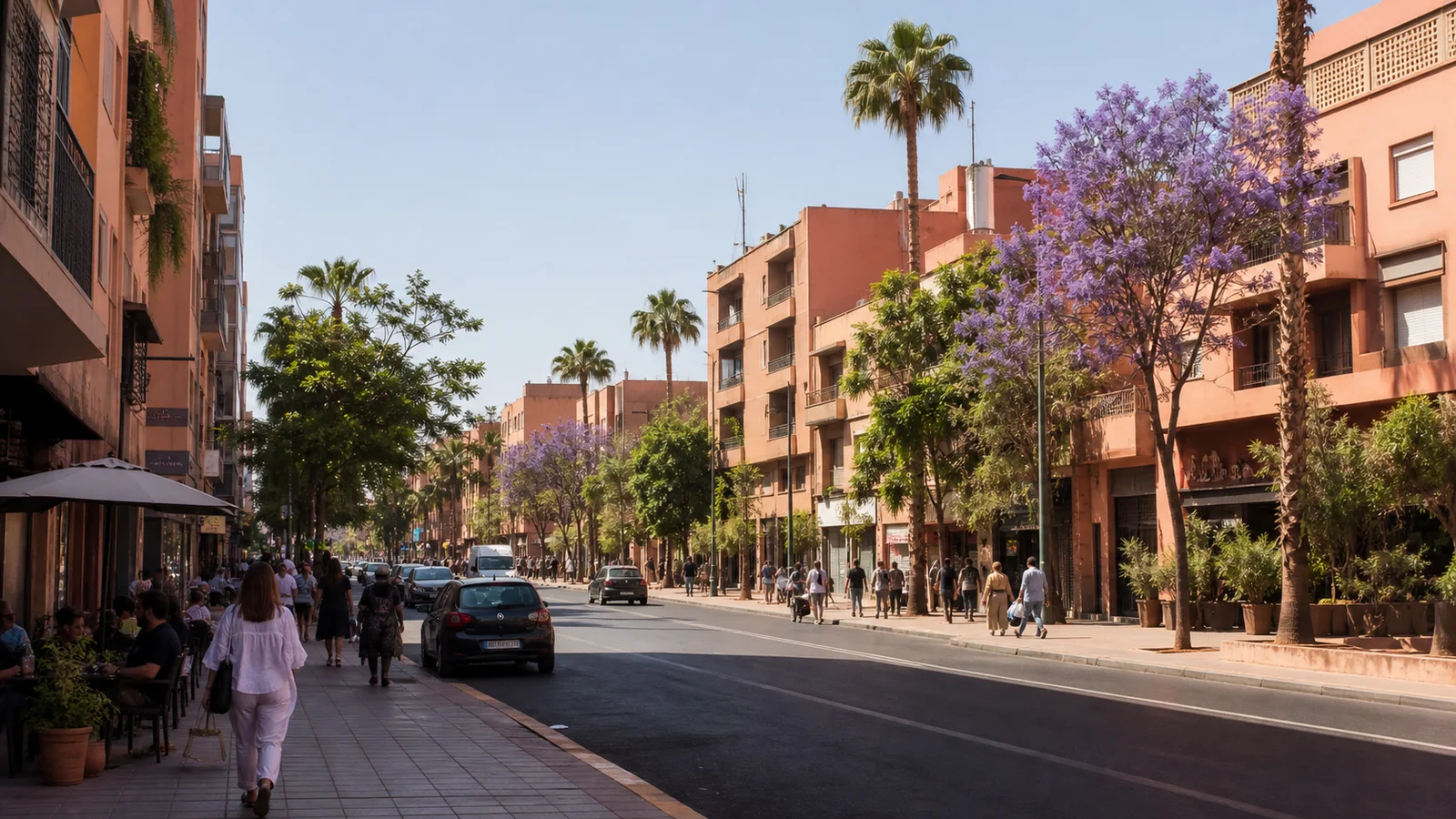
Original editorial visualization of Gueliz’s modern neighborhood character; it does not depict one named boulevard or business.
Gueliz is Marrakech’s modern commercial district. Morocco’s national tourism office identifies it as a business and urban center containing broad avenues, cafes, the railway station and major cultural or commercial infrastructure.
Stay in Gueliz when you value:
- direct taxi access;
- modern hotel layouts;
- cafes and restaurants outside the medina;
- proximity to the railway station;
- simpler late arrivals;
- an evening walk on wider, lit streets;
- easy separation between sightseeing and sleep.
You will travel to the medina by taxi or a longer walk depending on the hotel. That is not a failure of authenticity. It can make the old city easier to enjoy because you return to a less intense base.
Which part of Gueliz?
A position near the train station helps with onward rail travel. A central location around the main commercial avenues gives restaurant choice. Properties farther west or north may require more taxis than their “Gueliz” label implies.
Check distance to your actual priorities rather than the district name. A budget hotel at the edge can be less convenient than a medina-edge property at a similar price.
Hivernage: Hotels, Gardens and Nightlife
Hivernage is more residential and hotel-oriented than central Gueliz. Official tourism descriptions emphasize its larger prestigious hotels, vegetation, restaurants, convention activity and nightlife.
Best for
- resort-level service close to the city;
- business or conference travelers;
- couples prioritizing hotel facilities;
- travelers who want a pool, spa or larger garden;
- nightlife within hotel and boulevard environments.
Tradeoffs
Hivernage is not a walk-out-the-door medina experience. Taxis become part of the itinerary, restaurant spending may be higher, and hotel nightlife can conflict with the promise of quiet. Ask whether the room faces an entertainment venue, road, pool or internal garden.
Hivernage suits travelers who want Marrakech outside during the day and a polished retreat at night.
Palmeraie: Resort Space Outside the Center
The Palmeraie occupies a broad palm landscape beyond the historic core. UNESCO includes the palm grove in the Medina of Marrakesh’s wider natural and cultural setting, but accommodation marketed as Palmeraie can spread across a large area.
Choose it for
- a resort-centered break;
- large pools and gardens;
- families who expect significant property time;
- spa, golf or organized activities;
- combining city visits with rest days.
Do not choose it if
- you want to walk to the medina;
- every day is packed with central sights;
- you dislike planning transfers;
- dinner variety outside the resort matters;
- the visit is only two nights.
Ask for the actual road distance, transfer frequency and last return. A complimentary shuttle is useful only if its hours fit your plans.
Animal rides and entertainment are often marketed around the outer city. Examine welfare conditions and operator practices rather than treating every included activity as responsible.
The Medina Edge: Often the Best Compromise
Properties just inside or outside a major gate can combine quick historic access with a practical taxi meeting point. This is often the best option for a first-time visitor who wants a riad but worries about luggage and navigation.
Look for:
- a named gate within a short, clear walk;
- reception that meets arrivals;
- a public road where registered taxis can stop;
- nearby breakfast or dinner alternatives;
- rooms facing inward rather than onto traffic.
“Medina edge” is a planning concept, not one formal neighborhood. Verify it on a map.
Best Area by Traveler Type
First visit
Choose a well-reviewed central or edge-of-medina riad if you are comfortable walking. Choose central Gueliz if arrival simplicity and sleep matter more.
Family with young children
Gueliz or a full-service Hivernage hotel may reduce luggage, stairs and food logistics. A riad can still work, but verify railings, pool access, room layout and whether children are accepted.
Limited mobility
Prioritize a modern hotel with confirmed step-free entrance, lift dimensions and accessible bathroom. Do not rely on an accessibility icon alone. The old medina’s uneven lanes make a property-specific conversation essential.
Solo traveler
Both a hosted riad and central Gueliz hotel can work. Choose a clear arrival plan, reception availability and a route you feel comfortable repeating after dinner.
Couple or honeymoon
A quiet riad with courtyard character suits atmosphere; Hivernage suits spa and hotel service. Ask about privacy and noise rather than buying the most decorated photographs.
Nightlife
Hivernage and parts of Gueliz provide easier access to licensed hotel bars, lounges and clubs. Check dress rules, reservations, transport and current opening information directly.
Remote work
Gueliz is often practical for cafes and conventional hotel desks. Confirm room Wi-Fi speed with recent evidence and ask whether the property has backup connectivity; “free Wi-Fi” is not a performance guarantee.
Marrakech Airport Arrival by Area
Marrakech Menara Airport sits close to the city, but the final kilometer determines whether arrival feels easy.
Morocco’s airport authority states that an official taxi station is on the airport esplanade and destination fares are posted at the taxi parking area. It also lists a city–airport shuttle. Operating details can change, so check the current airport page on travel day.
To a medina riad
Pre-arrange the meeting point with the property. Give the driver the gate or road-access name, not only the riad name. Keep the host’s phone number available offline.
To Gueliz or Hivernage
Door-to-door vehicle access is more likely, but confirm the exact entrance. Use the official airport taxi system or a transfer arranged by a known provider.
To the Palmeraie
Pre-arranged transfer is often the simplest choice because properties are dispersed. Confirm whether the quoted fare covers the exact hotel and late arrival.
Never follow an unknown person away from the official area solely because they claim your hotel is closed or inaccessible.
Arrival-Day Plan
Do not schedule prepaid monuments after a long flight. Use arrival day for:
- checking in and understanding the return route;
- withdrawing or changing a small amount of money through an appropriate official service;
- a simple meal;
- one short orientation walk in daylight;
- rest.
If you stay in the medina, save an offline pin for the correct entrance, not only the roof center shown by a map.
A Three-Day Plan From Each Base
This section explains logistics rather than duplicating the full attraction itinerary.
If you stay in the medina
Day 1: Walk the core medina and return to the riad before the evening outing, so you recognize the route in both directions.
Day 2: Group southern palaces and Kasbah/Mellah stops, using one pickup point only if needed.
Day 3: Take a morning taxi to a garden or Gueliz, then return for a final medina evening.
If you stay in Gueliz
Day 1: Taxi to one medina gate, walk a one-way historic route and use a clear evening pickup point.
Day 2: Explore gardens and modern Marrakech close to your base, then add a planned medina dinner if desired.
Day 3: Choose a focused day trip or return to the old city for sites missed on day one.
If you stay in Hivernage
Day 1: Use the hotel as a recovery base and take one late-afternoon medina trip.
Day 2: Complete the main historic circuit before returning for pool or spa time.
Day 3: Choose gardens, Gueliz or a day trip without changing hotels.
If you stay in the Palmeraie
Day 1: Treat arrival as a resort day.
Day 2: Use one planned central drop-off and pickup for the medina.
Day 3: Stay at the resort or book one clearly timed excursion; avoid multiple back-and-forth transfers.
The detailed Marrakech itinerary covers attraction order, food and day-trip choices.
Getting Around Without Losing Time
Walking
Walking is best inside the medina, but route distance understates heat, crowds and wrong turns. Group nearby places rather than crossing the old city repeatedly.
Taxis
Ask the hotel or riad how current local taxi practice works and where to find a legitimate vehicle. For any non-metered journey, clarify the fare before departure. Do not accept pressure to add shops or change the destination.
Ride-hailing
App-based transport rules and availability can change. Government travel advice in some countries warns that unregulated app taxis may lack appropriate licensing or insurance. Use locally authorized options and current accommodation advice.
Private driver
A driver is useful for airport arrival, Palmeraie stays and Atlas or Essaouira routes. Obtain the itinerary, vehicle, total price and waiting terms in writing.
Noise, Heat and Sleep
Marrakech accommodation can be affected by:
- square or street activity;
- rooftop restaurants;
- mosque calls;
- nightclub bass;
- courtyard breakfast setup;
- pool equipment;
- construction;
- summer heat and weak air conditioning.
Read recent reviews for repeated patterns, then ask for the specific room position. A central riad can be quiet when rooms face inward; a luxury hotel can be loud near entertainment.
In hot periods, a small plunge pool may be decorative rather than suitable for long swimming. Confirm dimensions and seasonal access if the pool is central to the decision.
Booking Checklist
Before paying:
- verify the address and neighborhood on two map views;
- ask for the nearest vehicle drop-off;
- confirm porter and transfer prices;
- check reception hours;
- request the number of entrance and room stairs;
- confirm air conditioning and heating by season;
- ask whether the room faces a road, rooftop or nightclub;
- review pool access and child policies;
- check cancellation terms;
- confirm city tax and other mandatory charges;
- keep the property contact details offline.
Screenshots of promises are useful when booking through a platform.
Common Area-Choice Mistakes
Booking “Medina” without checking the gate
The district is too large for the label alone. The last walking section controls every arrival and departure.
Choosing Palmeraie for a sightseeing marathon
Resort distance can turn a cheap room into repeated transfer expense and lost time.
Assuming Gueliz has no culture
Modern Marrakech is part of the city, not an airport suburb. Official tourism material explicitly presents Gueliz and Hivernage as Marrakech’s contemporary counterpart to the medina.
Expecting silence beside nightlife
Map nearby clubs, restaurants and rooftop venues before requesting a quiet room.
Confusing decorative heritage with accessibility
Beautiful old stairs remain stairs. Ask for measurements and actual routes.
Frequently Asked Questions
Is it better to stay in the Medina or Gueliz?
Choose the Medina for riad atmosphere and walking access to historic sights. Choose Gueliz for vehicle access, modern hotels, restaurants and simpler arrival. First-time visitors can enjoy either with the right expectations.
What is the best area for a first visit?
A well-located riad near an accessible medina gate is the most atmospheric general choice. Central Gueliz is better when mobility, luggage or a late arrival makes logistics more important.
Is Hivernage walkable to the Medina?
Some parts are within a reasonable walk of the walls, while others are better by taxi, especially in heat or at night. Check the exact hotel rather than the district center.
How many nights should I stay?
Three nights allow two full sightseeing days plus arrival and departure time. Four nights are better with a day trip or significant hotel relaxation.
Should I stay near Jemaa el-Fna?
Yes if you value immediate access and evening energy. No if you are highly noise-sensitive or uncomfortable with dense crowds. A room facing an internal courtyard may reduce noise, but verify reviews.
Is the Palmeraie good for families?
It can be excellent when the resort provides pools, grounds and family facilities. It is less convenient when the family wants daily medina visits or independent restaurant choice.
Can taxis enter the Medina?
Many historic lanes are pedestrian-only. Taxis stop at gates or accessible roads, after which guests walk or use porter help. The exact point depends on the property.
Final Recommendation
Choose the Medina when Marrakech itself is the main experience. Choose Gueliz when you want the city to be easy. Choose Hivernage when the hotel is part of the holiday, and choose the Palmeraie when resort time matters more than spontaneous old-city walks.
The best reservation is not the most photogenic room. It is the one whose location, arrival route, stairs, noise and facilities fit the way you actually travel. Make that decision first, then build your three days around the base instead of fighting it.
For quieter secondary stops once your base is settled, our hidden Marrakech guide offers a different layer without repeating this neighborhood comparison.