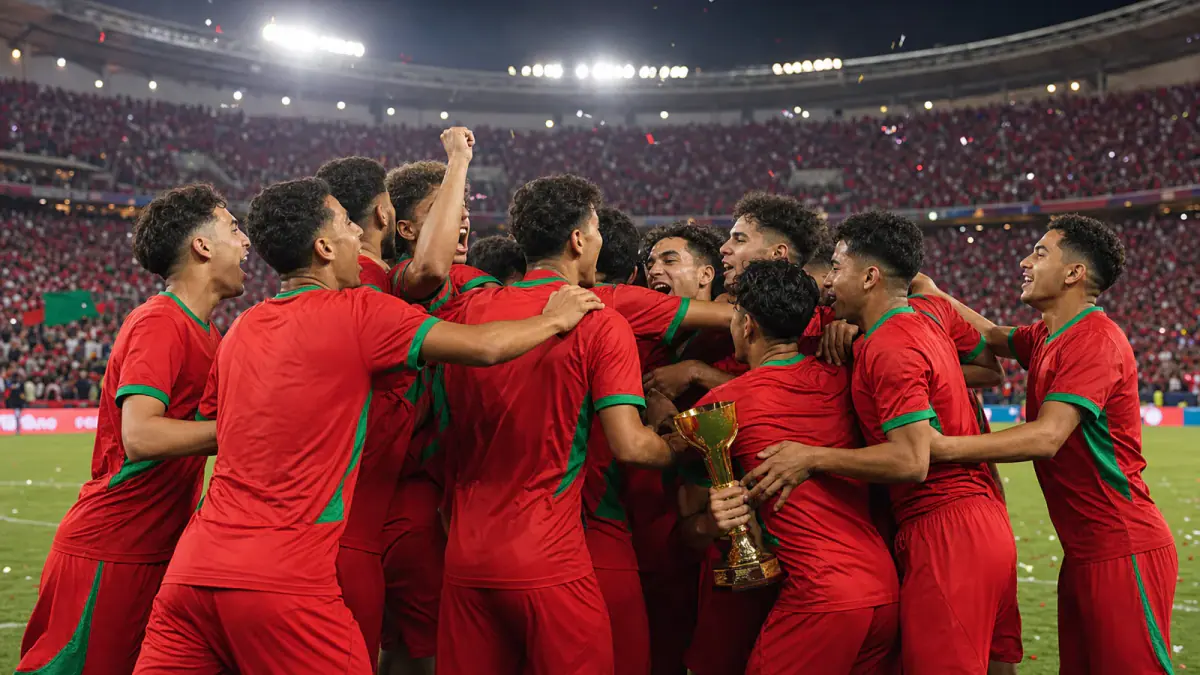
Morocco won the 2025 FIFA U-20 World Cup in Chile by beating Argentina 2–0 in the final on October 19, 2025. Yassir Zabiri scored both goals, a free kick in the 12th minute and a volley in the 29th, as Mohamed Ouahbi’s Atlas Cubs secured Morocco’s first global FIFA title.
The result was not one isolated upset. Morocco beat Spain and Brazil in the group, eliminated Korea Republic and the United States, survived a penalty shootout against France, then defeated six-time champion Argentina without conceding in the final. Othmane Maamma won the tournament’s Golden Ball; Zabiri received the Silver Ball.
Final: Argentina 0–2 Morocco
Scorer: Yassir Zabiri, 12’ and 29’
Date: October 19, 2025
Venue: Estadio Nacional Julio Martínez Prádanos, Santiago
Coach: Mohamed Ouahbi
Morocco’s Complete Results
| Stage | Match | Result |
|---|---|---|
| Group C | Morocco vs Spain | Won 2–0 |
| Group C | Brazil vs Morocco | Won 1–2 |
| Group C | Mexico vs Morocco | Lost 1–0 |
| Round of 16 | Morocco vs Korea Republic | Won 2–1 |
| Quarter-final | United States vs Morocco | Won 1–3 |
| Semi-final | Morocco vs France | 1–1 after extra time; won 5–4 on penalties |
| Final | Argentina vs Morocco | Won 0–2 |
Morocco finished top of a difficult Group C despite the final-match defeat to Mexico. The two opening victories had already established the campaign: Spain and Brazil were not defeated through reputation, but by a team prepared to defend, transition and attack decisive spaces.
How Morocco Won the Final
Argentina entered the final with six previous U-20 world titles and six straight wins in Chile. FIFA’s match report records that Diego Placente’s team had scored 15 goals and conceded only two before the final. Morocco were first-time finalists.
The difference was that Morocco converted the early moments that changed the match.
Zabiri’s 12th-minute free kick
Zabiri ran behind the defense and was brought down by goalkeeper Santino Barbi outside the penalty area. After review, Barbi received a yellow card and Morocco a free kick. Zabiri curled the set piece into the top corner.
The goal mattered beyond its quality. It forced Argentina to chase, creating the possibility of the transitions Morocco had used throughout the tournament.
The second goal in the 29th minute
Ismael Baouf recovered possession and found Othmane Maamma. Maamma advanced and crossed; Zabiri met it with a decisive volley. In three actions—recovery, delivery, finish—Morocco turned defensive organization into a 2–0 lead.
This was Maamma’s most visible contribution in the final and one of four assists FIFA credited to him across the tournament.
Protecting the lead
Argentina controlled long periods of possession and accumulated corners after half-time, but possession did not become clear chances often enough. FIFA highlighted the defending of Baouf, Fouad Zahouani and the Moroccan unit in front of goalkeeper Ibrahim Gomis.
Morocco still threatened when space appeared. Zabiri went close from distance after the break, reminding Argentina that committing more players forward carried risk.
The final score was controlled, but not effortless. Morocco’s achievement came from executing a game state perfectly after earning the early lead.
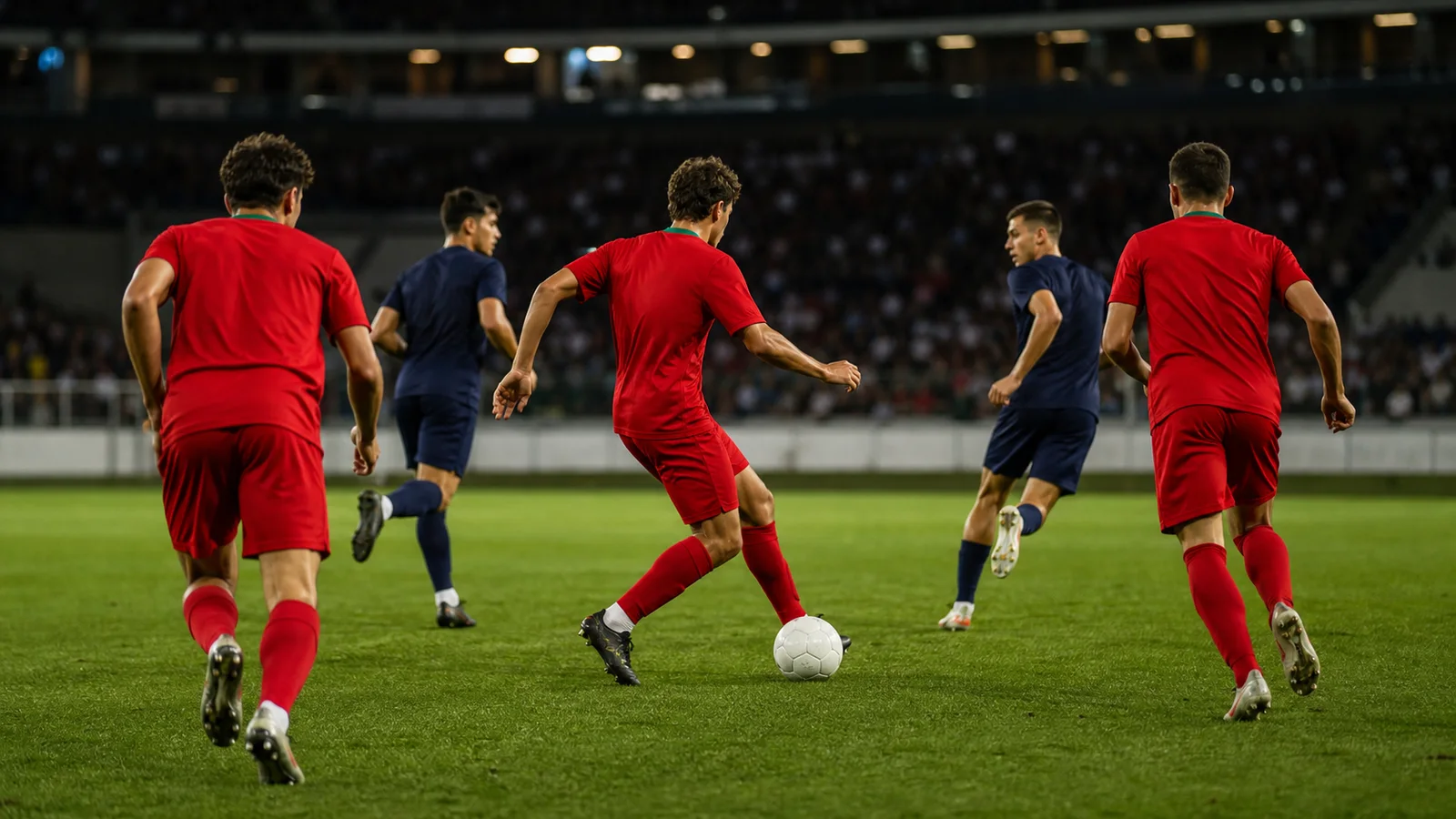
Original editorial visualization of transition play. It is not a documentary photograph of the final or a depiction of named players.
The Group Stage: Spain, Brazil and Mexico
Morocco 2–0 Spain
The opening win gave Morocco immediate control of its group position. Spain carried technical reputation, yet Morocco began the tournament with a clean sheet and the confidence of a two-goal result.
Opening matches are often cautious. Morocco instead established that it could defeat an elite opponent without needing a recovery story.
Brazil 1–2 Morocco
Beating Brazil confirmed that the Spain result was not a one-night surprise. Othmane Maamma scored as Morocco secured qualification with a match to spare.
The first two games also changed how later opponents approached Morocco. From that point, the Atlas Cubs could no longer be treated as an unknown outsider.
Mexico 1–0 Morocco
The defeat mattered because it exposed imperfection without removing first place. Morocco did not complete an unbeaten tournament, and the loss is part of the accurate record.
In hindsight, it also prevented the championship story from becoming a false tale of constant dominance. Morocco adapted after a setback and won every knockout tie.
Round of 16: Morocco 2–1 Korea Republic
Knockout football changed the risk. Morocco could no longer rely on group position, and Korea Republic forced a one-goal match.
The 2–1 win demonstrated a different quality from the opening clean sheets: Morocco could protect a narrow advantage when elimination pressure replaced group calculation.
This was also the first step in a knockout path that grew progressively harder. Korea Republic, the United States, France and Argentina demanded different solutions.
Quarter-final: United States 1–3 Morocco
The United States entered the knockout rounds with significant attacking output, but Morocco won by two goals in Rancagua. Zabiri scored as the team converted another major test into its clearest knockout scoreline.
The result showed that Morocco were not merely surviving. A 3–1 quarter-final victory placed them among the last four with attacking credibility as well as defensive structure.
Semi-final: Goalkeeper Changes and a 5–4 Shootout
The semi-final against France finished 1–1 after extra time. The official scoring record lists Morocco’s goal as an own goal by French goalkeeper Lisandru Olmeta after Zabiri’s penalty struck the goalkeeper, while Lucas Michal equalized for France.
The most unusual story came in goal.
Starting goalkeeper Yanis Benchaouch was injured and replaced by Ibrahim Gomis during regulation time. Before the shootout, coach Mohamed Ouahbi made another change: Abdelhakim Mesbahi entered specifically for penalties.
Mesbahi saved France’s decisive kick in sudden death, and Morocco won the shootout 5–4. FIFA described him as the unlikely hero of the first Moroccan qualification for a U-20 World Cup final.
The choice was bold, but it was not magic detached from preparation. A specialist substitute still has to read, react and handle the pressure of entering cold for the most concentrated moment of the tournament.
The Players Behind the Title
Othmane Maamma: Golden Ball
FIFA named Othmane Maamma the tournament’s best player. Its awards report credits him with one goal and four assists, including the cross for Zabiri’s second goal in the final.
Maamma’s award matters because the final naturally directs attention toward its two-goal scorer. Across seven games, however, chance creation and progression were central to Morocco’s attack.
Yassir Zabiri: Final hero and Silver Ball
Zabiri scored five tournament goals, including both in the final, and received the Silver Ball as the second-best player. His final combined two different forms of finishing: a direct free kick and a first-time volley.
An important correction is necessary: Zabiri did not win the Golden Boot. He finished on five goals, but FIFA awarded the Golden Boot to the United States’ Benjamin Cremaschi using assists as the tiebreaker. Zabiri’s official individual award was the Silver Ball.
Ismael Baouf and Fouad Zahouani
FIFA’s final report highlighted Baouf and Zahouani in the defensive effort. Baouf also began the second-goal move by regaining possession.
The title cannot be reduced to attacking awards. Morocco conceded in several earlier rounds, but the final required a clean sheet against the tournament’s most decorated nation.
Three goalkeepers, one semi-final
Benchaouch, Gomis and Mesbahi all became part of the semi-final story. It is rare for three goalkeepers to participate in one knockout match, rarer still for the third to decide the shootout.
The episode captured the squad nature of the title: players outside the usual starting narrative remained prepared for a narrow role.
Mohamed Ouahbi
Ouahbi’s team changed its match behavior without losing its identity. It could press and transition against Brazil, manage a one-goal round of 16, score three in the quarter-final, survive extra time and penalties, then defend a two-goal final lead.
The trophy is evidence of tournament coaching as well as player talent.
Official 2025 U-20 World Cup Awards
| Award | Winner |
|---|---|
| Golden Ball | Othmane Maamma, Morocco |
| Silver Ball | Yassir Zabiri, Morocco |
| Bronze Ball | Milton Delgado, Argentina |
| Golden Boot | Benjamin Cremaschi, United States |
| Silver Boot | Neyser Villareal, Colombia |
| Bronze Boot | Lucas Michal, France |
| Golden Glove | Santino Barbi, Argentina |
| Fair Play award | United States |
The Golden Boot tie is easy to misreport. Cremaschi, Villareal and Michal all scored five; FIFA’s ranking separated them by assists and then minutes under its competition criteria. Zabiri also scored five but was not listed among the three Boot awards.
Why the Championship Was Historic
Morocco’s first global FIFA title
FIFA characterized the victory as Morocco’s first global title. Forty-eight years after Morocco appeared in the inaugural U-20 World Cup, this generation won the competition.
Only the second African champion
Morocco became the second African nation to win the men’s U-20 World Cup, following Ghana in 2009. That places the achievement within African football history, not only Morocco’s.
A first final, won against the record champion
Argentina had won six editions, more than any other nation, and had lost only one U-20 final before 2025. Morocco won its first appearance in the deciding match.
The route carried elite weight
Spain, Brazil, the United States, France and Argentina represent five different tests with deep tournament traditions or strong 2025 performance. Morocco did not reach the trophy through one favorable draw.
What the Title Does—and Does Not—Prove
The title proves that this group won a seven-match global youth tournament under pressure. It shows that Morocco’s development system produced a champion team and two of the competition’s top individual performers.
It does not guarantee that every player will become a senior international or that Morocco will win a future senior World Cup. Youth development is not linear. Club minutes, injuries, coaching fit and the step from age-group football determine what follows.
The responsible way to follow the generation is to track development rather than declare finished stars. A world title gives opportunity and belief; it does not remove the work after age 20.
For the senior-team context, our Moroccan footballers overview separates established Atlas Lions from emerging players.
Connection to Morocco’s Wider Football Project
The U-20 win arrived in a period of strong Moroccan international results and significant football infrastructure planning. FIFA’s year-end review connected the youth title with the country’s wider 2025 successes.
The championship also entered discussion around Morocco’s co-hosting of the 2030 World Cup. The two subjects should not be blurred: a youth trophy is a sporting result, while stadium projects are long-term infrastructure commitments. Our Morocco 2030 stadium guide tracks that separate story.
At federation level, the Royal Moroccan Football Federation formally honored the U-20 world champions at the Mohammed VI Football Complex on October 22, 2025. That ceremony confirmed the national significance of the result beyond match-night celebrations.
Final Match Timeline
| Minute | Event |
|---|---|
| 12’ | Zabiri scores from a direct free kick |
| 29’ | Zabiri volleys in Maamma’s cross after Baouf wins possession |
| Half-time | Morocco lead Argentina 2–0 |
| Second half | Argentina control possession; Morocco protect the central areas |
| Full-time | Argentina 0–2 Morocco |
The clean timeline explains why the match remains memorable: two first-half goals created the lead, and an entire team defended it.
Frequently Asked Questions
Did Morocco win the 2025 U-20 World Cup?
Yes. Morocco beat Argentina 2–0 in the final in Santiago on October 19, 2025.
Who scored in the final?
Yassir Zabiri scored both goals, in the 12th and 29th minutes.
Was this Morocco’s first FIFA title?
FIFA described it as Morocco’s first global title. It was also Morocco’s first men’s U-20 World Cup final.
Who won the Golden Ball?
Othmane Maamma won the Golden Ball as the tournament’s best player. Yassir Zabiri won the Silver Ball.
Did Zabiri win the Golden Boot?
No. Zabiri scored five goals, but Benjamin Cremaschi won the Golden Boot. FIFA used assists to separate players tied on goals.
Who was Morocco’s coach?
Mohamed Ouahbi coached the championship team.
Who did Morocco beat on the way to the final?
Morocco beat Spain, Brazil, Korea Republic, the United States and France before defeating Argentina. Mexico beat Morocco in the final group match.
What happened in the semi-final?
Morocco drew 1–1 with France after extra time and won 5–4 on penalties. Substitute goalkeeper Abdelhakim Mesbahi made the decisive save.
Was Morocco the first African U-20 champion?
No. Ghana won in 2009. Morocco became the second African champion.
Final Takeaway
Morocco’s 2–0 win over Argentina was historic because it combined a first global title with a demanding path and a final performance of unusual clarity. Zabiri supplied the two goals, Maamma finished as the tournament’s best player, and Ouahbi’s squad defended the lead without turning the match into panic.
The lasting lesson is not that one generation guarantees the future. It is that Moroccan youth football produced a team capable of beating different opponents, recovering from defeat, surviving penalties and closing a world final. That record is strong enough without exaggeration.
Continue through our Morocco sports section for national-team, stadium and competition coverage.