Morocco’s Sahara is not an endless sea of sand beginning outside Marrakech. The country’s desert south includes golden dune fields, dark gravel plains, rocky plateaus, dry mountain ranges, seasonal river channels, palm oases and inhabited towns. Merzouga and Mhamid provide access to the best-known dune landscapes, while Zagora is better understood as a southern oasis-and-road destination. Agafay, near Marrakech, is a rocky arid landscape but not the Sahara.
For a first visit, understanding those differences matters more than choosing the most dramatic photograph. This guide explains the landscape, climate, communities and responsible behavior that make a Moroccan Sahara trip meaningful. Detailed driving routes, camp comparisons and activity choices remain in separate guides so this page can answer a simpler question: what are you actually entering?
Moroccan Sahara at a Glance
| Term or place | What it means for a traveler |
|---|---|
| Erg | A dune field or “sand sea,” such as Erg Chebbi or Erg Chigaga |
| Hamada | Broad rocky or stony plateau, often visually harsher than dunes |
| Reg | Gravel or pebble desert surface |
| Wadi | A channel that may be dry but can carry dangerous floodwater |
| Oasis | A managed living and agricultural system, not just palms around a pool |
| Merzouga | Developed gateway beside Erg Chebbi |
| Mhamid | Road-end gateway toward more remote Chigaga landscapes |
| Zagora | Draa Valley and desert-edge base with smaller dune experiences |
| Agafay | Convenient rocky landscape near Marrakech, outside the Sahara |
The Moroccan National Tourist Office’s Great South overview introduces Merzouga and Zagora as major desert destinations. Treat its imagery as inspiration and use precise local information for logistics.
Is There Really a Sahara Desert in Morocco?
Yes. Southeastern and southern Morocco reach the northwestern margins of the Sahara. However, the tourist journey usually crosses several transition zones before the best-known dune fields.
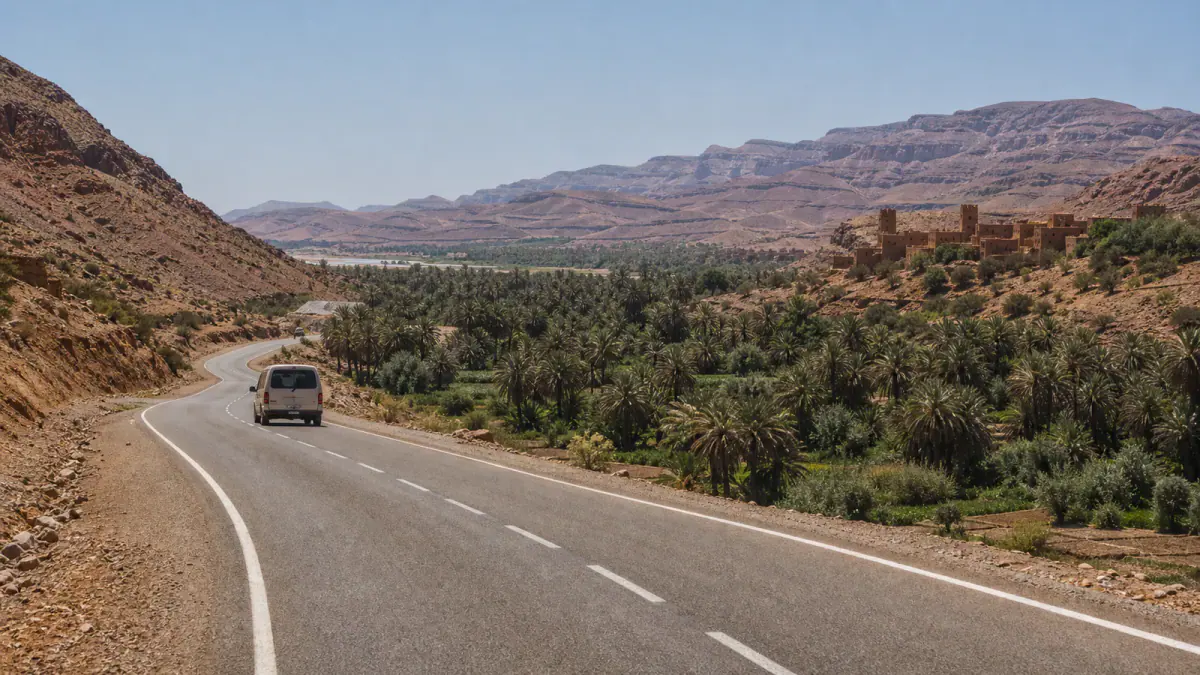
From Marrakech, the road crosses the High Atlas and descends through valleys, arid plateaus and oasis corridors. From Fes, the route passes the Middle Atlas and Ziz Valley. The gradual change is part of the geography: mountain water, river systems, rock, agriculture and settlement interact before open desert dominates.
Calling every dry place “the Sahara” hides those transitions. It also creates disappointment when a short excursion reaches a rocky plain instead of tall dunes.
Desert Does Not Mean Only Sand
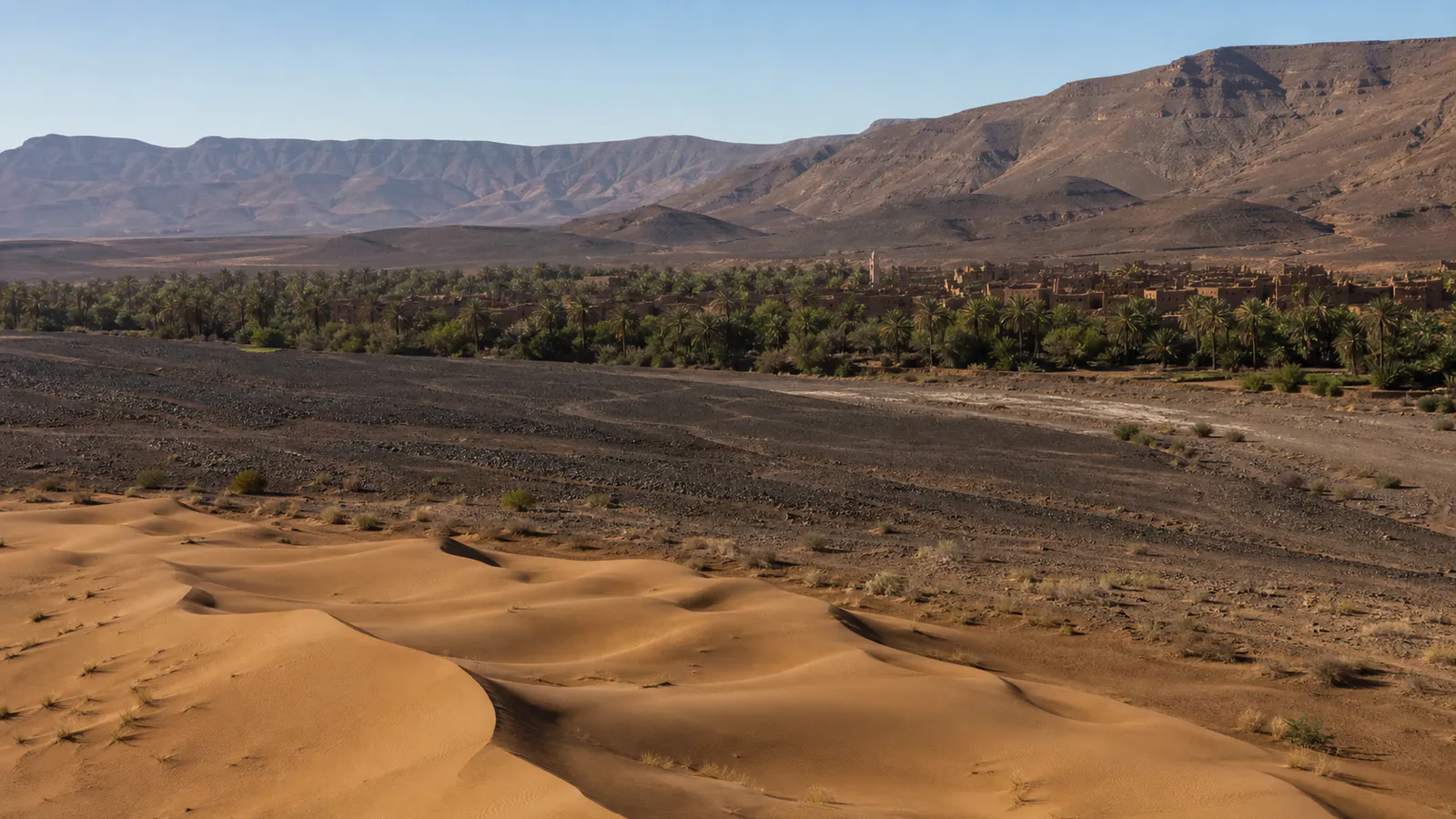
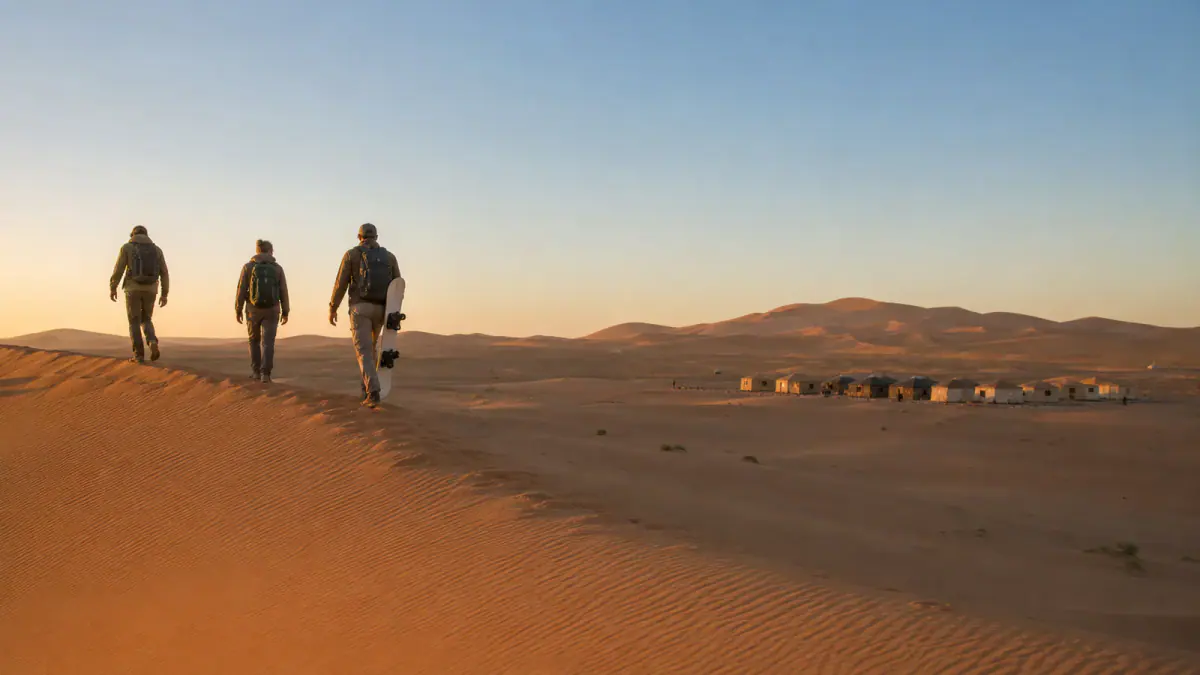
An erg is the landform most visitors imagine. Wind shapes loose sand into ridges and dune forms whose color and shadow change through the day. Erg Chebbi near Merzouga and Erg Chigaga beyond Mhamid are Morocco’s best-known examples.
Yet large parts of the surrounding desert are gravel, rock or hard earth. These surfaces may look empty from a vehicle but contain drainage patterns, plants, animal tracks, human routes and geological evidence.
Erg: dune field
Dune sand moves. Wind can erase footprints, expose roots and alter the shape of a slope. Climbing is harder than the height suggests, and descending carelessly damages vegetation at dune margins.
Hamada: rocky plateau
Hamada can appear flat and severe, with exposed rock and limited vegetation. Vehicle tracks may remain visible much longer than footprints on sand, so driving everywhere is not impact-free.
Reg: gravel plain
A reg is covered by stones or gravel shaped by erosion and wind. It can support fast vehicle travel on established tracks, but leaving those tracks spreads disturbance.
Wadi: temporary watercourse
A dry channel is not a safe road or campsite by definition. Rain far upstream can create sudden water even beneath clear local skies. Follow professional drivers and local warnings.
Learning these words turns “empty scenery” into readable terrain.
Merzouga and Erg Chebbi
Merzouga is the most straightforward first choice for iconic dunes. Erg Chebbi rises near a line of settlements, hotels, auberges and camps, so visitors can reach sand without a long off-road expedition.
This accessibility creates choice: budget and high-comfort camps, dune-edge rooms, guided walks, camel or 4x4 transfers, and activities. It also creates traffic, music and concentrated tourism.
Choose Merzouga when:
- large dunes are the priority;
- you want more accommodation options;
- the trip connects Marrakech and Fes;
- someone needs easier vehicle access;
- you prefer booking flexibility.
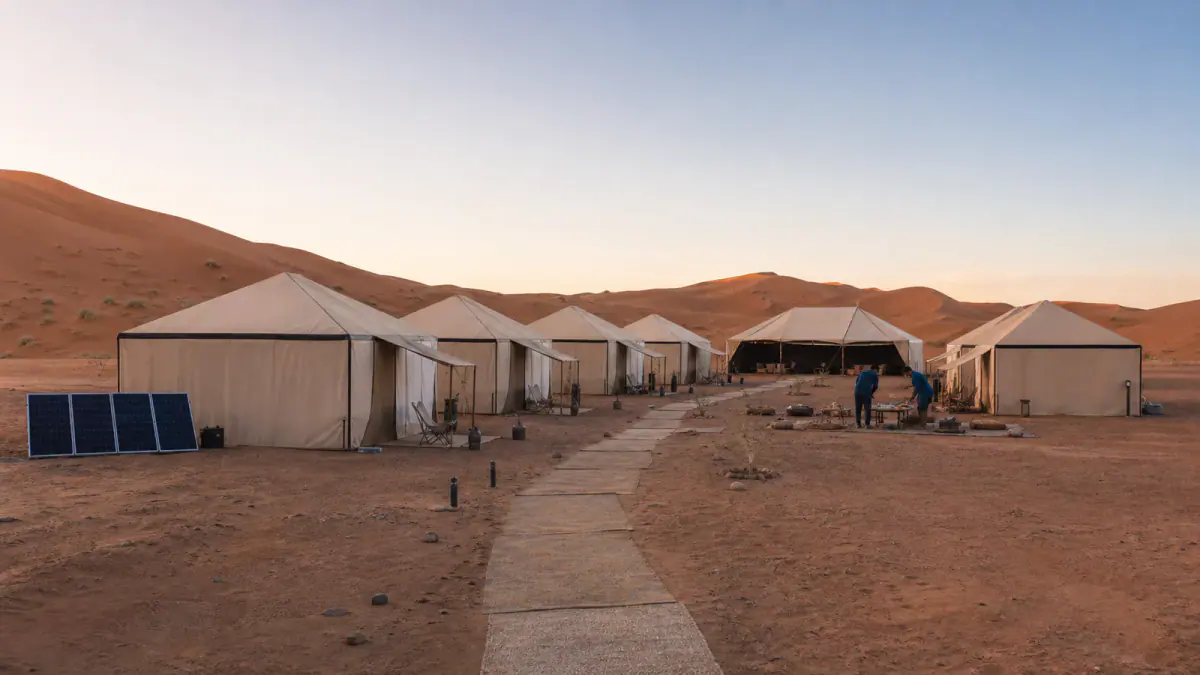
Do not imagine that every Merzouga camp sits alone beyond the horizon. Ask for a map pin and check nearby structures. Our desert camp booking guide explains how to evaluate the exact tent and location.
Mhamid and Erg Chigaga
Mhamid sits near the end of the paved approach down the Draa Valley. Erg Chigaga lies beyond, typically requiring a track transfer.
The landscape can feel less concentrated than Merzouga, but “remote” is not automatically better. It means stronger dependence on vehicle condition, driver judgment, communications, water planning and weather.
Choose Mhamid or Chigaga when:
- you have more time;
- the Draa Valley matters;
- a longer off-road transfer is acceptable;
- you want a less developed camp zone;
- the operator can explain emergency and environmental systems.
Ask where the booking begins. A camp rate may exclude transport from Mhamid, Zagora or Marrakech.
Zagora and the Draa Valley
Zagora is often marketed as the quick Sahara trip from Marrakech. The route can be excellent, but its strengths are broader than a dune photograph: earthen architecture, palm groves, dry mountains, oasis settlements and Draa Valley landscapes.
Choose Zagora when:
- two or three days are available;
- the road and valley are part of the goal;
- a simple desert-edge camp is enough;
- you understand that the dunes may be smaller.
Do not accept photographs of Erg Chebbi as proof of what a Zagora camp looks like.
The official Ouarzazate–Zagora–Tinghir destination page presents the southern region as a combination of valleys, gorges, kasbahs and arid scenery. That diversity is the reason to visit.
Agafay Is Not the Sahara
Agafay lies near Marrakech and offers a rocky, dry landscape with camps, meals and sunset experiences. It is useful when a multi-day journey south is impossible.
Choose Agafay for convenience and hospitality. Do not call it a shortcut to Erg Chebbi or expect high Saharan dunes. Honest geographic language helps both destinations.
An Oasis Is a Living Water System
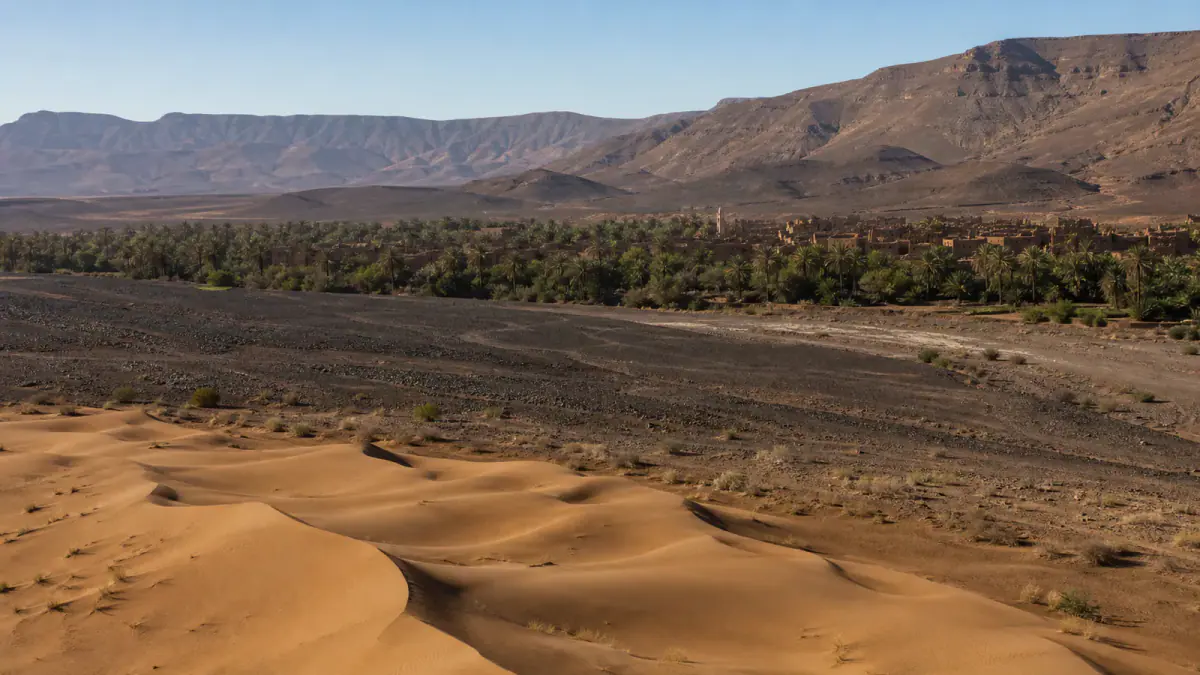
The word “oasis” often suggests a small pool and a few palms. Southern Moroccan oases are more complex. They combine water management, layered agriculture, settlement and social organization.
Date palms create upper shade. Fruit trees and crops can grow beneath them, depending on water and local conditions. Channels distribute scarce water; underground khettara systems historically moved it by gravity from higher ground.
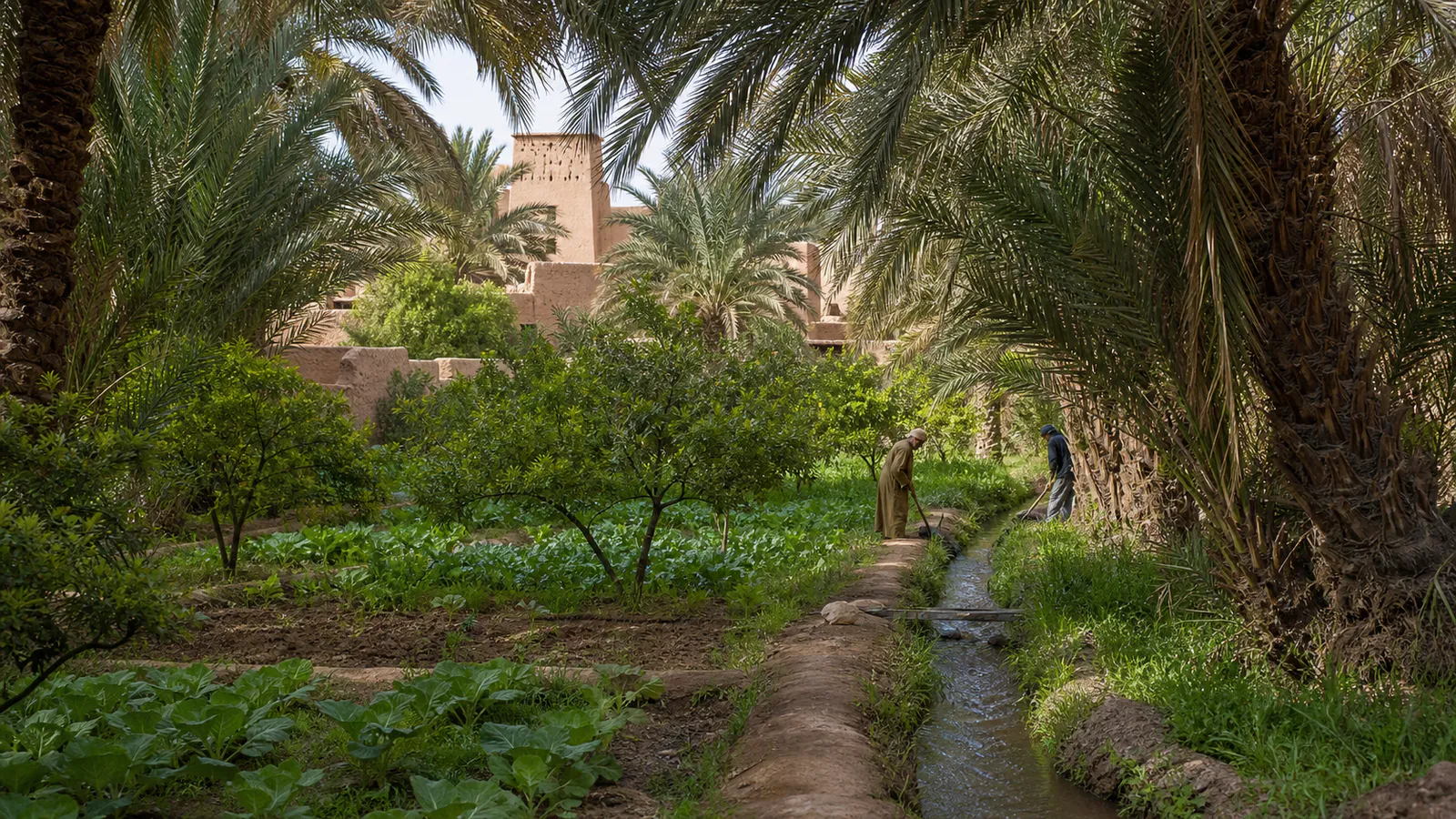
Illustrative view of a working oasis landscape; access to farms and water channels requires local permission.
UNESCO’s Oasis du Sud Marocain Biosphere Reserve covers a vast range from Mediterranean conditions to hyper-arid Sahara and emphasizes the role of oasis systems in biodiversity, agriculture and local livelihoods.
Its Morocco water heritage feature explains how khettaras carry groundwater toward agricultural land.
Visitors should not walk along channels, enter plots or pick dates without permission. Water infrastructure is not a decorative trail.
The Sahara Is Inhabited
Desert tourism sometimes describes nomadic culture as timeless or untouched. That language freezes living people into a visitor’s fantasy.
Communities across southeastern Morocco have long histories of movement, agriculture, herding, trade and settlement. Today, residents may combine guiding, driving, hospitality, farming, crafts, wage work, education and digital communication.
A guide wearing traditional clothing is not evidence that the person’s life exists outside the modern world. A music performance at camp may be genuine work and hospitality, but it does not represent one uniform “Saharan culture.”
Ask people how they describe their own community. Use Amazigh, Arab, Sahrawi or other terms only when context supports them rather than applying one label to everyone south of the Atlas.
Caravans, Oases and Trade
Morocco’s desert-edge towns developed through regional exchange, political power and movement across North and West Africa. Routes carried salt, gold, textiles, books and many other goods, while also participating in histories of slavery that should not be romanticized.
The Tafilalet region around Rissani holds particular historical importance, including connections to the Alaouite dynasty and trans-Saharan exchange. A local guide or museum can add context beyond a quick market photograph.
Avoid reducing caravan history to a camel silhouette. Trade shaped languages, food, architecture, family networks and religious scholarship as well as transport.
What Does a First Sahara Trip Feel Like?
The road is longer than many visitors expect. Arrival may occur after hours of mountain, valley and plateau travel. Sand can enter bags and cameras. Wind can remove the sunset view. The camp may be closer to a road than photographs imply.
At the same time, small changes can become memorable:
- shadow moving across one dune;
- temperature dropping after sunset;
- a quiet walk before vehicles arrive;
- the contrast between palms and gravel;
- a sky with less urban light;
- morning work beginning in a village.
The desert is strongest when the trip leaves room for observation instead of forcing every advertised activity into one night.
How Many Days Do You Need?
This page does not repeat full route schedules, but the basic principle matters: the Sahara is not a sensible day trip from Marrakech or Fes.
Allow enough time for the southern journey and avoid returning over the same road immediately where possible. A Marrakech–Merzouga–Fes route can use the desert as a bridge between cities.
Use our Morocco desert routes guide for realistic day-by-day comparisons. It owns the transport intent for this article cluster.
Best Time for a First Visit
No month guarantees comfort.
Autumn
Autumn often brings more manageable daytime conditions than summer. Nights become cooler as the season advances.
Winter
Days can be pleasant while nights feel very cold, particularly in exposed tents. Ask how heating works after generators or solar systems stop supplying power.
Spring
Spring can be comfortable but windy periods and blowing sand are possible. Rain elsewhere can affect roads and channels.
Summer
Extreme daytime heat can make normal activity unsafe. A camp tent may remain hot after sunset. Choose the season rather than assuming air-conditioning solves the environment.
Use the Morocco General Directorate of Meteorology for current forecasts and ask the operator about the exact route and camp. Our Morocco weather guide provides broader regional planning.
Temperature Swings and Clothing
The word “desert” does not mean permanently hot. Dry air, exposure, elevation and season can produce a strong change between afternoon and night.
Bring:
- breathable daytime layers;
- warm layer appropriate to the month;
- wind protection;
- sun hat and sunglasses;
- sunscreen and lip protection;
- closed footwear;
- scarf or buff for dust;
- small overnight bag.
Do not rely on a decorative camp blanket as the only cold-weather plan. Confirm bedding and heating.
Heat, Hydration and Health
Heat illness can begin before a traveler recognizes it. Reduce activity in the strongest heat, drink regularly and replace salts appropriately according to professional health guidance.
Travelers with respiratory conditions should consider dust, wind and campfire smoke. Those who require powered medical equipment need written confirmation of power capacity and backup.
Road fatigue matters too. Long transfers increase discomfort, dehydration and risk. A driver’s ability to rest is part of safety.
Seek individualized medical advice from an appropriate clinician. A travel article cannot judge whether heat, camel riding, remote access or a particular activity is suitable for one person.
Wind, Sand and Electronics
Fine sand reaches camera controls, phone ports and bag zippers. Use a sealable pouch, avoid changing lenses in blowing sand and clean equipment with appropriate tools rather than grinding particles into surfaces.
Wind can cancel camel rides, reduce visibility or change a camp transfer. This is not a service failure when the operator makes a safety decision.
Protect eyes with glasses and avoid rubbing them with sandy hands.
Flash Floods in Dry Country
Rainfall may be infrequent, but dry channels can flood rapidly. Water can arrive from a storm beyond the visible horizon.
Never camp, park or walk in a channel because it is currently dry. Follow local authorities and professional drivers. Mountain and secondary roads can also become hazardous during poor weather.
Current UK Morocco safety advice warns about flash flooding after heavy rain, hazardous mountain roads and the need for appropriate preparation and insurance for outdoor activities. Consult your own government’s guidance as well.
Wildlife and Plants
The desert is not biologically empty. Reptiles, insects, birds, mammals and plants survive through specialized behavior and water use.
Do not:
- handle snakes or scorpions;
- feed wildlife;
- remove plants, fossils, rocks or pottery;
- walk barefoot around camp at night;
- place hands under stones;
- approach nests or burrows;
- pay for harmful wildlife displays.
Shake out footwear and use a light after dark. Serious incidents are uncommon for many visitors, but basic caution is easy.
UNESCO notes the southern oasis reserve’s importance for Moroccan biodiversity. Tourism should not turn that biodiversity into props.
Stars and Night Photography
Desert skies can be impressive, but perfect stars are not guaranteed. Moon phase, cloud, dust, camp lights and nearby development affect visibility.
For a quieter night:
- ask when camp lights are reduced;
- move only along safe known paths;
- use a dim red light where practical;
- avoid shining lights at other guests;
- keep noise low;
- do not walk alone far beyond camp boundaries.
For photography, stabilize the camera and use manual settings rather than climbing an unfamiliar dune in darkness. Protect equipment from sand and condensation when moving between temperatures.
Photographing People Respectfully
Ask before photographing a guide, driver, musician, farmer, vendor or child. Consent to one portrait does not mean permission to publish it commercially.
Avoid:
- photographing private homes from close range;
- treating poverty or reconstruction as visual texture;
- staging children with gifts;
- interrupting work;
- representing a paid performance as a secret encounter;
- using “nomad” as a costume caption without context.
Landscape photographs also require care. Stay off cultivated plots and fragile dune-margin vegetation.
Camel Rides Are Optional
Camel transport is not required to experience the Sahara. A 4x4 transfer, dune walk or dune-edge hotel may suit mobility, health or welfare concerns better.
If considering a ride, observe body condition, tack, load, handling and rest. Decline if an animal appears injured or distressed.
Our Morocco desert activities guide owns the detailed comparison of camel riding, walking, sandboarding, 4x4 excursions and other experiences.
Desert Camps Are Not Automatically Sustainable
A remote tent still requires water, food, energy, waste removal and staff transport. Solar panels and canvas walls do not prove low impact.
Ask:
- Where does water come from?
- How are sewage and greywater handled?
- Is waste removed to a managed system?
- Are vehicle routes concentrated?
- How long do generators run?
- Are staff locally employed and fairly paid?
- Does the camp expand onto undisturbed land?
Use established paths and avoid single-use items where practical. Shorten showers even when they are included in a luxury rate.
UNESCO has documented water stress and environmental change affecting southern Moroccan oases. The green palm corridor is not an unlimited resource.
Visiting Oases Respectfully
An oasis is a workplace and neighborhood.
- Use public or guided paths.
- Ask before entering gardens.
- Do not step across irrigation walls.
- Keep soap and chemicals out of channels.
- Do not demand to enter a house.
- Buy dates or produce through an invited transaction.
- Carry litter out.
- Use water sparingly.
A local guide can explain agriculture and history while setting boundaries.
Common First-Time Misconceptions
“Every desert in Morocco has tall dunes”
Most arid land is not a dune sea. Choose a named erg when dunes matter.
“Zagora is a closer version of Merzouga”
It is a different landscape and route, not the same product at a shorter distance.
“Agafay is in the Sahara”
It is a rocky arid destination near Marrakech and should be chosen on its own terms.
“Remote means untouched”
Roads, camps, water use and vehicle tracks create impact even when no city is visible.
“Nomadic culture has not changed”
Desert communities are contemporary and diverse.
“The dunes are empty”
They are habitats, routes, workplaces and tourism spaces.
“A clear sky means no flood risk”
Rain upstream can affect a dry channel.
First-Time Readiness Checklist
- Identify whether your destination is Merzouga, Zagora, Mhamid or Agafay.
- Check the landscape in recent, location-specific images.
- Allow enough days for the road.
- Confirm the exact camp or hotel map pin.
- Verify transfer, bathroom, heating, power and meals.
- Check live weather and road information.
- Carry layers, sun protection, water and medication.
- Keep camel riding optional.
- Ask before photographing people.
- Stay out of channels, fields and private spaces.
- Understand waste and water practices.
- Keep insurance and contacts offline.
Final Takeaway
The Moroccan Sahara becomes more interesting when it stops being one postcard. Dunes are only one landform. Oases are engineered agricultural communities. Desert towns and guides participate in modern life, and remoteness does not remove environmental impact.
Choose Merzouga for straightforward Erg Chebbi access, Mhamid for a longer Chigaga journey, Zagora for Draa Valley context, or Agafay for a nearby rocky escape. Then arrive with enough time to notice the transitions between mountain, stone, water, palms and sand.
That understanding will not guarantee perfect weather or an empty horizon. It will give you a more honest first Sahara trip.