The hardest part of a Morocco desert trip is not choosing a tent. It is designing a route that leaves enough time outside the vehicle. Merzouga, Zagora and Mhamid sit far from Marrakech, Fes and the Atlantic cities, and a cheap two-day tour can turn a dream into two long drives with one hurried sunset.
This guide compares the useful road patterns, realistic minimum trip lengths, shared and private transport, camp transfers and booking questions. It does not rank camel rides or sandboarding; those belong in the separate activity guide.
Quick answer: Allow four days for Marrakech to Merzouga and back, or use a four-day Marrakech–Merzouga–Fes open-jaw route to avoid retracing the same road. From Fes, three days gives Merzouga a more comfortable rhythm. Choose Zagora for a two-day Draa Valley taste, not as a substitute for Erg Chebbi’s tall dunes.
Morocco Desert Routes at a Glance
| Route | Compressed minimum | Better pace | Best for |
|---|---|---|---|
| Marrakech–Merzouga–Marrakech | 3 days / 2 nights | 4 days / 3 nights | Classic dunes plus High Atlas road |
| Marrakech–Merzouga–Fes | 3 days / 2 nights | 4 days / 3 nights | Open-jaw Morocco itinerary |
| Fes–Merzouga–Fes | 2 days / 1 night | 3 days / 2 nights | Shorter access to Erg Chebbi |
| Marrakech–Zagora–Marrakech | 2 days / 1 night | 3 days / 2 nights | Draa Valley and limited time |
| Marrakech–Mhamid/Erg Chigaga | 3 days / 2 nights | 4–5 days | Remote tracks and slower south |
| Arrive Merzouga independently | Depends on origin | 2 nights near dunes | Flexible camp and activity choice |
“Minimum” means physically possible under ordinary conditions, not enjoyable for everyone. Weather, road works, mountain conditions, traffic and pickup delays can extend travel.
First Choose the Landscape
The route should follow the landscape you actually want.
Merzouga and Erg Chebbi
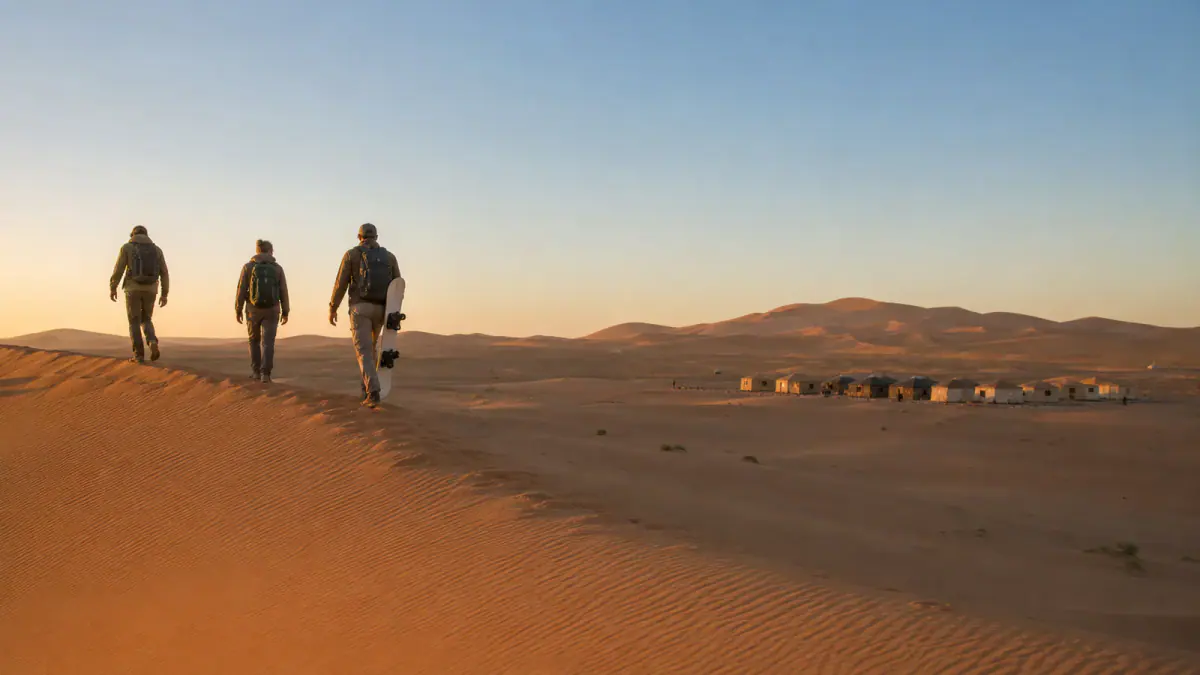
Choose Merzouga for the most straightforward access to tall dune scenery, a large range of camps and an itinerary that can connect Marrakech with Fes. The Moroccan National Tourist Office describes the Errachidia–Midelt–Merzouga region as a meeting of mountains, palm groves, tracks and the Erg Chebbi dunes.
Merzouga is not one isolated camp. The dune edge includes villages, hotels, guesthouses and different camp zones. Ask for the exact meeting point and camp location rather than accepting “Merzouga desert” as an address.
Zagora
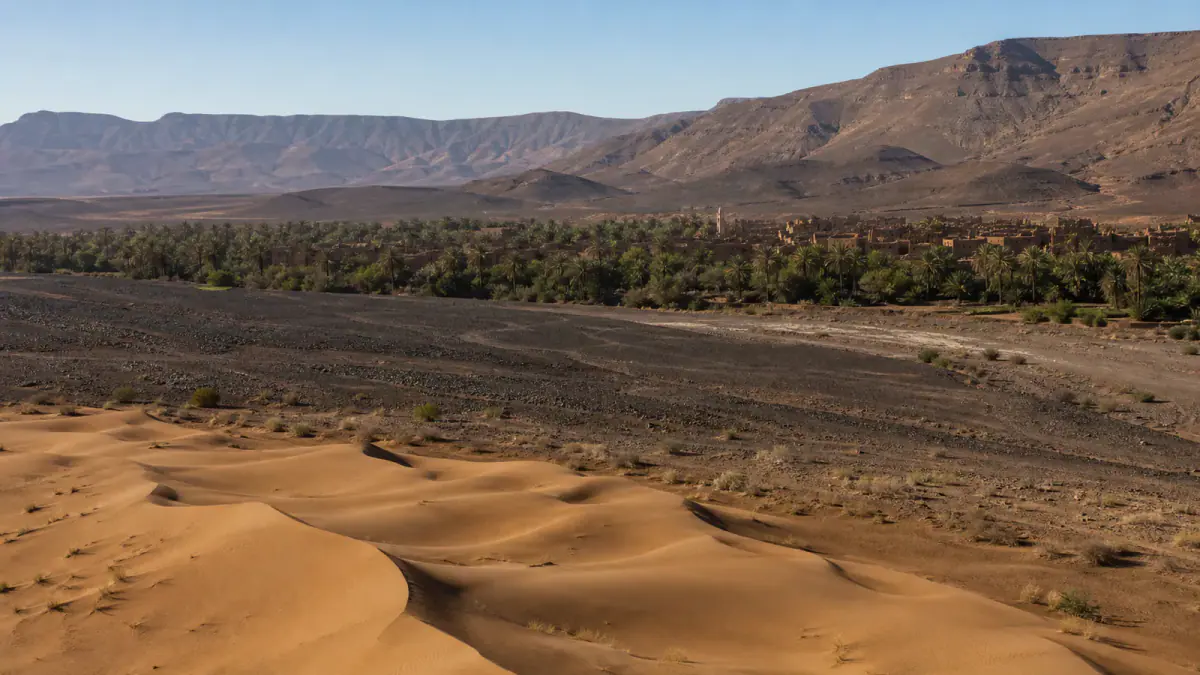
Choose Zagora when two days from Marrakech is the hard limit and the Draa Valley road matters as much as the camp. The area has arid landscapes, palm groves, kasbah architecture and smaller dune experiences.
Do not book Zagora expecting the tall sweeping dunes shown in every Sahara advertisement. The route can be worthwhile precisely because it is a road-and-valley journey.
Mhamid and Erg Chigaga
Mhamid sits near the end of the paved approach into the south. Erg Chigaga generally requires a track transfer and more time. Choose it for a less concentrated camp environment and a journey where remoteness is part of the point.
The tradeoff is complexity: longer transfers, more reliance on a capable driver, fewer last-minute alternatives and greater sensitivity to weather and vehicle condition.
Agafay
Agafay is a rocky landscape outside Marrakech, not the Sahara and not an Erg Chebbi substitute. It is useful for a sunset meal or camp night when you cannot make a multi-day southern journey.
Be honest about the goal. If you want a convenient landscape break, Agafay can work. If your trip is built around high dunes, save enough days for Merzouga or Chigaga.
Route 1: Marrakech to Merzouga and Back
This is the most commonly sold desert circuit and the one most often compressed too aggressively.
Three-Day Version
A typical compressed structure is:
- Day 1: cross the High Atlas, continue toward Ouarzazate and a valley overnight;
- Day 2: drive through southeastern Morocco to the Merzouga edge, then transfer to camp;
- Day 3: leave after breakfast and return all the way to Marrakech.
The weakness is the final day. After sunrise, travelers face a very long road back. Stops become functional, not exploratory, and delays can push arrival late.
Choose this version only when budget and schedule are fixed, you tolerate long drives and the camp night matters more than a relaxed road journey.
Four-Day Version
The additional day lets the route breathe:
- Day 1: Marrakech to Ouarzazate or a nearby valley;
- Day 2: Dades/Todra region or southeastern road with meaningful stops;
- Day 3: reach Merzouga with time before camp transfer;
- Day 4: return to Marrakech, or continue elsewhere if arranged.
Four days does not make the distances short, but it separates major road sections and gives the landscape more than a photo-stop role.
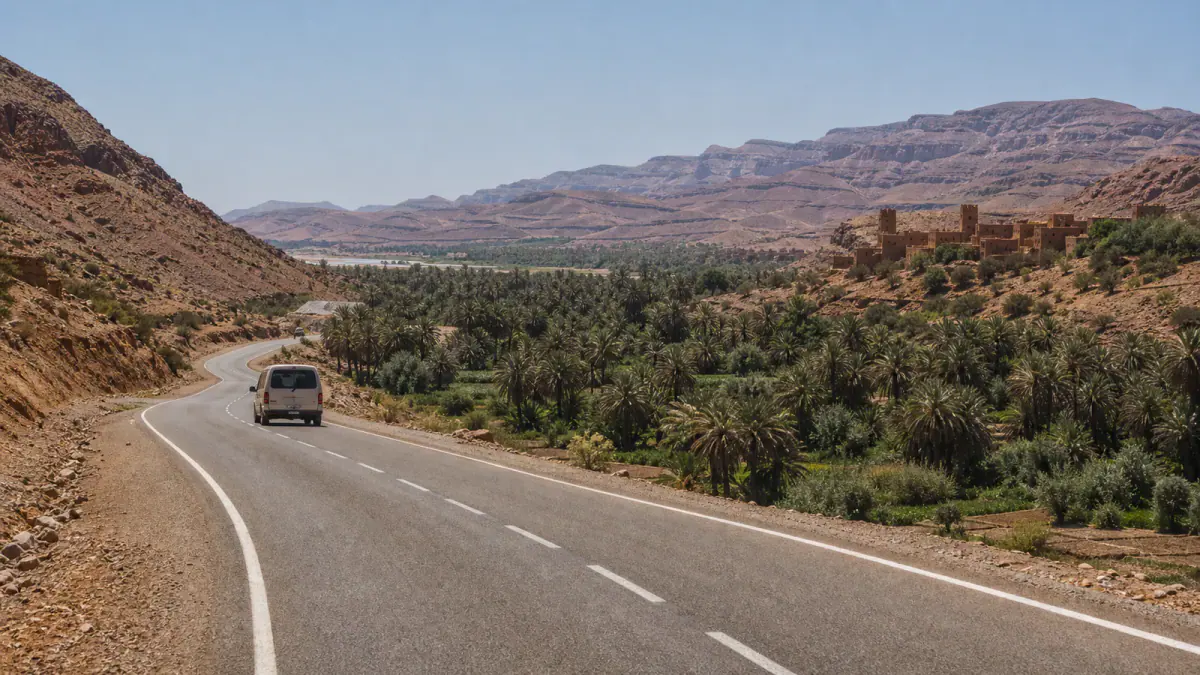
The official tourism board’s Ouarzazate–Zagora–Tinghir page shows why the approach matters: valleys, gorges, kasbahs and arid plateaus form a destination region of their own.
Route 2: Marrakech to Merzouga to Fes
An open-jaw route is often the best answer for a first Morocco circuit. Instead of returning west over the same road, continue north through the Ziz Valley, Errachidia and Middle Atlas toward Fes.
A comfortable four-day outline is:
- Day 1: Marrakech to Ouarzazate or Dades area;
- Day 2: Dades/Todra and southeastern route;
- Day 3: Merzouga arrival, dune time and camp night;
- Day 4: Merzouga edge to Fes.
The final day remains long, but every main road section moves the wider trip forward. You also see the environmental transition from desert edge through upland landscapes toward Fes.
This route works well in either direction:
- Marrakech → Merzouga → Fes; or
- Fes → Merzouga → Marrakech.
Ask whether the tour genuinely ends in the second city or merely drops you into another vehicle. Confirm baggage limits, arrival estimate and the exact endpoint.
Do not book a non-refundable Fes departure for the same evening. Mountain weather, traffic and road delays make a tight connection irresponsible.
Route 3: Fes to Merzouga
Fes is a practical starting city for Erg Chebbi. The approach passes through changing elevations and the Ziz corridor before reaching the desert edge.
Two-Day Version
Driving from Fes, transferring to camp, sleeping and returning the next day is possible but road-heavy. The desert portion becomes a short interval between two transfers.
Use this only for a firm schedule or as a one-way move onward to Marrakech.
Three-Day Version
Three days allows:
- one measured journey south;
- one camp night plus time near the dune edge;
- a return or onward travel day without combining every stop.
It is especially useful if you want a daytime village, market, geology or oasis experience in addition to sunset and sunrise.
For Fes arrival and accommodation logistics before the route begins, use our practical Fes travel guide.
Route 4: Marrakech to Zagora
The two-day Zagora route often follows the High Atlas and Draa Valley before a modest camp experience.
A realistic structure is:
- Day 1: long drive through mountain and valley landscapes, late desert-edge transfer, camp;
- Day 2: breakfast, return with selected stops, Marrakech arrival.
The road is the main experience. If a sales page mentions only “Sahara dunes and camel sunset,” it is hiding the proportion of time spent traveling.
Three days makes Zagora more interesting because you can slow down in the Draa Valley, explore earthen architecture with permission and avoid treating every place as a ten-minute van stop.
Choose this route for:
- limited time;
- interest in oasis and valley scenery;
- a first camp night;
- travelers who understand the dunes are smaller.
Do not choose it solely because an operator labels it “the same desert, closer.”
Route 5: Mhamid and Erg Chigaga
Mhamid and Chigaga require a stronger logistics conversation. Clarify:
- where paved-road travel ends;
- which vehicle handles the track;
- whether the same driver stays with the group;
- recovery equipment and communication;
- how weather affects access;
- emergency and breakdown planning;
- exact camp coordinates or zone;
- water and fuel capacity.
Four or five days from Marrakech gives this route a better rhythm. It can pair with Draa Valley stops and more than one night in the south.
Remote does not automatically mean environmentally responsible or culturally respectful. Ask how the camp handles waste, water and vehicle tracks.
Shared Tour, Private Driver, Rental Car or Public Transport?
Shared Minibus Tour
Shared tours lower the cost and solve accommodation and transfer coordination. They also create the least control.
Before booking, ask:
- maximum group size;
- vehicle seating layout and air conditioning;
- hotel pickup zone;
- number and purpose of shopping stops;
- room type on the non-camp night;
- which camp is used;
- final arrival range;
- cancellation when roads are affected.
A low headline price may rely on commissions, basic rooms or a camp different from the photographs.
Private Driver
A private driver gives control over start times, rest stops and route pace. It is the best option for families, photographers, mobility needs and open-jaw routes.
Private does not mean unlimited. Drivers need safe rest, and weather still controls the road. Agree on daily endpoints rather than demanding every optional stop.
Confirm whether the quote includes:
- driver accommodation and meals;
- fuel and tolls;
- parking;
- local guides;
- entrance fees;
- camp transfer;
- passenger insurance;
- one-way vehicle return cost.
Rental Car
Self-driving provides flexibility on paved roads. It also shifts navigation, fatigue, insurance and breakdown responsibility to you.
The UK government’s current Morocco road-safety advice warns about poor lighting at night and hazards on secondary and mountain roads in bad weather. Avoid planning long after-dark stages.
Check:
- whether the rental contract permits the intended roads;
- tire and spare condition;
- fuel range;
- roadside-assistance coverage;
- insurance exclusions;
- parking at each hotel;
- whether the camp meeting point is reachable by normal car.
Do not drive onto dunes or remote tracks because a map app draws a line. Park at the agreed edge and use the camp transfer.
Public Transport Plus Local Transfer
Independent buses can reach desert-edge towns, followed by guesthouse or camp pickup. This works for flexible travelers staying at least two nights.
Advantages include lower cost and choosing the camp independently. The tradeoffs are fixed schedules, terminal logistics and the need to coordinate a late or early local transfer.
Use the transport operator’s current official timetable. Send arrival details to the accommodation and confirm what happens if the bus is delayed.
Camp Transfer: The Detail Most People Miss
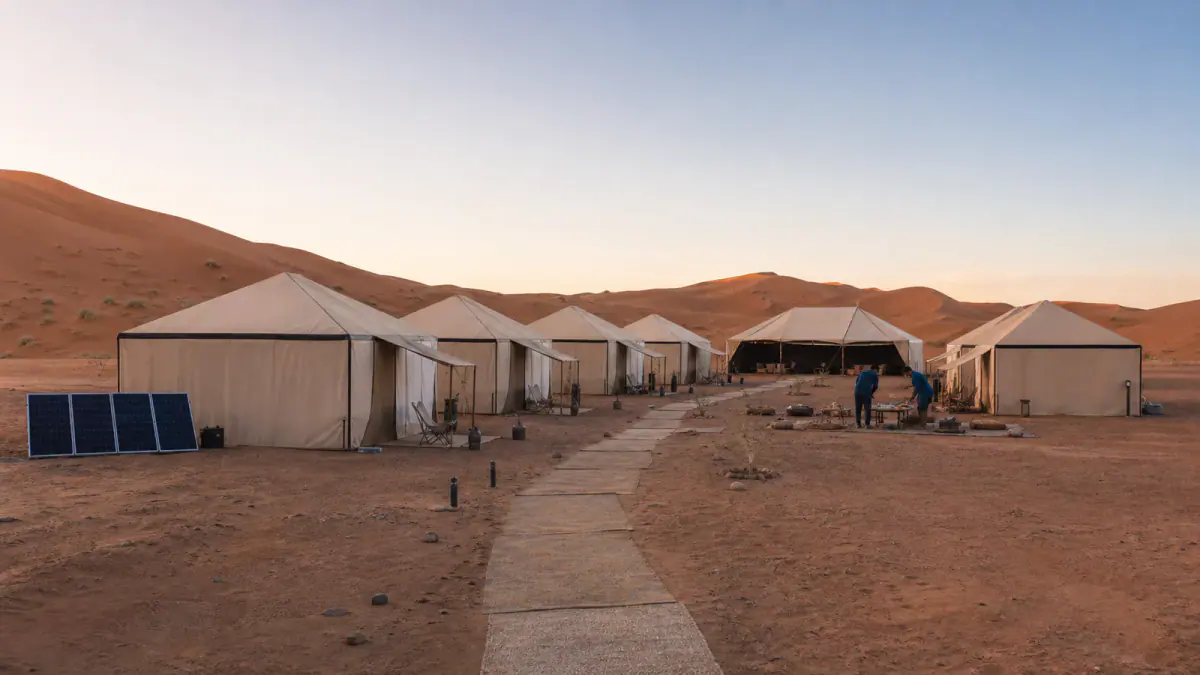
Many camps cannot be reached by an ordinary road vehicle. The reservation should explain where you leave the main vehicle, what you carry, and how you reach the tent.
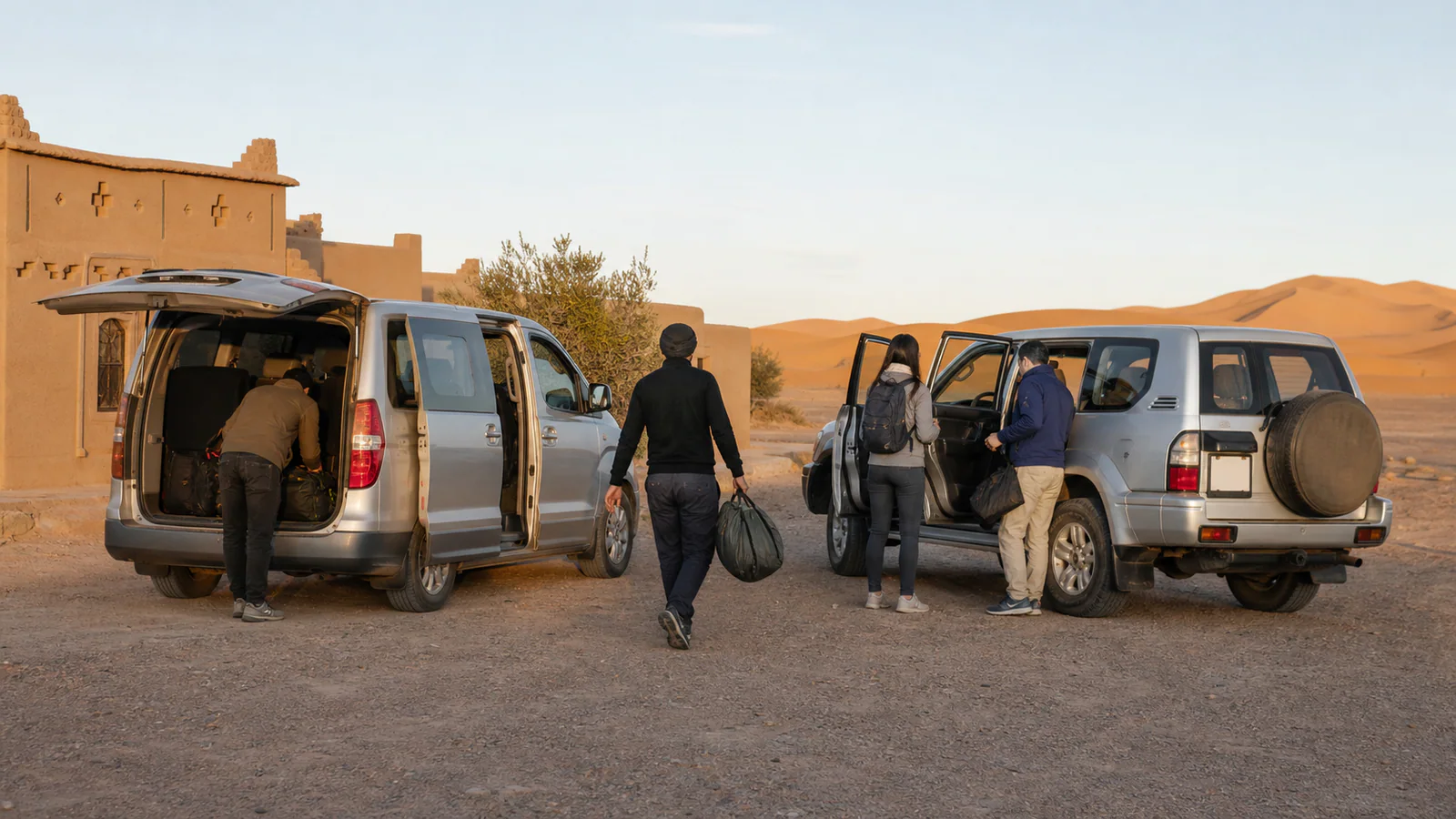
Ask:
- What is the exact meeting point?
- Is secure storage available for the main suitcase?
- Is transfer by camel, 4x4 or either?
- How long does it take?
- Is transfer included both ways?
- What happens in strong wind or rain?
- Can a traveler with limited mobility reach the tent?
- Does a late arrival miss sunset or dinner?
Pack one small overnight bag. Keep passport, medication, electronics and valuables with you. Do not assume a large hard-shell suitcase fits safely in a 4x4 or on an animal.
How to Read a Desert Tour Itinerary
Sales pages often describe every village and viewpoint as a visit. Translate the language:
- “Panoramic stop” may mean ten minutes beside the road.
- “Visit a kasbah” may mean an exterior photo unless entry is named.
- “Camel trek” may be a short transfer.
- “Luxury camp” does not define bathroom, heating or power.
- “Private tour” may mean private vehicle but shared camp.
- “Local guide” may be optional and separately paid.
- “Three-day tour” often includes two major road days and one camp night.
Request the overnight towns, named camp, included admissions and approximate driving blocks in writing.
Camp Questions Without the Marketing Language
This route page does not rank camps, but transport and camp logistics cannot be separated completely.
Confirm:
- permanent or seasonal tent;
- private or shared bathroom;
- hot-water system;
- heating, extra blankets and summer ventilation;
- electricity hours and charging;
- dinner and breakfast;
- dietary-allergy process;
- number of tents;
- distance between tents and bathroom;
- quiet hours;
- waste and wastewater handling;
- emergency vehicle access.
“Luxury” has no universal technical standard. A private bathroom may still have limited water, and heating may be a portable unit used only at certain hours.
Road Safety and Weather
The High Atlas crossing and southeastern roads are real transport corridors with trucks, villages, construction and changing weather. Beautiful scenery does not remove risk.
Build safety into the itinerary:
- avoid unnecessary night driving;
- use seat belts;
- do not pressure a driver to recover lost time;
- schedule food and bathroom breaks;
- keep water accessible in the vehicle;
- carry motion-sickness medication if appropriate;
- check forecasts and road reports locally;
- leave buffer before flights and trains.
Heavy rain can cause flooding in valleys and affect roads. Snow and ice can affect high mountain sections in winter. Strong wind and dust can change camp transfers.
A legitimate operator changes the plan when conditions require it. Refusing an unsafe shortcut is good service.
Best Season for Each Route
Morocco’s tourism office identifies spring and autumn as the best seasons for the desert. They generally balance daytime walking and nighttime comfort, though busy dates can increase prices.
Winter
Days may be pleasant, nights cold and High Atlas conditions variable. Ask about heating and road contingency.
Spring
Comfortable overall, with possible wind and sand. Holiday demand matters.
Summer
Heat can dominate every decision. Long vehicle hours, camp tents and midday stops may become uncomfortable or unsafe. Do not choose summer merely because the price is lower.
Autumn
Often comfortable, but storms and flash-flood risk can occur. Local road information still matters.
Route Planning for Families
Children experience a “scenic drive” as a long time in a seat. Favor four days, private transport and hotels with predictable bathrooms.
Ask about:
- child seats;
- seat belts in every row;
- maximum nonstop driving block;
- food flexibility;
- tent distance from bathrooms;
- sand temperature;
- camel age and rider policy;
- emergency medical access.
A two-day Zagora trip may be shorter in calendar days but still contain demanding road blocks.
Mobility, Pregnancy and Health
Desert routes involve vehicle steps, uneven rest areas, camp paths and soft sand. Share needs before paying.
Request:
- door-to-door vehicle details;
- 4x4 instead of camel transfer;
- tent near common facilities;
- minimal-step bathroom;
- firm path information;
- refrigeration or power for medication;
- additional rest stops.
Travelers with heart, respiratory, heat-related or mobility concerns should obtain personal medical advice. A camp’s “suitable for everyone” claim is not individualized guidance.
What to Pack in the Vehicle
Keep these with you rather than buried under luggage:
- water;
- sun protection;
- warm layer;
- snacks;
- medication;
- tissues and hand sanitizer;
- charging cable and power bank;
- motion-sickness supplies;
- passport and money;
- offline booking documents;
- headlamp for late arrival.
Pack dust-sensitive electronics in sealed bags. Keep a small overnight kit ready so the camp transfer does not require opening every suitcase.
Responsible Stops Along the Road
Roadside visits can support local guides, cafes, cooperatives and heritage conservation when the relationship is transparent.
Avoid:
- photographing residents without asking;
- entering homes because a driver claims they are “nomads”;
- buying fossils or artifacts of unclear legal origin;
- leaving rubbish at viewpoints;
- pressuring children to pose;
- assuming every cooperative is member-owned without evidence.
Spend where value is real: a knowledgeable local guide, a meal, a well-made product or a legitimate admission. A stop should offer more than a commission handoff.
How the Sahara Content Cluster Works
This URL owns road sequence, trip length, tour type and camp transfer.
Use the complete Moroccan Sahara destination guide to choose between Merzouga, Zagora and Mhamid at a broader level.
Use the Morocco desert activities guide for camel rides, dune walking, stargazing, sandboarding and low-impact behavior after arrival.
For the mountain geography crossed from Marrakech, our Atlas Mountains regional guide explains the High, Middle and Anti-Atlas without turning them into roadside scenery.
Frequently Asked Questions
How many days from Marrakech to Merzouga?
Three days is a compressed common minimum. Four days provides a much better pace. An open-jaw finish in Fes avoids repeating the entire road to Marrakech.
Is Fes closer to Merzouga than Marrakech?
Fes provides a more direct northern approach to Erg Chebbi, but it is still a long road journey. Allow three days for a comfortable return trip or use Merzouga as a bridge between Fes and Marrakech.
Is a two-day Sahara tour from Marrakech worth it?
Choose two days for Zagora and the Draa route, understanding that dune scale and road time differ from Merzouga. Two days to Merzouga is too compressed for most travelers.
Can I drive a rental car to the camp?
Usually you drive to a named desert-edge meeting point, hotel or parking area and use a camp transfer. Do not enter tracks or dunes without contract permission and local guidance.
Should I carry my full suitcase to camp?
No. Arrange secure storage and take one small overnight bag unless the camp gives different instructions.
Which is better: shared or private tour?
Shared tours suit tight budgets and fixed itineraries. Private transport gives more control, better support for families and mobility needs, and easier open-jaw routing.
Can road delays affect my flight?
Yes. Do not schedule a desert return and international flight with a narrow same-day buffer.
Final Takeaway
A successful Morocco desert route begins with honest arithmetic: long roads, one or more mountain crossings, a final camp transfer and the need to arrive with energy left for the dunes.
Give Merzouga four days from Marrakech when possible, consider an open-jaw finish in Fes, and treat Zagora as its own Draa Valley experience. Confirm every transfer, overnight and arrival point in writing. The road should reveal southern Morocco—not make you wish the trip were over.