The best hidden gems in Chefchaouen are not secret blue doors guarded by an insider. They are quieter sections of the hillside medina, ordinary workshops, small viewpoints and changes in timing that let you see the city as a lived-in Rif Mountain town. Begin early, walk uphill with patience, and leave the busiest photo lanes before they become the whole story.
This guide gives you a practical half-day walking route from Place Outa el-Hammam through the upper medina to Ras El Ma, followed by an optional climb toward the Spanish Mosque viewpoint. It also explains when the Kasbah is worth entering, how to photograph private streets respectfully, and why Akchour needs a separate day.
Route at a glance: Outa el-Hammam → Kasbah → eastern and upper medina lanes → Bab Onsar area → Ras El Ma → Bouzâafar/Spanish Mosque viewpoint → return for lunch. Allow about four hours with pauses, more if you enter the Kasbah or stop often.
What “Hidden Gem” Really Means Here
Chefchaouen’s medina is compact. A place mentioned online is rarely hidden for long, and promising an empty street at midday is unrealistic. The useful distinction is between:
- a landmark visited at a quieter hour, such as the Kasbah garden or Ras El Ma;
- a residential area where visitors must behave like guests, not stage a photo shoot;
- a view that requires an uphill walk, which naturally filters out hurried groups;
- a small craft encounter, where the value is conversation and workmanship rather than a famous shop name;
- a separate nature excursion, such as Akchour or Talassemtane National Park.
The route below avoids fabricated “local secrets.” It gives you a framework for wandering without turning private homes into attractions.
Before You Start
| Question | Practical answer |
|---|---|
| Best starting time | Around 8:00–9:00 for calm lanes and usable morning light |
| Time needed | 3–5 hours for the medina route; a full day for Akchour |
| Difficulty | Short distance but frequent steps, slopes and uneven paving |
| Shoes | Closed walking shoes or sandals with reliable grip |
| Navigation | Offline map for orientation, then follow public lanes and signs |
| Best stay | At least one night, so you can walk before day visitors arrive |
| Main etiquette | Do not pose against private doors or photograph people without permission |
If rain has made the stone slick, shorten the route. Chefchaouen’s blue lanes look gentle in photographs, but the town is built on a slope and polished steps can be tiring.
Stop 1: See Outa el-Hammam Before It Gets Busy
Place Outa el-Hammam is not hidden, but it is the best orientation point. Visit before cafe terraces fill and look at how the square connects the Kasbah, Grand Mosque exterior and several medina lanes. The calm morning version helps you understand the town instead of merely passing through its busiest room.
Do not build the whole visit around a restaurant terrace here. The square is useful for a first coffee or final rest, while the side lanes provide a better sense of scale and daily movement.
Should you enter the Kasbah?
The Moroccan National Tourist Office describes the Kasbah as a garden retreat within the old quarter and notes its museum collection of historic weapons, photographs and textiles. Enter if you enjoy small museums, walls and town views; skip it if your priority is a long nature walk and you have limited time.
Opening arrangements and admission can change. Check the entrance board on the day rather than relying on an old blog price. Even without entering, pause outside to notice the contrast between the earth-colored fortress and the blue medina.
Stop 2: Leave the Main Photo Circuit
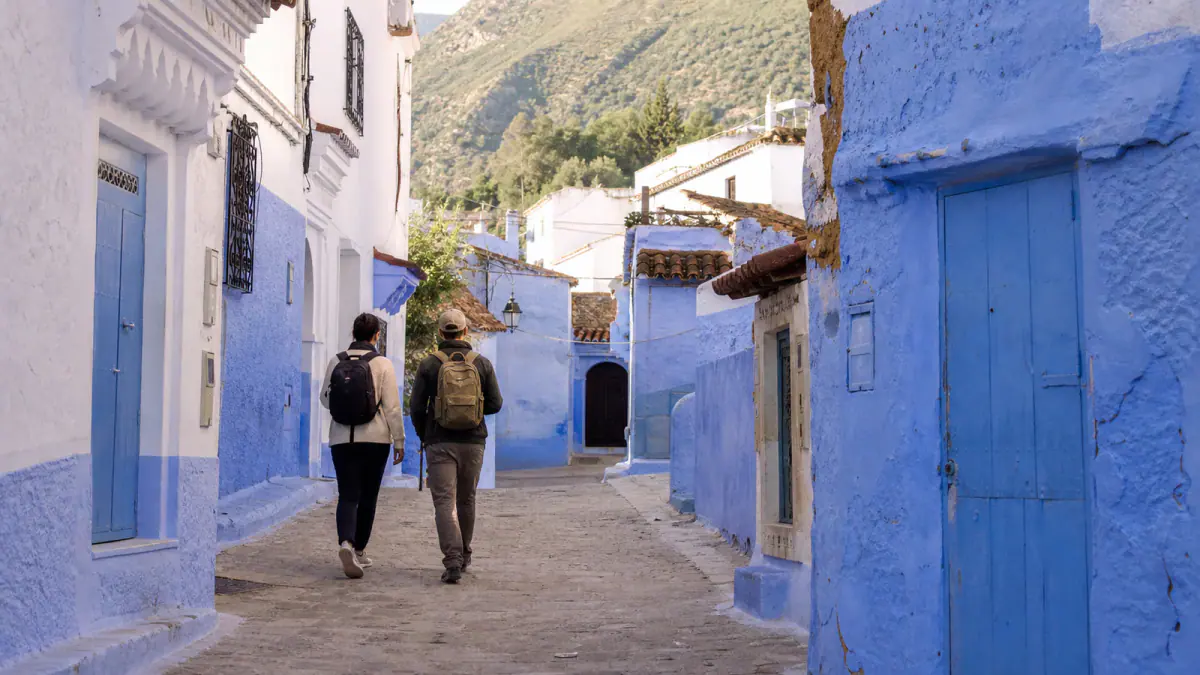
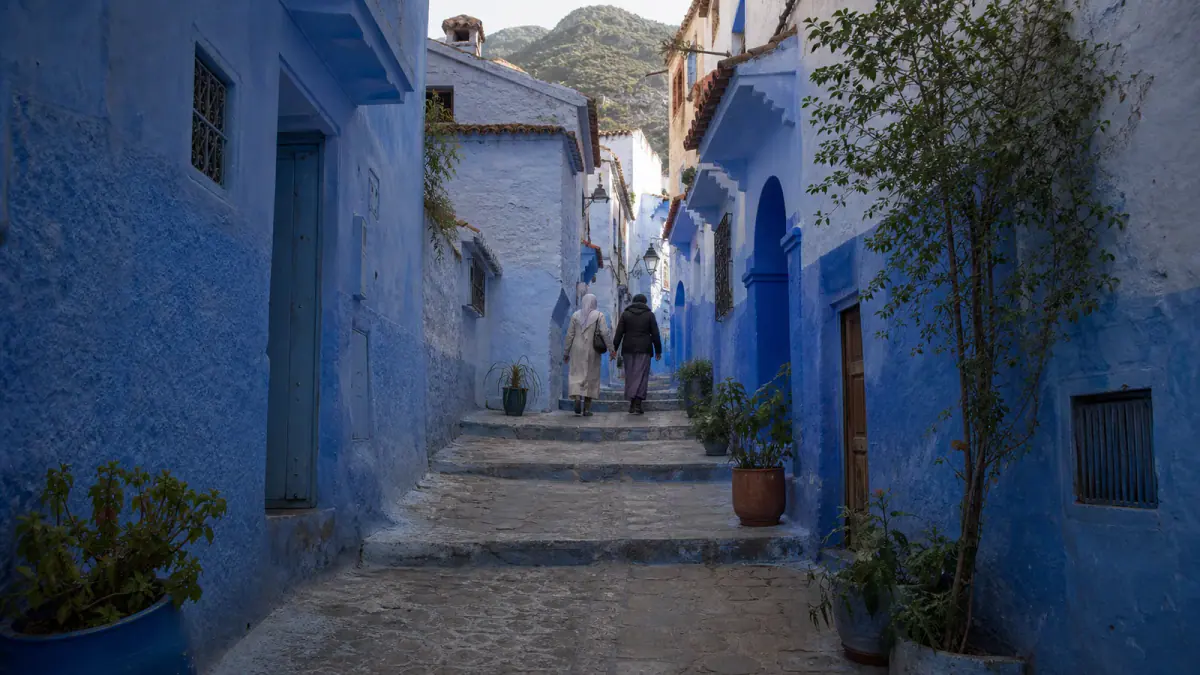
From the square, move east and gradually uphill rather than following the densest flow of souvenir shoppers. There is no single magic street. The pleasure comes from choosing public lanes that continue uphill, noticing where commercial signs thin out, and allowing yourself to turn back when a passage feels private.
Look for:
- changes from bright tourist repainting to faded, textured blue;
- small ovens, groceries and workshops serving residents;
- views created where stairways cross rather than at staged doorways;
- rooflines and mountains appearing above the walls;
- the sound of work, school and household life.
Stay on public paths. A partly open doorway, courtyard or staircase is not an invitation to enter.
A simple rule for blue-door photography
If your body, tripod or group blocks a door, you are too close. Take a wider street composition and move immediately when someone needs access. Ask before including an identifiable person, especially a child or someone working.
Some visitors rent decorative clothing or create prolonged photo sessions in residential lanes. Even if a local business facilitates a shoot, do not assume every neighboring household agreed to become its background.
Stop 3: Notice Working Craft, Not Only Souvenirs
Chefchaouen is associated with woodwork, wool, weaving, leather and other crafts. The official tourism office specifically highlights weaving and carpentry within the city’s heritage. A useful craft stop is not necessarily the shop with the largest display.
When you see visible work taking place:
- Greet the shopkeeper before photographing anything.
- Ask whether the goods were made locally or sourced elsewhere.
- Compare material, finishing and size rather than bargaining immediately.
- Do not request a long demonstration unless you are genuinely interested.
- Agree on the total price before customization or shipping.
A fair purchase is a better memory than pushing a craftsperson toward the lowest possible price. If you are not buying, a brief appreciative conversation is enough; no one owes visitors a performance.
Stop 4: Upper Medina Lanes and Bab Onsar
As you climb toward the upper and eastern side of the medina, the lanes become steeper and often calmer. Bab Onsar is a useful orientation area on the way toward Ras El Ma, but the small intersections before it are just as interesting.
This is where Chefchaouen’s mountain setting begins to make sense. The blue walls are not isolated decoration: they sit on a slope beneath the Rif, linked by water, footpaths and gates. Pause where the lane naturally widens rather than occupying a narrow stair.
The route is intentionally flexible. Construction, local activity or simple wrong turns may alter the exact line. If a lane becomes a dead end or seems to enter a shared residential court, turn around without treating that as a failure.
Stop 5: Ras El Ma Beyond the First Photo
Ras El Ma lies just beyond the medina edge where mountain water reaches the town. It is well known, so it should not be marketed as a secret. What many rushed visitors miss is the transition: dense lanes give way to flowing water, open air and paths along the hillside.
Arrive before late-morning crowds when possible. Pause without obstructing washing or everyday activity. Water levels and the atmosphere change by season, so do not expect every visit to match a long-exposure waterfall photograph.
The Moroccan National Tourist Office identifies Ras El Ma as one of Chefchaouen’s essential places and connects the city with nearby Rif walking. That relationship—town, water and mountain—is more interesting than treating the spring as a single selfie stop.
Stop 6: Continue Toward the Spanish Mosque Viewpoint
The path toward the Bouzâafar or Spanish Mosque viewpoint begins beyond Ras El Ma. It is a popular walk, not a hidden one, but the elevated view explains Chefchaouen better than any close blue-wall photograph. You can see the medina as a compact settlement held between cultivated slopes and rugged mountains.
Allow roughly an hour for an unhurried out-and-back walk from Ras El Ma, depending on pace and stopping. This is a planning estimate, not a guaranteed trail time.
Bring water and sun protection. The path can be exposed, and the return becomes harder to judge after dark. Sunset attracts more people; morning or late afternoon before the sunset rush may feel calmer.
When to turn back early
You do not need to reach the mosque to get a view. Turn around if:
- the path is slippery after rain;
- heat or fatigue is building;
- you lack enough daylight for the descent;
- anyone in the group is uncomfortable with the surface;
- weather over the Rif is deteriorating.
The goal is a safe perspective on the city, not completing a social-media checkpoint.
A Quiet Lunch Strategy
Return toward the medina after the viewpoint rather than scheduling lunch at an exact minute. Side-street restaurants and small rooftops can be calmer than the main square, but “away from the square” does not automatically mean better.
Read the current menu, check recent hygiene signals, and ask what is actually available that day. Useful choices may include:
- a vegetable or meat tagine that has had time to cook;
- bissara, a fava-bean soup common in northern Morocco;
- grilled items where turnover appears steady;
- bread, olives and seasonal salad;
- goat cheese when a restaurant can explain its source and storage.
Avoid claiming a restaurant is a local secret simply because it occupies a narrow lane. Businesses change, cooks move and quality varies by day. A current recommendation from your host is more useful than an unverified list copied for years.
For a wider introduction to dishes and dining rhythms, use our traditional Moroccan food guide.
Small Experiences That Are Better Than a “Secret Spot”
Watch the color change
Blue paint behaves differently in shade, morning sun and overcast weather. Instead of chasing one famous staircase, revisit a lane at another hour and compare its texture. Morning usually gives quieter scenes; late afternoon brings warmer contrast on upper walls.
Sit where you are not blocking anyone
A short tea stop can be more revealing than another hour of photography. Choose a cafe with a proper seat rather than settling on a household step. Watch movement through the lane without pointing a camera at every passerby.
Look above eye level
Visitors often photograph only doors. Roof tiles, drain spouts, electrical repairs, timber, mountain ridges and irregular upper stories show how the medina actually functions. These details create more original pictures while reducing pressure on private entrances.
Buy one well-understood object
Ask who made it, what material it uses and how it should be cared for. One textile or wooden object with a clear story is preferable to a bag of items sold with invented provenance.
Respectful Photography in Chefchaouen
Chefchaouen’s popularity has placed unusual pressure on ordinary lanes. Use these rules throughout the walk:
- Ask before photographing an identifiable resident.
- Never photograph children without a parent or guardian’s clear consent.
- Do not lean on, decorate or repeatedly open a private door.
- Keep drones grounded unless you have verified every applicable national and local authorization.
- Avoid blocking shop deliveries, school routes or household access.
- Do not offer money to stage children or animals for a photograph.
- When someone indicates “no,” lower the camera immediately.
A street can be visually public while the people in it still retain dignity and agency.
Is the Medina Accessible?
Chefchaouen is challenging for many visitors with limited mobility. Steps, steep gradients, uneven stone and vehicle-free lanes are central to the old town. A hotel described as “near the square” may still require a climb or luggage carry.
Before booking, ask the property:
- whether a car can reach the entrance;
- how many steps separate drop-off and reception;
- whether rooms require internal stairs;
- whether staff can assist with luggage;
- which flatter route they recommend.
Travelers who cannot complete the viewpoint walk can still enjoy Outa el-Hammam, accessible edges of the medina and viewpoints reached by road with a reputable driver. Accessibility claims should be confirmed with the specific property or provider.
Akchour Is a Separate Day, Not a Medina Add-On
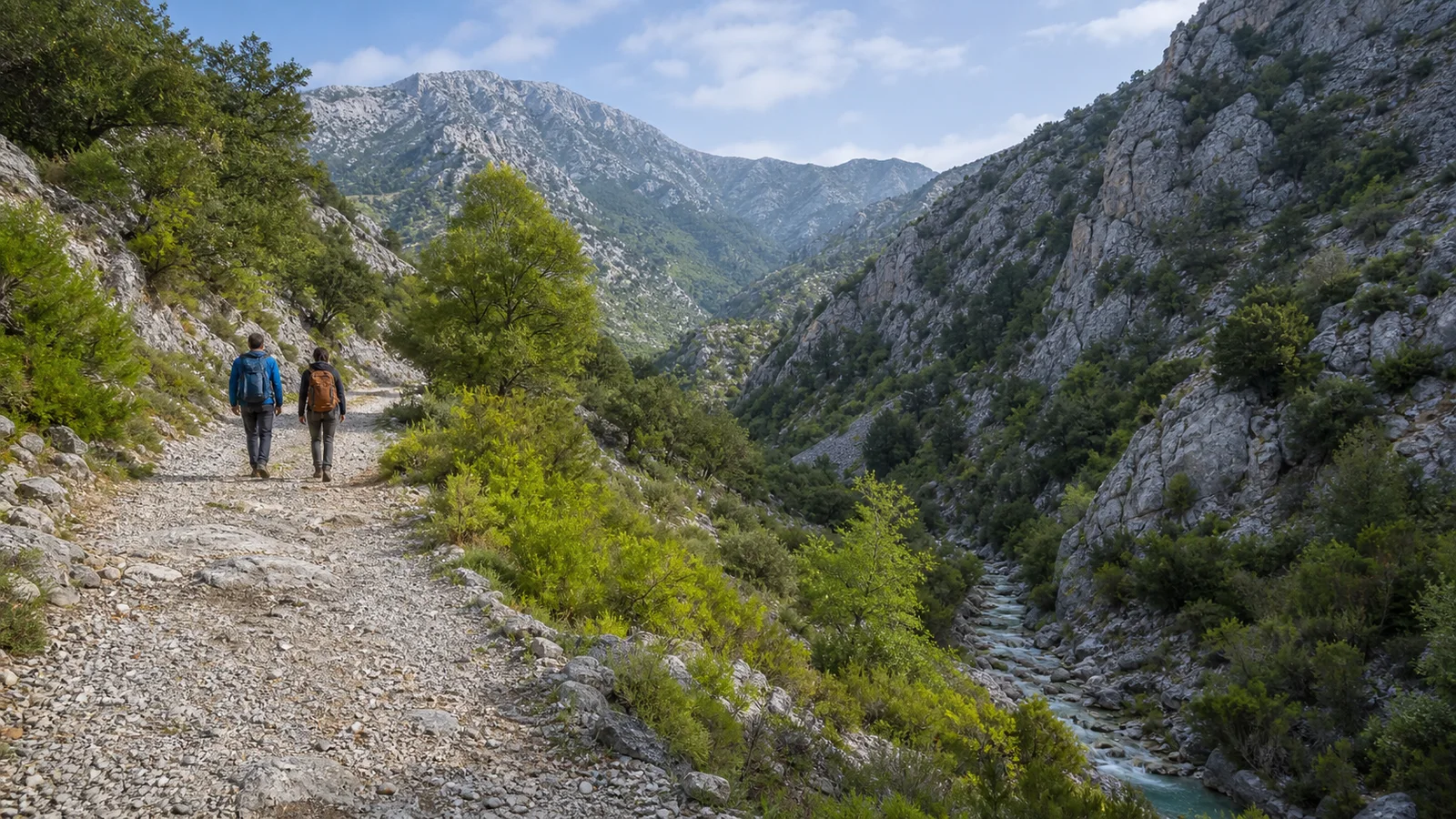
Original editorial visualization of a Rif Mountain path; it does not depict or promise conditions on one named trail.
Akchour and Talassemtane National Park provide the strongest nature extension from Chefchaouen. The Moroccan biodiversity clearing-house records Talassemtane as a 60,000-hectare national park established in 2004, protecting limestone Rif landscapes and rare forest ecosystems.
This is meaningful natural heritage, not simply a waterfall backdrop. A day may involve road transport, trail finding, variable water, slippery rock, heat, crowds and limited services. Conditions after heavy rain can be dangerous.
Plan Akchour responsibly
- Use a full daylight window rather than adding it after a medina morning.
- Confirm transport and the return arrangement before leaving Chefchaouen.
- Ask locally which route is currently suitable and open.
- Carry water, food, sun protection and shoes with grip.
- Do not enter fast or flooded water.
- Take litter back out.
- Hire a professional guide when route conditions or your experience justify it.
- Check that insurance covers the planned walking activity.
Government travel advice warns that heavy rain can cause flash flooding in mountain and river areas and that walking or driving in flood water is dangerous. A sunny start does not guarantee safe water conditions upstream.
The commonly promoted waterfalls and natural-bridge routes are not interchangeable in length or difficulty. Do not start from a social-media photo; start from a same-day description of the route.
A Realistic One-Night Plan
Arrival afternoon
Check in, learn the easiest luggage route and walk only the lower medina. Visit Outa el-Hammam and the Kasbah if time and current opening allow. Eat without rushing toward a sunset viewpoint on the same arrival day.
Early morning
Begin the route in this article: square, upper lanes, Bab Onsar area and Ras El Ma. Continue toward the Spanish Mosque viewpoint only if weather, surface and energy are suitable.
Lunch and departure
Return for a late breakfast or lunch, collect luggage and leave time for the winding road onward. Chefchaouen has no railway station; avoid a tight same-day connection based on perfect road timing.
For general transport choices, length of stay and first-time essentials, use the separate Chefchaouen travel guide.
If Chefchaouen is one stop in a longer route, our Morocco cities comparison helps you decide whether to continue toward Fes, Rabat or the Atlantic coast without squeezing too many cities into one week.
A Better Two-Night Plan
Day 1: Arrive, settle in and explore the lower medina without a checklist.
Day 2: Follow the full quiet walking route, visit the Kasbah and take time over lunch and crafts.
Day 3: Choose Akchour with current guidance, or enjoy another slow medina morning before departure.
Do not force Akchour into the plan if rain, transport or trail information is poor. A second calm day in Chefchaouen is still worthwhile.
Common Mistakes
Searching for one undiscovered blue alley
The city is extensively photographed. Originality comes from respectful observation, changing light and composition—not from intruding farther into residential space.
Arriving and leaving on the same crowded timetable
A long day trip can show the main square and blue lanes, but it misses the calmer evening and morning. One night changes the experience more than adding another attraction.
Treating every doorway as a set
Painted doors belong to homes, shops, mosques and shared buildings. Do not assume decoration equals permission.
Combining Akchour and the full medina route
Both deserve daylight and flexible time. Combining them creates pressure to rush trails, transport or the return after dark.
Wearing shoes chosen for photographs
Smooth soles and high heels are poorly suited to steep polished stone. Comfort and grip matter more than matching the blue walls.
Frequently Asked Questions
Where are the hidden gems in Chefchaouen?
Focus on the quieter upper medina lanes between Outa el-Hammam, Bab Onsar and Ras El Ma, plus the walking path toward the Spanish Mosque viewpoint. These are public areas, not guaranteed empty “secret” locations.
What is the least crowded time?
Early morning is usually calmest because many day visitors have not arrived and shops are only beginning to open. Crowd levels vary by season, weekend and holiday.
Is the Spanish Mosque walk difficult?
It is a relatively short uphill path, but heat, loose surfaces, rain and individual mobility change the difficulty. Wear suitable shoes, carry water and return before darkness.
Is Ras El Ma worth visiting?
Yes, especially as part of a continuous walk from the upper medina. Its value is the relationship between water, town and mountains rather than a guaranteed large waterfall.
Can I visit Akchour without a guide?
Some visitors do, but route choice, water and weather conditions vary. Ask for current local advice and use a professional guide when navigation, conditions or your experience make that the safer choice.
How long should I stay in Chefchaouen?
One night is the practical minimum for a quieter morning and evening. Two nights work better if you want the walking route at leisure or a separate Akchour day.
Is Chefchaouen only for photography?
No. The Kasbah, crafts, food, Rif setting, water and ordinary rhythm offer much more. The trip improves when photography becomes one activity rather than the purpose of every interaction.
Final Checklist
- Start the medina route early.
- Wear shoes with reliable grip.
- Keep the indexed map offline, but respect dead ends and private space.
- Ask before photographing people.
- Do not block blue doors or lanes.
- Check the Kasbah’s current opening information on site.
- Carry water for the viewpoint path.
- Give Akchour its own daylight day.
- Verify mountain and river conditions close to departure.
Chefchaouen’s most rewarding “hidden gem” is a different way of moving: slower than the day-tour crowd, curious without entitlement, and aware that the blue medina is home before it is an image. Follow the hillside rather than a viral doorway list, and the city begins to feel connected to its water, crafts and Rif landscape.