The Imilchil Marriage Festival is better understood as a High Atlas moussem: a seasonal Amazigh gathering shaped by pilgrimage, market trade, harvest rhythms, music, family ties and engagement traditions. Calling it a “mass wedding” or “bride market” makes an easy headline, but it turns a complex community event into a tourist stereotype.
For 2026, several travel calendars suggest dates around September 18–21, but the festival organiser’s own website had not published a confirmed 2026 programme as of July 28. Its public homepage still showed September 19–21, 2024. Treat every 2026 date as provisional until the organiser, Midelt provincial authorities or the relevant commune publishes an updated notice.
That uncertainty should affect how you plan: reserve cancellable accommodation, avoid buying a non-refundable long transfer solely for the festival and reconfirm the exact site as well as the dates.
2026 status: expected in September, exact dates not yet confirmed by an authoritative current source. Some listings say September 18–20; others September 18–21. This guide will be updated when the organiser publishes the programme.
Imilchil festival 2026 date check
| Source or claim | What it currently shows | How to use it |
|---|---|---|
| Festival organiser website | Homepage still displays September 19–21, 2024 | Reliable contact point, but not confirmation for 2026 |
| Independent 2026 calendars | Conflicting ranges around September 18–21 | Useful planning window only |
| Local or provincial announcement | No current notice found in our July 28 review | Wait for this before locking transport |
| Traditional timing | End of summer or early autumn, after harvest | Context, not an exact date |
The official festival contact currently published at MoussemImilchil.com is the best place to watch for a new programme. If you need certainty, contact the organiser and ask for the dates, daily schedule and exact festival ground in the same message.
What is the Imilchil Marriage Festival?
The event is commonly called the Imilchil Marriage Festival, Betrothal Festival or Moussem des Fiançailles. In Amazigh contexts, agdud can also describe a communal gathering or market. The moussem is associated with the Ait Hdiddou communities of the eastern High Atlas and with the shrine of Sidi Hmad Mghani.
A moussem is not simply a music festival. Depending on place and history, it can combine religious observance, an annual market, family meetings, agricultural exchange and public celebration. At Imilchil, people historically travelled from dispersed mountain settlements at the end of the harvest season, before winter made movement more difficult.
The gathering provided a practical place to:
- buy and sell livestock, grain, clothing, tools and household goods;
- meet relatives and renew agreements between communities;
- visit the shrine and seek blessing for important commitments;
- enjoy Ahidous music, poetry and collective dance;
- acquire clothing, jewellery and supplies connected with marriage;
- formalise engagements or marriages already rooted in family and community relationships.
This is why “people arrive and choose a stranger to marry on the spot” is a poor explanation. Courtship and legal or family arrangements do not begin from nothing for the entertainment of visitors.
Why “bride market” is misleading
Foreign coverage has long marketed Imilchil as a romantic or exotic bride fair. That phrase encourages visitors to look at local women as if they were on display and implies a commercial exchange of brides. It also pushes the market, religious and harvest functions out of the frame.
A more accurate approach is:
- this is a community moussem with a history connected to engagement and marriage;
- people may attend in distinctive regional clothing, but clothing is not an invitation to photograph them;
- a public ceremony does not reveal the private decisions or family negotiations behind it;
- modern staged elements, festival concerts and tourism promotion may sit beside older practices;
- not every attendee is single, seeking marriage or participating in a ceremony.
An Al Jazeera field report likewise cautions that the event is not designed simply as a wedding ceremony. It describes the moussem of Sidi Hmad Mghani as an end-of-harvest religious and market gathering that has brought Amazigh groups together for centuries.
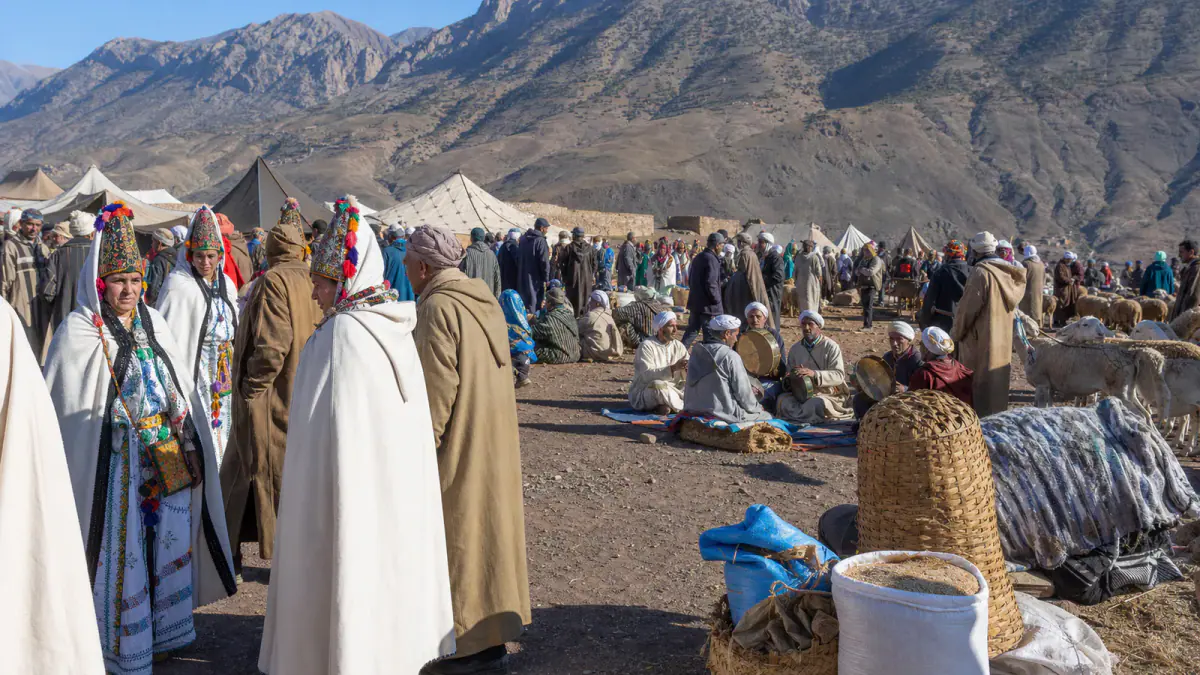
The header image is an original editorial visualization of a High Atlas market gathering. It is not a documentary photograph of a named year or participant.
The legend of Isli and Tislit
The best-known origin story tells of a young man and woman from neighbouring rival groups who were forbidden to marry. They grieved until their tears formed two mountain lakes: Isli, traditionally associated with the groom, and Tislit, associated with the bride. Their tragedy persuaded the communities to let young people exercise more choice in marriage.
The festival organiser presents this forbidden-love story as the moussem’s emotional foundation. It is a legend, not a documented transcript of one historical event. Its power lies in what it expresses: love constrained by group conflict, the cost of separation and reconciliation through new social rules.
The lakes are real places in the Imilchil region, and both are part of the landscape visitors associate with the story.
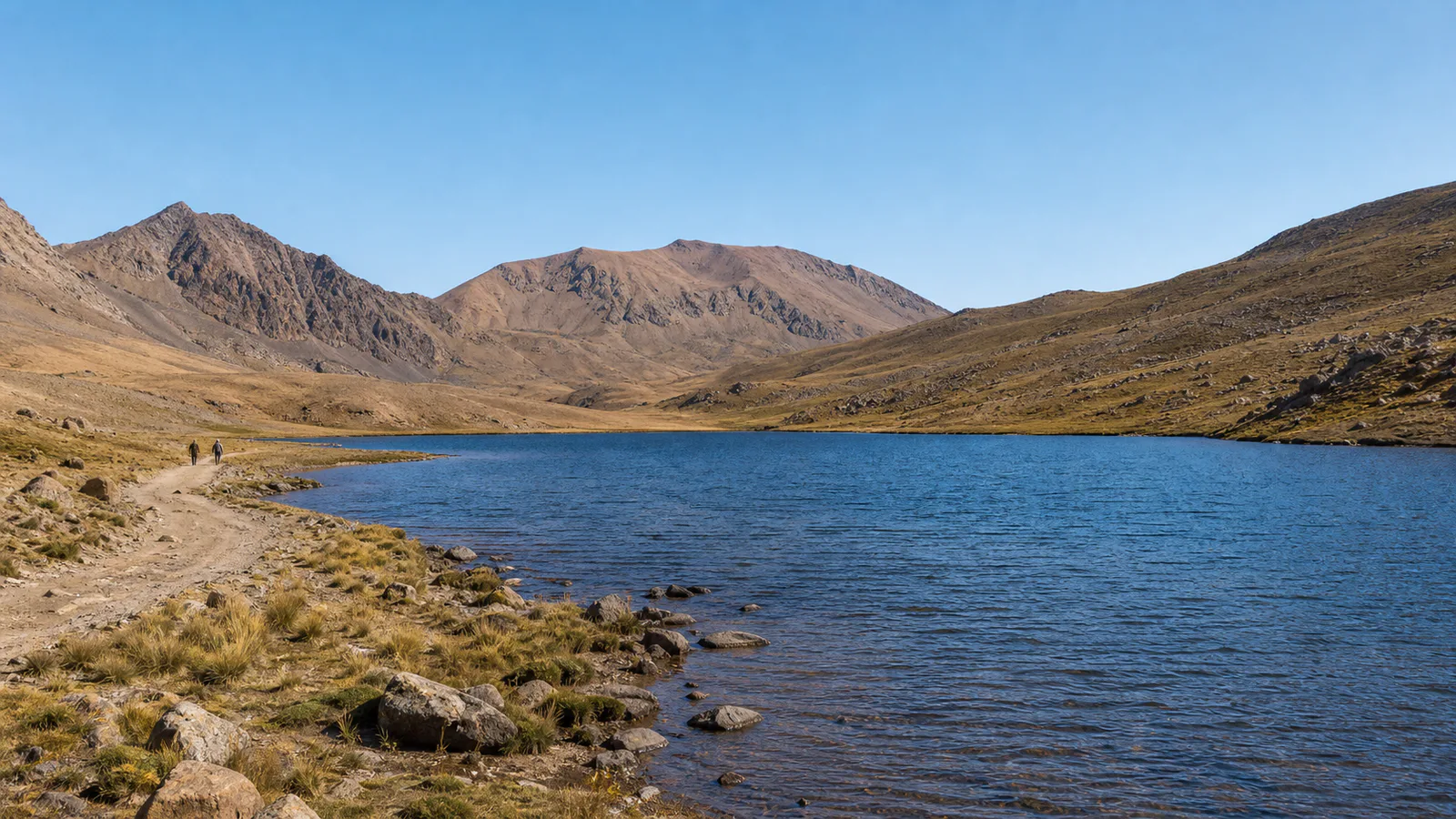
Editorial landscape visualization inspired by the Imilchil plateau; conditions and water levels vary by season.
The Moroccan National Tourist Office also presents Isli and Tislit through the local story of impossible love. Visit them as mountain landscapes and community places, not as props for recreating a romantic legend.
What you may see at the moussem
The programme changes, and the traditional gathering is not identical to the modern music festival that may accompany it. A visit may include:
The annual market
Trading is a central part of the moussem’s purpose. Expect practical goods before souvenir theatre: livestock, grain, blankets, clothes, jewellery, household supplies and food. The market reflects preparation for the cold season as much as festival colour.
Ahidous music and dance
Ahidous brings performers together in a line or circle through frame drums, poetry, repeated song and coordinated movement. It is a shared Amazigh art rather than a short stage interlude. Give performers room, watch before pushing forward with a camera and do not interrupt a circle for a portrait.
Traditional clothing and jewellery
Women from local communities may wear white wool outer garments, colourful woven clothing, jewellery and distinctive headpieces; men’s dress may include wool cloaks, djellabas or turbans. Details vary by community, family and occasion. Avoid treating every garment as one universal “Berber costume.”
Engagement or ceremonial elements
Some years include public or symbolic ceremonies connected with engagement and marriage. Their format can be influenced by administration, law, tourism and the accompanying festival programme. Do not promise yourself a mass wedding: arrive to understand the gathering as a whole.
Music Festival of the Peaks
The Festival des Musiques des Cimes was launched in the 2000s to bring concerts and wider visibility to the region. The organiser treats it as a companion to the older moussem. Its stage programme should be confirmed separately because cultural acts and the traditional market may have different times or sites.
Where does the festival actually take place?
“Imilchil Festival” does not necessarily mean the centre of Imilchil village. The traditional moussem is associated with the Ait Ameur area and the shrine of Sidi Hmad Mghani, south of Imilchil. Older and third-party descriptions vary in spelling and exact distance.
Before departure, request:
- a dropped map pin for the current entrance;
- the name of the commune or village;
- opening and closing times for each day;
- where public vehicles must park;
- whether concerts and the traditional market use the same site.
This small check can prevent a large mistake on mountain roads with limited mobile reception.
How to reach Imilchil
Imilchil sits on a remote high plateau in the eastern High Atlas, far from Morocco’s main rail network. The final journey is by road. Approaches are possible through towns such as Rich on the eastern side or through El Ksiba and mountain roads from the west, depending on your wider itinerary and current road conditions.
For most visitors, the practical choices are:
- a private driver who knows the current route;
- a small organised tour with confirmed accommodation;
- a rental car for an experienced, confident mountain-road driver;
- local shared transport, only with generous time and flexible expectations.
Do not calculate the trip from distance alone. Curves, road works, festival traffic, livestock and weather can make a mountain stage much slower than the map suggests. Avoid planning a late-night arrival on an unfamiliar road.
Our Morocco airport guide helps compare the larger arrival gateways, while the Morocco cities guide can help you decide which urban stop fits before or after the mountains.
Where to stay
Imilchil and nearby settlements have small guesthouses and simple hotels, but capacity is limited during the moussem. A listing that looks available online may still require direct confirmation.
Ask your accommodation:
- whether it is in Imilchil itself or near the festival ground;
- whether hot water and heating are dependable;
- whether breakfast and dinner are available;
- whether it can arrange transport to the event;
- whether parking remains accessible during the busiest hours;
- what its cancellation terms are if the dates move.
Expect practicality rather than resort service. Staying with a locally run guesthouse can also provide the most useful last-mile information, provided you do not ask the host to guarantee a schedule they do not control.
Weather and what to pack
Imilchil is at high altitude, and September can deliver strong sun in the day with genuinely cold mornings and nights. Conditions change quickly, while an outdoor market offers limited shelter.
Pack:
- warm layers and a wind-resistant outer layer;
- a sun hat, sunglasses and sunscreen;
- sturdy closed shoes for dust and uneven ground;
- drinking water and simple snacks;
- cash in small denominations;
- a charged power bank;
- offline maps and saved contact numbers;
- a reusable dust cover or bag for camera gear;
- any personal medication you cannot easily replace.
Check the forecast shortly before leaving. Our best time to visit Morocco guide explains how sharply conditions differ between Morocco’s cities, coast, desert and mountains.
Respectful photography and behaviour
The festival is visually striking, but access does not equal consent.
- Ask before photographing an identifiable person at close range.
- Accept “no” immediately and without negotiation.
- Never label a woman as a “bride” based on clothing.
- Do not photograph legal paperwork or private family discussions.
- Keep away from prayer and shrine activity unless invited.
- Do not block the market while arranging a shot.
- Avoid drones unless authorities and local communities have clearly authorised them.
- Buy directly from local traders when you value their craft, but bargain calmly.
A few wide atmosphere photographs taken from public space are different from following one family or couple. If someone agrees to a portrait, show them the result and offer to share it.
A practical three-day outline
Because the 2026 programme is not confirmed, use this as a flexible structure rather than a fixed schedule.
Day 1: arrive and confirm
Reach Imilchil in daylight, check into your guesthouse and verify the current programme and event location locally. Do not rush immediately to the lakes after a long drive.
Day 2: moussem and market
Go early enough to watch the gathering develop before the busiest period. Spend time at the market, listen to music and observe how the social and commercial parts overlap. Leave room for pauses instead of photographing continuously.
Day 3: lakes and return
If road and weather conditions are suitable, visit Tislit or Isli with local guidance, then begin the next mountain stage with plenty of daylight. Do not try to visit both lakes, the entire festival and a distant city in one hurried day.
Frequently asked questions
When is the Imilchil Marriage Festival in 2026?
It is expected in September, but no current authoritative programme had confirmed the exact dates as of July 28, 2026. Independent calendars conflict between September 18–20 and September 18–21. Verify directly with the organiser before booking.
Is the Imilchil festival a mass wedding?
That description is incomplete and often misleading. The moussem combines a shrine gathering, market, harvest-season meeting, music and traditions connected with engagement and marriage. Public ceremonies do not mean strangers are selected and married for visitors.
Is Imilchil in the Atlas Mountains?
Yes. Imilchil lies on a high plateau in the eastern High Atlas, in Midelt Province. Its altitude and remote roads make weather and transport central to planning.
What is a moussem?
A moussem is a recurring local gathering that can combine religious, community, agricultural, commercial and celebratory functions. Each moussem has its own history; the word does not describe one standard festival format.
Can tourists attend?
The modern event welcomes visitors, but it remains a community gathering. Attend modestly, follow local directions and request permission for close photographs.
Are Lake Isli and Lake Tislit at the festival site?
They are in the wider Imilchil region but should be treated as separate excursions. Confirm road access and travel time locally rather than assuming both sit beside the market grounds.
Should you plan a trip around it?
Yes, if you value Amazigh culture, rural markets, mountain landscapes and patient travel more than a polished show. No, if your trip depends on a guaranteed programme, luxury accommodation or a quick day trip from Marrakech.
The best Imilchil visit begins by letting go of the “bride market” story. What remains is more interesting: an annual High Atlas gathering where harvest, trade, memory, music, pilgrimage and marriage traditions meet—and where visitors should arrive as respectful observers, not directors of the scene.