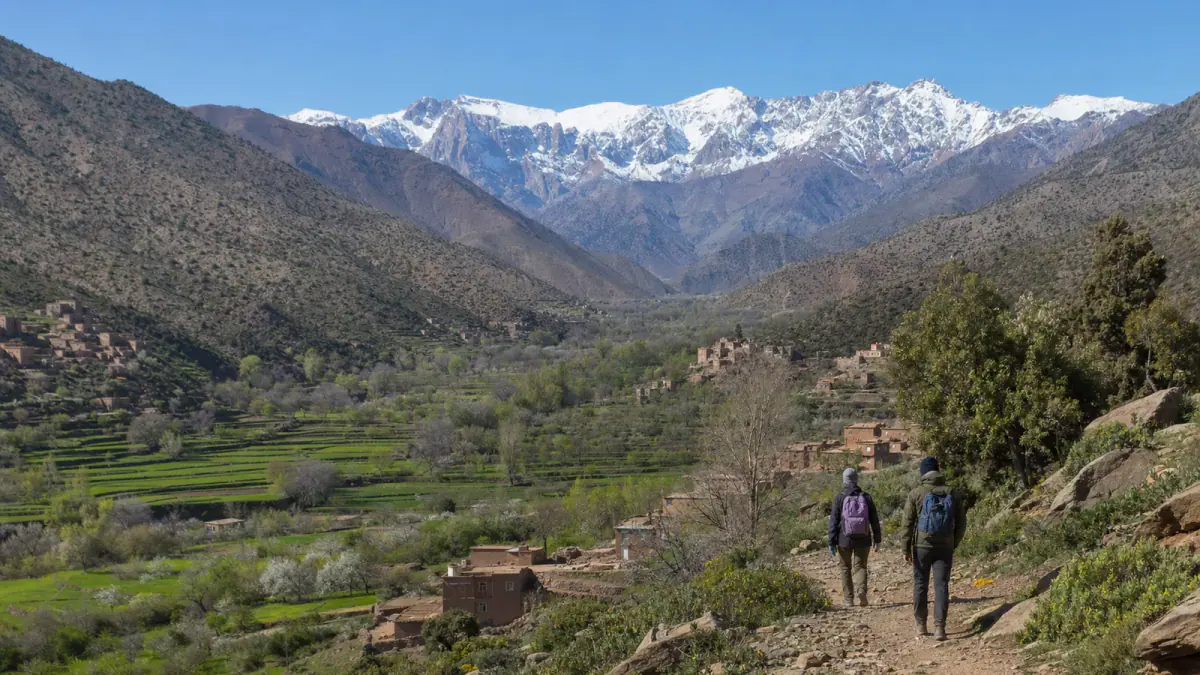
A first trip to Morocco works best when you resist the urge to collect cities. Pick one region, allow two or three nights in the places that matter, and treat long transfers as part of the itinerary—not empty space between attractions.
For most first-time visitors, seven to ten days is enough for two major cities plus one contrasting experience, such as the Atlantic coast, the High Atlas or the Sahara. Marrakech, Fes, Chefchaouen, Essaouira and Merzouga can fit on the same map, but squeezing all five into one week usually means seeing Morocco through a windscreen.
This Morocco travel guide covers the decisions that make the trip easier: entry checks, routes, trains and coaches, money, riads, etiquette, packing and what to arrange before arrival.
First, check Morocco’s entry requirements
Entry rules depend on your nationality, passport and travel purpose. Do not rely on a general blog list or assume that a friend’s rules apply to you. Check Morocco’s official Accès Maroc entry portal and, when necessary, the nearest Moroccan consulate before buying a non-refundable ticket.
The Moroccan National Tourist Office says visitors need a passport and that visa requirements vary by nationality. Its official formalities page also directs eligible applicants to Accès Maroc. An eVisa has its own passport-validity and eligibility conditions, so read the official conditions for your application type rather than treating them as universal entry rules.
Also confirm what your airline requires for check-in and keep digital and paper copies of your first accommodation address, onward or return arrangements, travel insurance and prescriptions. Rules can change, so recheck shortly before departure.
How many days do you need in Morocco?
The right length depends less on the number of pins on your map than on the roads between them.
| Trip length | A realistic first route | Best for |
|---|---|---|
| 5 days | Marrakech and Essaouira, or Casablanca, Rabat and Fes | One city pair and a gentle introduction |
| 7 days | Marrakech, High Atlas and Essaouira, or Tangier, Chefchaouen and Fes | City culture plus coast or mountains |
| 10 days | Casablanca/Rabat, Fes, Marrakech and one nearby excursion | A balanced rail-friendly overview |
| 12–14 days | Imperial cities plus a properly paced Sahara or Atlantic section | Travelers who want variety without daily transfers |
These are frameworks, not checklists. A late arrival, an early departure and a three-day desert loop can remove several usable sightseeing days. Count nights and full days separately before committing.
A relaxed five-day first trip
Fly into Marrakech, spend three nights exploring the medina and modern neighborhoods, then use two nights for Essaouira—or reverse the balance if you prefer the sea to a busy city. The two places feel different without requiring a cross-country journey.
If you arrive in Casablanca, a northern alternative is Casablanca, Rabat and Fes by train. Casablanca is often the practical gateway, Rabat offers a calmer first landing, and Fes provides the dense historic medina experience.
A balanced seven-to-ten-day route
Choose one of these shapes:
- Atlantic and south: Marrakech, a High Atlas day or overnight, then Essaouira.
- Northern culture: Tangier, Chefchaouen and Fes.
- Rail corridor: Casablanca, Rabat, Fes and Marrakech.
- Desert-focused: Marrakech or Fes plus a multi-day route to the dunes, with fewer city stops.
Read our Morocco cities guide before choosing your anchors. For season and region-specific conditions, use the separate best time to visit Morocco guide rather than assuming the whole country shares one climate.
Where should a first-time visitor go?
Marrakech is the most immediate introduction: markets, gardens, palaces, food and intense street life in a compact area. It is exciting, but the medina can feel demanding on day one. Arrange your arrival and take the first afternoon slowly.
Fes rewards travelers interested in craft traditions, architecture and layered history. Its old city is larger and more intricate than many visitors expect, so a licensed guide can be useful for an initial orientation.
Rabat is a practical, less hectic capital with rail connections, Atlantic air and major historic sites. Our Rabat travel guide explains how to use it as more than a quick stop.
Essaouira suits travelers who want a walkable medina, working harbor and breezier coastal rhythm. It pairs naturally with Marrakech.
Chefchaouen is visually memorable, but it is not on the rail network. Include it because you want time in the Rif—not only for a photograph—and account for the road journey.
The Sahara is not a short detour from Marrakech. Merzouga and the Erg Chebbi dunes require substantial road time, while Zagora-area trips offer a shorter southern journey but a different desert landscape. Choose the experience first, then build the route around it.
Arriving in Morocco without a stressful first hour
Morocco has several international gateways. Casablanca generally offers the broadest onward connections; Marrakech is convenient for southern itineraries; Tangier works well for the north; and airports at Fes, Rabat and Agadir can eliminate backtracking when flights suit your route. Compare them in our guide to airports in Morocco.
Before landing:
- Save the accommodation’s full address, phone number and map pin offline.
- Ask a medina riad exactly where a car can stop; many old-city lanes are pedestrian-only.
- Confirm whether an airport pickup is included, optional or unnecessary.
- Download an offline map and your booking documents.
- Carry enough Moroccan dirhams, or plan to use an airport ATM, for the first transfer and small expenses.
If a host offers a reasonably priced first-night transfer to a hard-to-find riad, it can be worthwhile. You can learn local transport after sleeping rather than navigating unfamiliar lanes with luggage.
Getting around Morocco: train, coach, taxi or car?
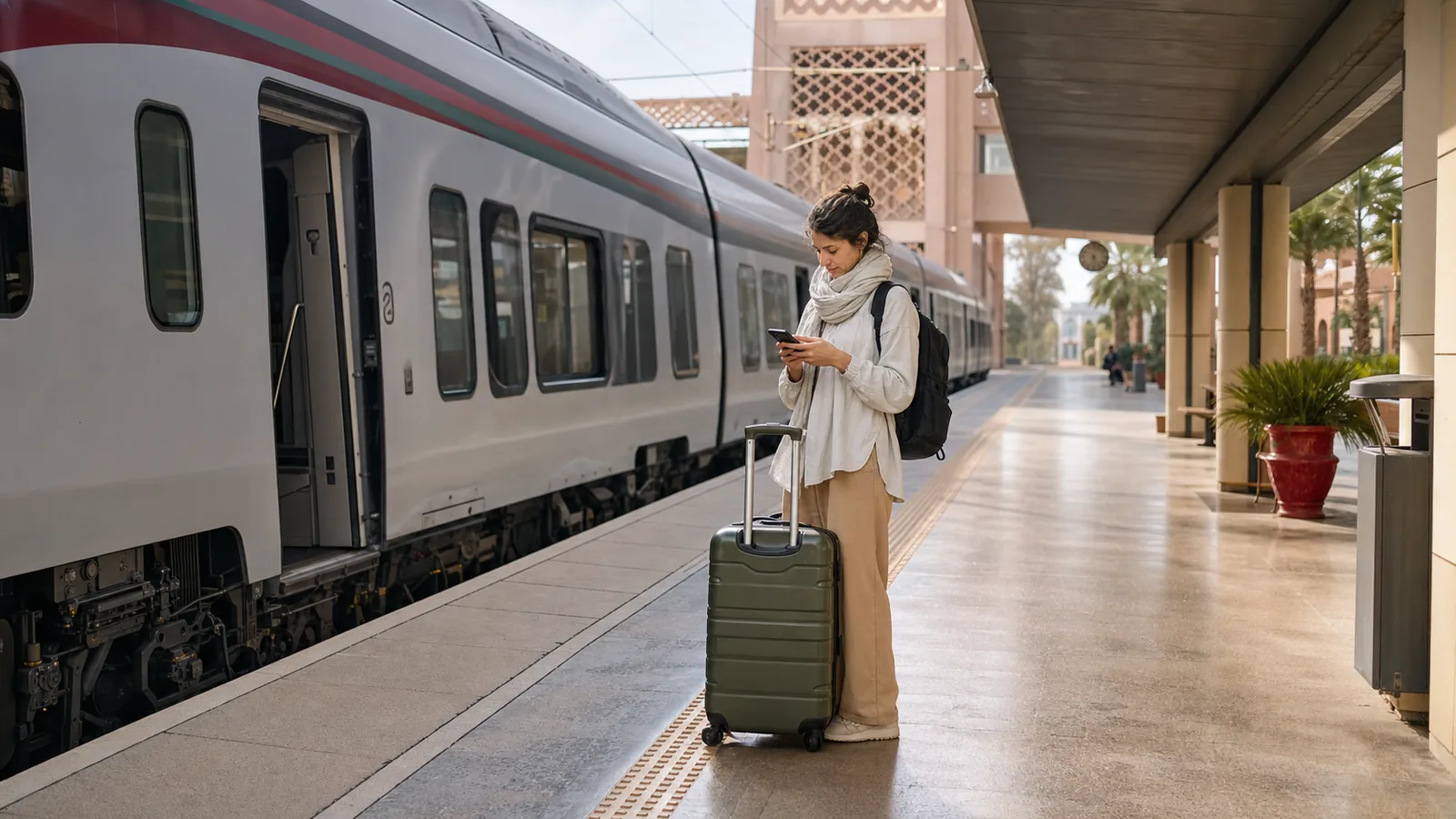
There is no single best transport mode. Use the network that fits each leg.
| Transport | Works best for | Watch for |
|---|---|---|
| Train | Tangier, Kenitra, Rabat, Casablanca, Fes and Marrakech corridors | Not every destination has a station |
| Intercity coach | Essaouira, Chefchaouen and towns beyond the railway | Allow time for station transfers and stops |
| Petit taxi | Short journeys within a city | Local operating rules and fares vary by city |
| Grand taxi | Shared or private regional trips | Confirm destination, whether it is shared, and the fare before leaving |
| Rental car | Rural routes and flexible mountain or coastal travel | Parking, medina access and mountain-road fatigue |
| Private transfer | Airport arrivals, families and complex point-to-point routes | Compare exactly what the quoted price includes |
Morocco’s tourism office describes rail as the main way to connect major cities, with coaches filling gaps beyond the network. Its official getting-around overview notes that Al Boraq serves the Tangier–Kenitra–Rabat–Casablanca axis, while conventional trains connect other principal cities.
Check current schedules and buy rail tickets through ONCF Voyages. For coaches, use the operator’s official site or station and verify the departure terminal—city names can have more than one bus stop. Avoid building a tight same-day flight connection around an unprotected train or coach journey.
Should you rent a car?
A car is useful for the Atlantic coast, Anti-Atlas, mountain valleys and rural stops. It is less useful if your route is mostly Casablanca, Rabat, Fes and Marrakech, where trains avoid parking and city traffic.
Morocco drives on the right. If you rent, inspect the vehicle, photograph existing damage, understand the insurance excess and ask where you can legally leave the car overnight. Do not plan unfamiliar mountain roads after dark merely because a mapping app shows a short distance.
Money and daily costs
The official currency is the Moroccan dirham (MAD). Cards are common at many hotels, established restaurants and larger shops, but cash remains useful for small cafés, markets, taxis and rural purchases. The tourism office’s useful information page recommends exchanging money through authorized banks or establishments.
Use an ATM attached to or inside a bank when practical, shield your PIN and keep a backup card separately. Ask whether a card terminal will charge in dirhams and review the amount before approving it. Keep smaller notes and coins for minor purchases; a large note can be awkward for a short taxi ride or a bottle of water.
Morocco can suit several budgets, but “cheap” is too vague to plan around. A private riad, licensed guide and long transfer can change the daily total quickly. Price the four biggest items first—international flight, accommodation, intercity transport and any desert tour—then set a daily allowance for food and activities.
Staying in a riad, hotel or guesthouse
A riad is a traditional inward-facing house built around a courtyard; many have been converted into small guesthouses. The experience can be atmospheric and personal, but access, stairs, sound and room size vary widely.
Before booking, check:
- whether the property is reachable by car or requires a walk;
- how far it is from a known gate or landmark;
- whether someone can meet you on a late arrival;
- if the room has heating or air-conditioning appropriate to the season;
- whether breakfast is included and when it is served;
- recent reviews that discuss noise, cleanliness and location rather than décor alone.
For a first medina stay, a clear arrival plan matters more than being hidden in the deepest lane. Save the route to your accommodation, but do not wave an expensive phone around in a crowded passage while distracted.
Etiquette that makes travel easier
Morocco is diverse and used to visitors, yet everyday courtesy still matters.
- Dress with awareness of the setting. Beachwear belongs at the beach; looser, more covered clothing is considerate in residential medinas, rural areas and religious surroundings.
- Ask before photographing an identifiable person, artisan at work or shop display. A smile and a clear gesture are better than a hidden camera.
- Non-Muslim access to mosques is generally restricted, with notable exceptions open to visitors. Follow signs and staff instructions.
- Use your right hand when offering or receiving food or money when convenient.
- Learn a few greetings. “Salam alaykum” is widely understood; French is also useful in many travel situations.
- During Ramadan, daily rhythms and opening times can change. Visitors are not expected to fast, but discreet daytime eating and patience are respectful.
Bargaining is normal in many souks, but it is a conversation, not a contest. Ask the price, make a reasonable counteroffer only if you may buy, and leave politely if you cannot agree. Fixed-price shops and supermarkets are not bargaining settings.
Food, water and staying comfortable
Start with busy establishments, freshly cooked food and fruit you can peel. Travelers differ in what their stomachs tolerate, so make changes gradually rather than turning the first evening into a street-food marathon.
Tap-water advice varies by location and individual tolerance. Many visitors choose sealed bottled water or properly filtered water; check the seal and stay hydrated, particularly in dry inland areas. Bring any medication you routinely use and discuss health needs with a qualified clinician before travel.
Tell a restaurant clearly about serious allergies, ideally with a translated card, but understand that cross-contact can be difficult to guarantee in small kitchens. Travel insurance should cover your planned activities and medical needs.
What to pack for Morocco
Pack for your regions, not for an image of Morocco as permanently hot.
- breathable layers and one warmer layer;
- comfortable closed walking shoes with grip for uneven lanes;
- a light scarf or wrap for sun, wind and more conservative settings;
- sun protection, sunglasses and a reusable water bottle;
- a compact day bag that closes securely;
- essential medication in original packaging and prescription copies;
- a universal adapter suited to your devices;
- a small power bank and offline copies of bookings;
- a light rain layer when your season and route require it.
Mountain and desert nights can be cold even after warm days. Atlantic evenings can feel cool and windy. Check the forecast for each overnight stop during the week before departure rather than packing for Marrakech alone.
Phones, maps and staying connected
A local SIM or an eSIM can make arrival pickups, train checks and translation easier. Compare current packages at official operator shops or authorized airport counters and keep your passport available if registration is required.
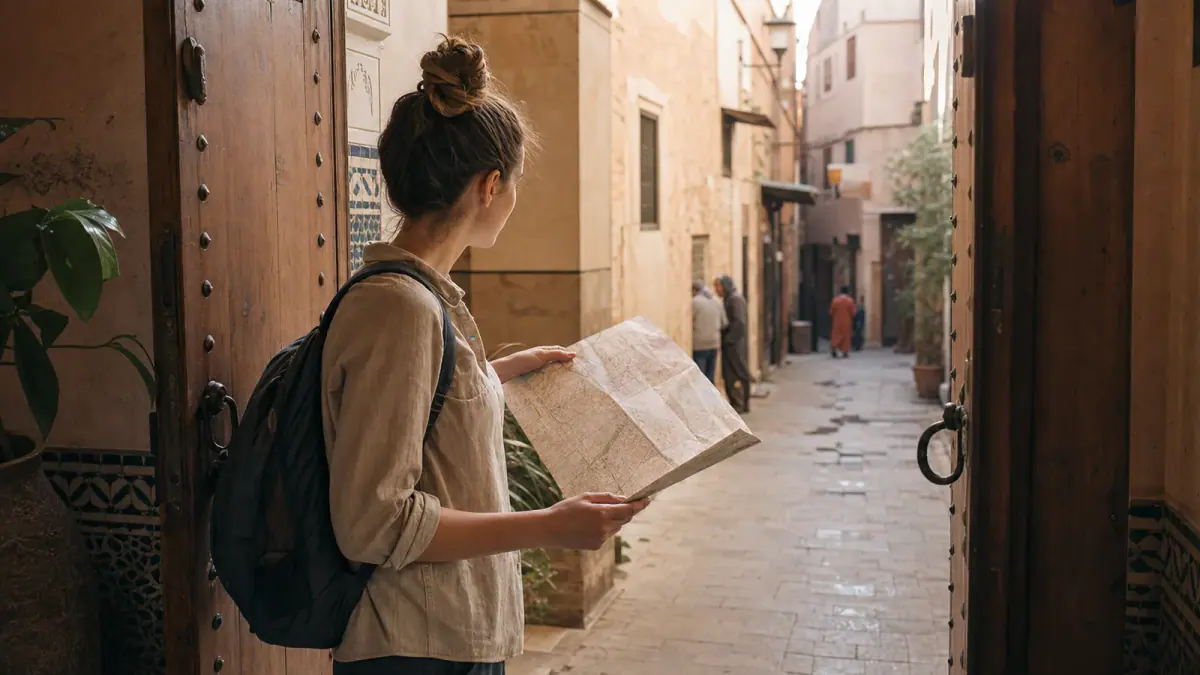
Download the areas around your riads, stations and meeting points for offline use. In a medina, a map pin may show the destination without showing a usable doorway. Ask your host for the nearest gate, parking point or recognizable landmark.
Use the same basic precautions you would in any busy destination: avoid leaving a phone on an outdoor café table, do not share one-time banking codes, and confirm unexpected payment requests through the booking platform or a known number.
Common first-time mistakes to avoid
Trying to combine every famous place
Marrakech to Merzouga, Merzouga to Fes and Fes to Chefchaouen are meaningful travel legs. A route that looks efficient on a small map may contain several tiring days. Remove one destination before removing sleep.
Booking the cheapest desert trip without reading the route
Check daily driving time, camp location, private versus shared transport, meals, room type and what happens in poor weather. “Three-day Sahara tour” can describe very different experiences.
Ignoring the first and last day
An evening arrival is not a Marrakech sightseeing day. A morning international departure may require sleeping close to the airport or arranging a pre-dawn transfer. Build the itinerary from actual flight times.
Accepting unsolicited help without clarity
Many people are sincerely helpful, but vague offers to guide you, find a closed attraction or lead you through the medina can end with pressure for payment. Use a licensed guide when you want a tour, and ask your accommodation for directions when unsure.
Treating weather as one national forecast
Fes, Essaouira, the High Atlas and the Sahara can require different clothing in the same week. Check elevation, wind and nighttime temperature as well as the daytime maximum.
A simple pre-departure checklist
- Verify passport and nationality-specific entry rules on official sources.
- Choose two or three route anchors and calculate transfer days.
- Book the first nights and confirm late-arrival instructions.
- Save airport, station and accommodation details offline.
- Check current train, coach or transfer arrangements.
- Buy travel insurance suitable for your activities.
- Tell your bank about travel if it requires notification.
- Keep a backup payment method and copies of key documents.
- Recheck regional weather and pack layers.
- Leave some free time; Morocco is better when every hour is not reserved.
Frequently asked questions
Is Morocco good for first-time international travelers?
It can be. Major destinations have established tourism infrastructure, intercity transport and a wide accommodation range. The busiest medinas can be intense, so a planned arrival, a focused route and normal urban awareness make the first days easier.
Is seven days enough for Morocco?
Seven days is enough for a satisfying regional trip or two cities plus one nearby landscape. It is not enough for a comfortable sweep through Marrakech, the Sahara, Fes, Chefchaouen and Essaouira.
Do I need a tour for Morocco?
No. Rail-linked cities and major destinations can be traveled independently. A licensed city guide, mountain guide or well-vetted desert operator can add value where navigation, access or local interpretation matters.
Can I use English in Morocco?
English is common in many tourism businesses, particularly in major destinations, but not everywhere. Moroccan Arabic and Amazigh languages are part of daily life, and French remains useful in transport, administration and commerce. A few greetings and an offline translation tool help.
Should I visit Marrakech or Fes first?
Choose Marrakech for a southern route with the Atlas, Essaouira or desert; choose Fes for northern Morocco, craft heritage and connections toward Rabat, Tangier or Chefchaouen. Flight price and direction often make the decision easier than ranking one city above the other.
Final advice
Your first Morocco trip does not need to explain the whole country. Give one medina time to become familiar, choose one contrasting landscape and leave room for an unplanned lunch, a long conversation or a slower morning.
The strongest itinerary is not the one with the most famous names. It is the one whose distances, climate and daily rhythm still let you notice where you are.